
Forum Replies Created
-
AuthorPosts
-
August 25, 2024 at 7:45 am in reply to: A Sotāpanna knows how to distinguish between Dhamma and Adhamma. #51616
Lal
KeymasterThank you!
- Dhamma/adhamma, kusala/akusala, and other basic concepts are also discussed in “Anguttara Nikāya – Suttā on Key Concepts.”
3 users thanked author for this post.
KeymasterPlease take the time to prepare the comment. I made some corrections/improvements so that others can understand it.
1. Yes. “Tattha katamo kāya saṅkhāro?” means “What is kaya sankhara?”
- Pali verses are not broken into separate words in many instances. “kāyasaṅkhāro” is “kāya saṅkhāro.”
- Also, singular words usually end with “o” in Pali. Thus, “kāya saṅkhāro” means “kāya saṅkhāra.”
2. I do not know why it asks the question, “What is kaya sankhara?” and goes on to explain the other two types as well.
- But it should not matter. Should it?
3. All we need to know here is that kamma can be done with the mind (thoughts arising in the mind), speech, and bodily actions. They are, respectively, citta (or mano) saṅkhāra, vaci saṅkhāra, and kāya saṅkhāra.
- But all three types arise in the mind. The first kind can arise without conscious thinking (automatically) and those are also called sankappa.
- To be included in “avijjā paccayā saṅkhārā” those must be “abhisankhara” done with sancetana (i.e., with raga, dosa, moha in mind.)
- The “Saṅkhāra Sutta (AN 3.23)” conveys those ideas.
1 user thanked author for this post.
August 24, 2024 at 8:39 pm in reply to: Post on ” Paṭicca Samuppāda – “Pati+ichcha” + “Sama+uppāda” #51612KeymasterVery good!
The connection to the chart is given in the “Dutiyabhava Sutta (AN 3.77)“: “Kāmadhātuve pakkañca, ānanda, kammaṁ nābhavissa, api nu kho kāma bhavo paññāyethā”ti?
- The Buddha asks Ven. Ananda, “If, Ānanda, there was no kamma took place, would it be possible for the kāmadhātu to ripen (expand) and transition into kāma bhava?”
- The answer was “no.”
In the above chart, the sensory input makes the mind fall into kama dhatu. It automatically gets the “kama sanna.“
- However, the mind would automatically generate “mano kamma” (“kāma saṅkappa” or “mano sankhara“) ONLY IF it attaches to that kama sanna. That must happen for the mind to enter kama bhava.
- Since an Arahant or an Anagami has removed kama raga, their minds WILL NOT enter kama bhava.
That was briefly explained in #10 of “Purāna and Nava Kamma – Sequence of Kamma Generation” which I quote below.
10. The “Sanidāna Sutta (SN 14.12)“ points out the general sequence of steps involved in kamma accumulation based on any sensory input in kāma loka. We discussed that in the post “Upaya and Upādāna – Two Stages of Attachment.”
- “Kāma dhātuṁ, bhikkhave, paṭicca uppajjati kāma saññā, kāma saññaṁ paṭicca uppajjati kāma saṅkappo, kāma saṅkappaṁ paṭicca uppajjati kāmacchando, kāmacchandaṁ paṭicca uppajjati kāma pariḷāho, kāma pariḷāhaṁ paṭicca uppajjati kāma pariyesanā.” OR “Attachment to kāma dhātu leads to kāma saññā, attachment to kāma saññā leads to kāma saṅkappa, attachment to kāma saṅkappa leads to kāmacchanda..and so on to kāma pariyesanā.“
1 user thanked author for this post.
August 24, 2024 at 3:40 pm in reply to: Post on ” Paṭicca Samuppāda – “Pati+ichcha” + “Sama+uppāda” #51607KeymasterJittananto wrote: “When one becomes an Arahant, one will experience Kamma bhava but it will not generate any Uppatti Bhava which leads to the 31 realms. All Kamma Bhava is destroyed during Parinibbāna.”
1. An Arahant does not generate kamma bhava.
- Kamma bhava is generated while engaging in a kamma with raga, dosa, or moha.
2. Furthermore, an Arahant does not belong to kama bhava, rupa bhava, or arupa bhava. Also, note the difference between kamma bhava and kama bhava.
- For example, an Arahant born with a human body will be at the “kama dhatu” stage and not get to “kama bhava.”
- When that Arahant gets into a jhana, his mind stops at the “rupa dhatu” stage and does not progress to “rupa bhava.”
- When that Arahant gets into an arupa samapatti, his mind stops at the “arupa dhatu” stage and does not progress to “arupa bhava.”
3. The following chart has a lot of information, including #1 and #2 above.
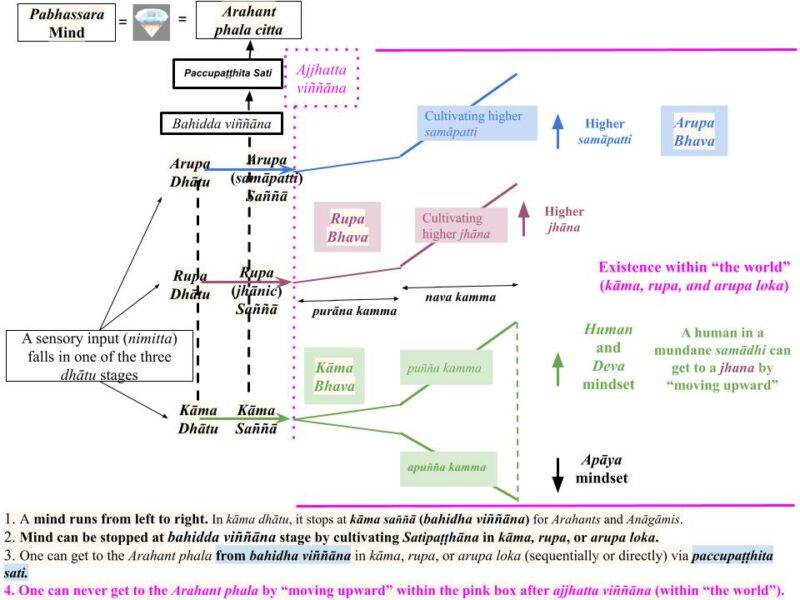
Please feel free to ask questions. These are somewhat technical issues, but resolving them will help you understand the concept of “distorted sanna ” and related concepts.
4. P.S. Let me give the following examples to get you all to think about and fully understand:
- Consider an Anagami who has not cultivated jhana. Since he has removed kama raga, his/her mind will not go beyond the bahiddha vinnana in kama dhatu and enter the ajjhatta vinnana in kama loka.
- Next, consider an Anagami who has cultivated the first jhana, for example. While not in that jhana, his/her mind will similarly stay at the bahiddha vinnana in kama dhatu. When in the jhana, his/her mind will go beyond the bahiddha vinnana in rupa dhatu and enter the “rupa loka.”
- In another example, consider a “human Arahant” who has cultivated the first jhana. When in the jhana, his/her mind will not go beyond the bahiddha vinnana in rupa dhatu and enter the “rupa loka.” It will stay in the bahiddha vinnana in rupa dhatu while in the jhana.
1 user thanked author for this post.
August 24, 2024 at 8:30 am in reply to: Post on ” Paṭicca Samuppāda – “Pati+ichcha” + “Sama+uppāda” #51603KeymasterYes. If his mindset does not change before the end of the human existence of 1000 years, he is likely to be born an animal.
- However, changing one’s gati within that time is entirely possible.
- If suitable conditions appear, one can change gati in a very short time. Angulimala’s “killer gati (mindset)” was removed within a few hours of meeting the Buddha.
3 users thanked author for this post.
KeymasterTaryal wrote: “I wonder why we haven’t and if we will ever encounter highly advanced humans from other solar systems.”
- The nearest cakkavāla (star with planets) is about four light-years away. That means a spacecraft traveling at the speed of light will take four years to get there.
- It is unlikely that even one-hundredth of the speed of light can be achieved for a spacecraft. So it will take 400 years to get to the nearest planetary system!
- I don’t understand why intelligent scientists keep asking why we have not heard from “aliens.” How do they expect any aliens to get here?
Taryal wrote: “The usage of the word “chakkavāla” by Buddha is quite interesting too. Correct me if I’m wrong but “chakka” has to do with something spinning or circular. Planets revolve around sun in circular/elliptical orbits. It seems intentional.”
- It is intentional.
- Everything in this world is in motion. Any object, no matter how large, is in constant motion. Earth and other planets orbit the Sun. All “star systems” in our galaxy are in motion around the galactic center. All galaxies are in motion, too.
- Each object has two modes of motion: For example, Earth spins around its axis (giving rise to day and night) and rotates around the Sun (it takes a year to complete a trip).
- The smallest unit of matter, a suddhāṭṭhaka, does not stay still. Depending on its rotation or spin (bramana) and its rotation around something else (paribbramana), other “modes of energy” and “types of rupa” arise.
- See #7 of “31 Realms Associated with the Earth.”
Taryal wrote: “I don’t remember the sutta but I think I’ve read that the light from a sun can only light up one chakkavāla but a Tathagata can light up the entire “dasa sahassi loka dhatu“.
- I don’t think the translation is correct. Each chakkavāla has its own “Sun”, i.e., a star.
2 users thanked author for this post.
August 23, 2024 at 6:26 pm in reply to: Post on “Citta, Manō, Viññāna – Nine Stages of a Thought” #51590KeymasterI need to rewrite the post. Unless I can finish it sooner, it will likely be the post for next week.
2 users thanked author for this post.
KeymasterHe perceives it as pleasant but does not attach to it because he fully comprehends that it is a “sanna made up by the mind.”
2 users thanked author for this post.
KeymasterYou missed the next point on that list.
- “All vedanā initially coming through the other five sense faculties are neutral, i.e., adukkhamasukha vedanā.” But they give rise to “distorted sanna.”
- For example, the taste of ice cream as sweet is not a vedana, but a “distorted sanna.” Since a puthujjana does not realize that they crave the sweet taste of ice cream, they generate samphassa-ja-vedana based on that craving.
- See, for example, #9 of “Saññā – All Our Thoughts Arise With “Distorted Saññā” Of course, read the whole post to get the idea.
P.S. I revised the post “Vedana (Feelings) Arise in Two Ways” to include a link to the above post.
1 user thanked author for this post.
Keymaster“OK then Buddha knew about aliens too.”
- Of course. He taught that the universe has uncountable populated planetary systems like our Solar system (cakkavāla).
- There can be numerous “dasa sahassi loka dhatu” (a large cluster of cakkavāla) in the universe. But they are totally separated from each other. Each “dasa sahassi loka dhatu” can have only one Buddha Sasana at a time. There can be living Buddhas in other “dasa sahassi loka dhatu” right now.
“Did he say that the stars of the night sky represent chakkavalas?”
- That should be obvious. Some suttas compare the light from the Sun to that of the Moon (weak.)
3 users thanked author for this post.
August 23, 2024 at 5:49 am in reply to: Post on “Citta, Manō, Viññāna – Nine Stages of a Thought” #51567KeymasterYou have some valid points. I will take a look at it later today. Thank you!
1 user thanked author for this post.
August 23, 2024 at 5:46 am in reply to: Dānamahapphala Sutta (Generosity can lead to the Anagami stage!) #51564KeymasterThank you, y not.
- I have linked to the discussion in y not’s post above.
- We can discuss it further here if needed.
The main point is that a “punna kamma” done by an Ariya (Noble Person) could automatically become a “kusala kamma” depending on the level of understanding.
- Since Arahants do not need to do kusala kamma, all punna kamma by Arahants are “punna kriya” or “good deeds without kammic implications.”
1 user thanked author for this post.
KeymasterOK. Taryal’s question about cakkavāla.
“If this (cakkavāla) refers to a planetary system, it would be insane for someone to know this 2500 years ago without a telescope.”
- It is not that complicated. The Tipitaka contains many accounts of Buddha’s travels to the Deva and Brahma realms, which are located well above the Earth. See, for example, “Brahmanimantanika Sutta (MN 49).”
“The suttas that I’ve read which discuss the cosmos say that our sun, earth and the moon make up a cakkavāla. Then there are categorizations of a 1000 such systems, 10,000, million and even billions of cakkavāla. This can be interpreted as a collection of planetary systems but the suttas do not mention other planets.”
- From the above, it is evident that the Buddha could see the other planets associated with our Solar system. Also, he could travel to any of the other “star systems” or cakkavāla within our “dasa sahassi loka dhatu,” which contains thousands of “star systems.”
- It is true that the Buddha mentioned only the Sun, the Moon, and famous mountains in the discourses. There was no reason to describe other planets. Regarding other “star systems,” he mentioned that they also had their own Sun and Moon.
P.S. Also see “Buddhahood Associated Controversies.”
2 users thanked author for this post.
KeymasterTaryal wrote: “The physical body’s map is provided by mother and father in the form of zygote, isn’t it? That’s why we observe many similarities between the parents and the offsprings. In some cases, even the traits from grandparents can appear when the part of genetic code supressed in parents get expressed in the offspring. So how can we say that the physical body is created by kammic energy?”
Many factors come into play to form the physical body of a human.
1. First level: Births in various existences are according to gati; see “Gati Sutta (AN 9.68).” The translation of “gati” as “birth” there is wrong. Rather, births are according to gati: “Gati to Bhava to Jāti – Ours to Control.”
2. However, within those major categories there are many variations. For example, the six Deva and the 20 Brahma realms are all lumped together due to “Deva gati.” That just indicates they do not have “immoral gati” while in that existence.
- The realms in the apayas are sorted into three categories according to the major “immoral gati” that led to such existences. Births in the human realm are due to a mix of “moral and immoral gati” and a human may have such gati at various times too.
3. The type of “distorted sanna” depends on those major gati and branches out into various sub-categories depending on the realm.
- For example, rupavacara Brahmas automatically receive a “distorted sanna” of “jhanic pleasure” and arupavacara Brahmas automatically receive a “distorted sanna” of “samapatti pleasure.”
- Humans have specific “distorted sanna” that could be different from those of animals, and each animal species may have different types of “distorted sanna” as we have discussed.
4. The point is that all humans have “built-in distorted sanna” common to all. That is the “first-level” I mentioned above.
- However, there can be many different types of gati in humans. Some are easy to anger, some are more sensual than others, some are more moral, etc.
5. When a gandhabba is pulled into a womb, nature automatically matches the gati of the gandhabba to those of the parents as much as possible.
- That is why the DNA of a child matches those of the parents in most cases.
- P.S. The zygote (or the “base”) that a gandhabba merges with (in the womb) is created by the merging of the mother’s egg and the father’s sperm. It is the physical basis of DNA: “Buddhist Explanations of Conception, Abortion, and Contraception.”
6. However, a human existence is primarily determined by the “janaka kamma” responsible for grasping the human existence, as can be also seen in the “Abhiṇhapaccavekkhitabbaṭhāna Sutta (AN 5.57)“ in Waisaka’s comment.
- It is a complex issue, but the above summary should give a general idea.
I have to leave now and will answer Taryal’s other question about cakkavāla later.
Keymaster“Can I clarify that the Arahant will not taste it to be pleasant but netural, because Samphassa-jā-Vedanā do not arise in an Arahant..?”
- The sweet taste of ice cream comes BEFORE the mind gets to the “Samphassa-jā-Vedanā” step. Please re-read the relevant post from which you got the wrong idea.
- If that post is unclear, please quote the unclear passage from the post. I may need to revise it.
-
AuthorPosts


