Kāma Saññā can be overcome in two ways. The mundane way is to willfully suppress kāma rāga. The Noble way is a combination of sense restraint coupled with insight meditation (Vipassanā), which is the basis of Satipaṭṭhāna. The difference between Ariya and anariya jhāna is explained.
August 23, 2025; last revised on January 14, 2026
Two Possible Outcomes for a Paṭisotagāmi
1. In the previous two posts, we discussed an anusotagāmi (“Growth of Pañcupādānakkhandha – ‘Anusotagāmi’“) and a paṭisotagāmi (“Paṭisotagāmi – Moving Toward Satipaṭṭhāna Bhūmi and Nibbāna“).
- By the way, anusotagāmi/paṭisotagāmi can be used to represent the corresponding process or a person following that process.
- Knowingly or unknowingly, an “uneducated” puthujjana is an anusotagāmi trapped in not only the rebirth process, but also in kāma loka.
- An “educated puthujjana” (meaning one learning Dhamma from a Noble Person) striving to attain a magga phala would be a paṭisotagāmi. A Sotapanna or a Sakadāgāmi striving to get to the Anāgāmi stage, or an Anāgāmi striving to be an Arahant, would also be a paṭisotagāmi.
- Furthermore, an anariya yogi cultivating breath meditation or kasina meditation would also be a paṭisotagāmi in the mundane sense. They are also striving to transcend kāma loka and attain a jhāna associated with the rupa loka. See #3 below.
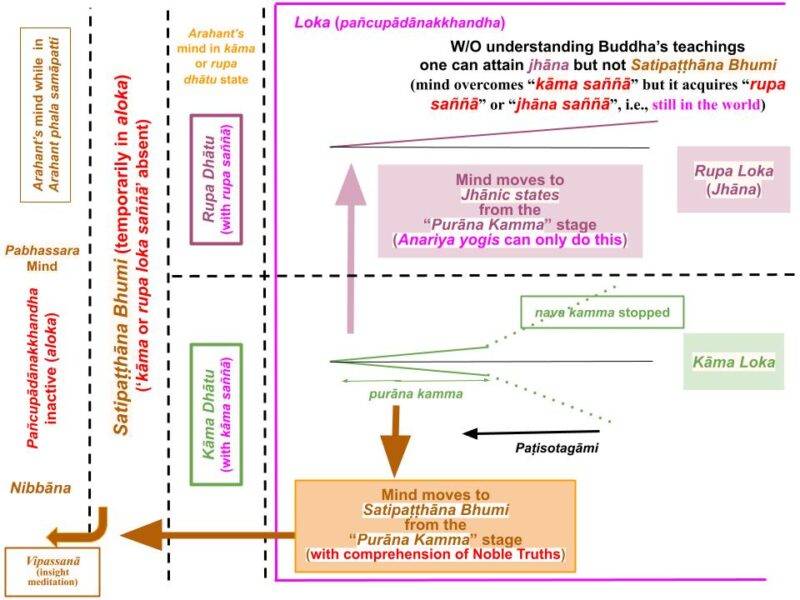
- Those two possibilities for a paṭisotagāmi Sotapanna Anugāmi (in kāma loka) are shown in the following chart. One overcomes the kāma saññā to move up to rupa saññā corresponding to rupa loka (i.e., attain an Ariya jhāna by comprehending the anicca, dukkha, and anatta nature). The other is to overcome all types of saññā to progress into the Satipaṭṭhāna Bhūmi and attain the Sotapanna phala moment.
- Those who attain Ariya jhāna normally go up the ladder of higher jhānās and arupa samāpatti, and eventually attain ubhatobhoga Arahant status from the highest arupa samāpatti.
Download/Print: “Overcoming Kāma Saññā – Satipaṭṭhāna Bhumi or Jhāna“
Overcoming Kāma Saññā – Jhāna or Satipaṭṭhāna Bhūmi
2. If one can stop the “nava kamma” stage (i.e., stop mainly those kamma done via the body and speech), and also minimize one’s exposure to sensory inputs that can trigger a greedy or an angry mindset, it is possible to move the mind to a critical point at the beginning of the “purāna kamma” stage and overcome ‘kāma saññā.’
- As the above chart shows, there are two possible outcomes at the time of reaching the critical point: the mind can move to the ‘Satipaṭṭhāna Bhūmi‘ and become a Sotapanna, or it can progress to the first jhāna.
- Once reaching a critical point in the “purāna kamma” stage, the mind of a puthujjana under the guidance of a Noble Person may overcome the kāma saññā and jump over to the ‘Satipaṭṭhāna Bhūmi.‘ In some cases, overcoming the kāma saññā leads to entering the ‘rupa loka‘ with rupa loka saññā, i.e., the first jhāna.
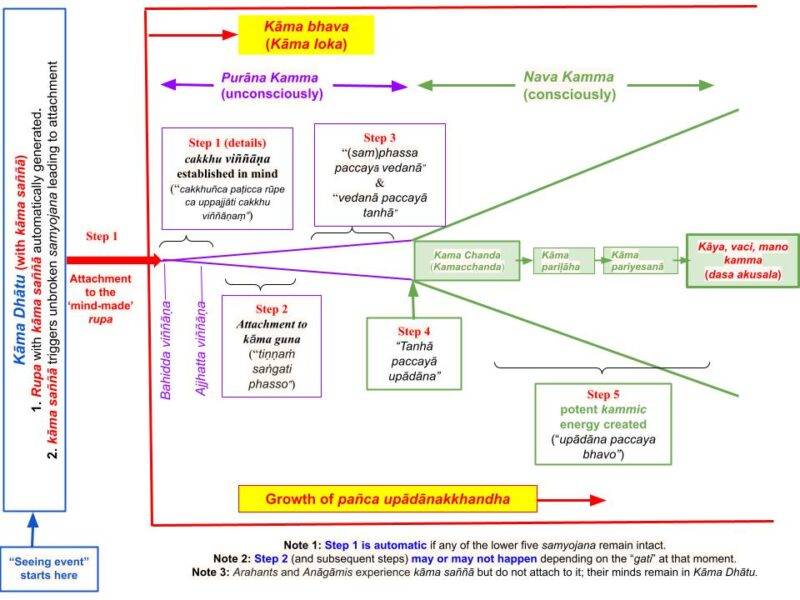
- Specifically, that critical point is at Step 1 (before reaching the ajjhatta viññāna) in the chart below. We discussed this chart in the previous two posts: “Growth of Pañcupādānakkhandha – ‘Anusotagāmi’” and “Paṭisotagāmi – Moving Toward Satipaṭṭhāna Bhūmi and Nibbāna.“
Download/Print: “Growth of Pañcupādānakkhandha“
Anariya Yogis Can Only Access Jhāna
3. As the first chart above shows, there can be only one outcome for an anariya yogi who successfully overcomes the kāma saññā before reaching that critical point. They will enter a jhāna without comprehending the anicca, dukkha, and anatta nature.
- Note that an anariya yogi will transition to the anariya version of the jhāna at the latter stage of the ‘purāna kamma’ stage (after the ajjhatta viññāna). Without comprehending the transition from the kāma dhātu stage to bahiddha viññāna, an Ariya jhāna is not possible.
- Even though the kāma saññā at the kāma dhātu stage triggered subtle attachment that resulted in cakkhu viññāna establishing in the mind (with the mind proceeding to the ajjhatta viññāna stage in Step 1), the level of attachment at that stage is weak enough for the mind to jump over to the ‘rupa loka‘ via the first anariya jhāna.
- That would be the maximum that an anariya yogi can accomplish.
- Reaching the ‘Satipaṭṭhāna Bhūmi‘ or an Ariya jhāna is possible only by comprehending Noble Truths, as we discuss below.
Only Those With Jānato/Passato Can Access Satipaṭṭhāna Bhūmi
4. Now consider a puthujjana who is being instructed by a Noble Person (Ariya) whose mind also traces back to the critical point in the “purāna kamma” stage. If they grasp the anicca nature of attaching to pañcupādānakkhandha, they will overcome the bahiddha viññāna, enter the Satipaṭṭhāna Bhūmi, and attain the Sotapanna stage; they may attain an Ariya jhāna instead in some rare cases.
- The above statements explain the difference between ‘jānato‘ and ‘passato‘. When one has learned and comprehended the Buddha’s teachings to some extent, one becomes a ‘jānato‘; however, until the meanings are grasped with wisdom (‘passato‘), one cannot overcome the kāma saññā and reach the Satipaṭṭhāna Bhūmi or the Ariya jhāna. Also see “‘Jānato Passato’ and Ājāniya – Critical Words to Remember.”
- Now, let us determine the critical point mentioned in #2 above.
Five Steps in the Growth of Pañcupādānakkhandha
5. Five Steps in the growth of the pañcupādānakkhandha were discussed in the post “Growth of Pañcupādānakkhandha – ‘Anusotagāmi’.” Those five Steps are shown in the second chart above. We can summarize those five Steps to figure out the critical steps to reach the critical point mentioned in #2 above:
Step 1: The Mind automatically attaches to the ‘kāma saññā’ at the ‘kāma dhātu’ stage. This stage is based on all ten saṁyojana. This step triggers processes that generate bahiddha and ajjhatta viññāna. The formation of ajjhatta viññāna is the same as the generation of the corresponding “āyatana” (for example, in the case of a visual sense input, cakkhu āyatana and rupa āyatana are formed).
Step 2: The Mind attaches to the ‘kāma guṇa’ perceived at the “āyatana” stage. Here, what matters is the mindset (or ‘gati‘) present at that moment and what type of sensory inputs are experienced. One can live their life in a way to maintain ‘good gati‘ and avoid sensory temptations to prevent the mind from attaching to ‘kāma guṇa.‘ (If Step 2 happens, then automatic progression to Steps 3 through 5 cannot be stopped.)
Step 5: Once one reaches the “upādāna paccayā bhava” step in Paṭicca Samuppāda (Step 4), one consciously begins accumulating “new strong kamma” (or “nava kamma“) in Step 5. We can train ourselves to minimize the “damage” at this point, i.e., resist the urge to engage in immoral deeds, speech, and thoughts (kāya, vaci, and mano kamma). This is “sīla,” or “moral conduct,” as most people perceive it.
- To reach the critical point mentioned in #2 above, one must first complete Step 5, then Step 2. The critical point is in Step 1. Anyone who is striving for that is a Paṭisotagāmi. Only a Paṭisotagāmi comprehending the Noble Truths can enter the Satipaṭṭhāna Bhūmi and attain the Sotapanna phala.
Base Level of “Sīla” – Reversing Step 5
6. “Sīla” or ‘moral conduct’ as perceived by most people is to reverse Step 5. Even those who may not have been exposed to Buddha’s teachings have an innate (built-in) saññā (as part of ‘human gati‘) to avoid immoral deeds. They are hiri (‘sense of shame’) and otappa (‘sense of fear’) for engaging in immoral deeds; see “Hirīottappa Sutta (AN 7.65)“.
- However, hiri and otappa are to be cultivated. One can begin by committing to live by the five precepts. It can be extended to eight precepts for a few days a month to practice/cultivate sīla.
- While willfully suppressing the urge to attach to sensory temptations (in Step 5) is a critical first step, “sīla” or ‘moral conduct’ can be enhanced by comprehending how the preceding Step 2 triggers the conditions for a mind to move inevitably through Steps 3 and 4 to Step 5. This is essentially to avoid “mind-pleasing sensory inputs.”
Deeper Level of “Sīla” Based on Understanding Step 2
7. Even before the Buddha, ancient yogis like Alāra Kālāma realized that it is easy to live a ‘moral life’ without committing the worst of kāya, vaci, and mano kamma by avoiding ‘attractive sensory inputs.’
- For example, if one habitually watches videos or movies with ‘adult content’, one’s mind is always filled with lust and desire for sexual activities; such activities are fuel for ‘kāma saññā‘. If one focuses on the next delicious meal, this mindset cultivates ‘kāma saññā‘ toward tasty foods. You can think about numerous such examples.
- That is why ancient anariya yogis, like Alāra Kālāma, lived in forests, away from sensory distractions. There were no women, tasty foods, nice fragrances, luxury houses, etc. (called ‘nimitta‘ or sensory attractions) to trigger the kāma rāga.
- However, those anariya yogis held the mistaken belief that women, tasty foods, pleasant scents, and luxurious houses possess kāma guṇa (‘mind-pleasing’) characteristics. Still, avoiding them helped them overcome the ‘kāma saññā‘ and get into jhāna. Getting into a jhāna means temporarily dissociating from the kāma loka and moving up to ‘rupa loka‘; a jhāna is the mindset of the Brahmās who live in ‘rupa loka.’
8. The Buddha explained that kāma guṇa (or ‘mind-pleasing’) characteristics are not in external objects like women, tasty foods, nice fragrances, luxury houses, etc.
- Our ‘built-in’ kāma saññā makes it appear that way. Even the external physical world is tailored to provide that ‘distorted kāma saññā‘. See “Paṭicca Samuppāda Creates the External World, Too!”
- I have discussed this in the post “Kāma Guṇa – Origin of Attachment (Tanhā).”
Getting Into an Anariya Jhāna
9. Still, if one can live the life of an anariya yogi in an environment ‘away from sensory attractions,’ it is possible to bring the mind toward the end of the ‘purāna kamma’ stage (after the ajjhatta viññāna).
- At that point, the mind can overcome the ‘kāma saññā‘ associated with ‘kāma loka‘ and jump up over to the ‘rupa loka‘ and get into the first anariya jhāna.
- The point is that an anariya yogi cannot get to the critical point mentioned in #2 above, i.e., the bahiddha viññāna.
Some Can Easily Get Into an Anariya Jhāna
10. Furthermore, the above process can occur easily in a puthujjana who has cultivated anariya jhāna in previous lives or if they lived in a Brahma realm immediately before the present human existence.
- Such people can attain anariya jhāna while living in society. They need to focus their attention on a ‘neutral sensory object’ such as the breath for an extended period. During that time, the mind will overcome not only the ‘nava kamma‘ stage but also Step 2 above and get into an anariya jhāna.
- However, they will not be able to attain a magga phala until fully comprehending the ‘initial kamma formation,’ i.e., the ‘purāna kamma’ stage. That is what is meant by becoming a Sandiṭṭhiko; see “Sandiṭṭhiko – What Does It Mean?“
- An Ariya in an Ariya jhāna can also enter the ‘Satipaṭṭhāna Bhūmi‘ from that jhāna. For that, one must comprehend Steps 1 through 5 within the ‘rupa loka.’ Another way to state this is that ‘Satipaṭṭhāna Bhūmi‘ can be accessed from kāma loka, rupa loka, or arupa loka by comprehending the Noble Truths, Paṭicca Samuppāda, and Tilakkhana (all are equivalent). When one understands all five Steps (especially Step 1), one has comprehended the fundamentals of the Buddha’s teachings.
Satipaṭṭhāna Bhūmi (and Not Jhāna) Necessary for Magga Phala
11. The Buddha advised the general process of cultivating Satipaṭṭhāna. One may or may not attain an Ariya jhāna while cultivating Satipaṭṭhāna. If the process first leads to a jhāna, then one can cultivate Satipaṭṭhāna while in that jhāna.
- One could adopt some of the techniques used by those anariya yogis, such as Alāra Kālāma, in the early stages.
- One does not necessarily need to live in forests or be isolated from society. However, one should avoid excessive sensory indulgence. With time, one will feel the relief of not being burdened by ‘sensual thoughts’ which will make it easier to avoid more and more of such indulgences.
- These are the ‘mundane versions’ of steps 2 through 6 advocated in the “Sabbāsava Sutta (MN 2).” Stated in simple terms, they mean exercising restraint, using only essentials, being able to endure minor discomforts, avoiding bad situations (such as living in a bad neighborhood), and rejecting unwise temptations that arise in the mind. I have discussed the Sabbāsava Sutta briefly in #15 of “The Sōtapanna Stage.”
- By the way, when the steps in the Sabbāsava Sutta are followed with the comprehension of the Noble Truths, that will also fulfill Satipaṭṭhāna and lead to all magga phala.
Reaching the Satipaṭṭhāna Bhūmi Requires Seeing “Pañcupādānakkhandha = Dukkha”
12. Unlike the Steps 2 through 5 discussed above, Step 1 can be avoided only by eliminating all ten saṁyojana listed in #5 above.
- That, of course, is possible only by understanding why pañcupādānakkhandha equals suffering (‘saṅkhittena pañcupādānakkhandhā dukkhā’); see #8 of “Essence of Buddhism – In the First Sutta.”
- That is evident in the first chart above. Every time a mind attaches to a sensory input and initiates a pañcupādānakkhandha growth process (the same as initiating a Paṭicca Samuppāda process), one moves away from Nibbāna located to the left in the chart.
- To be free of suffering of the rebirth process, one must first overcome the ‘kāma saññā‘ that binds one to the ‘kāma loka.’ Next, one must overcome the ‘rupa saññā‘ that binds one to the ‘rupa loka.’ Finally, one must overcome the ‘arupa saññā‘ that binds one to the ‘arupa loka.’ See “Loka and Nibbāna (Aloka) – Complete Overview.”
- All those steps are completed while one’s mind is in the ‘Satipaṭṭhāna Bhūmi.’ That is where the mind is free of any type of saññā that makes a mind automatically attach to something in the world (loka). Pañcupādānakkhandha (which the Buddha also called ‘loka‘) DOES NOT arise while the mind is in the ‘Satipaṭṭhāna Bhūmi.’ Thus, ‘sensual thoughts’ or ‘kāma saṅkappa‘ do not arise while in the ‘Satipaṭṭhāna Bhūmi.’
- That makes it possible to contemplate the teachings of the Buddha (i.e., engage in Vipassanā) without the interference from any type of “lokiya saññā,” i.e., any type of saññā associated with any realm of the world. One’s mind will be focused on ‘dhamma vitakka‘ and ‘dhamma vicāra‘ or ‘thoughts about concepts like Paṭicca Samuppāda or Tilakkhana.
Must Read Posts
“Kāma Saññā – How to Bypass to Cultivate Satipaṭṭhāna” and “Loka and Nibbāna (Aloka) – Complete Overview.”