 Lal
LalGood questions.
1. The word ‘anusotagāmi’ (‘anu sota gāmi’) means to stay engaged (‘gāmi’) with (“anu”) the flow of the rebirth process (‘sota’). Thus, the mind of an ‘anusotagāmi’ initiates a pañcupādānakkhandha process (equivalently, a Paṭicca Samuppāda process) upon receiving a sense input. The growth of the pañcupādānakkhandha is shown in the following chart.
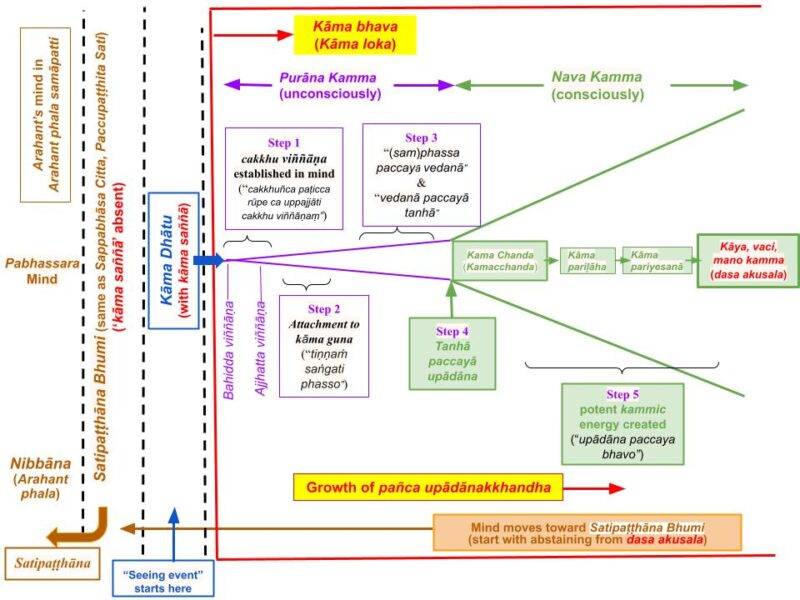
- The growth of the pañcupādānakkhandha is from left to right in the above chart for an ‘Anusotagāmi.’ See “Growth of Pañcupādānakkhandha – ‘Anusotagāmi’.”
- When cultivating Satipaṭṭhāna (i.e., for a Paṭisotagāmi), one’s mind must move in the opposite direction. When someone sits down to cultivate Satipaṭṭhāna, their mind is already in the ‘expanded’ nava kamma stage. They must start moving the mind from the right to the left toward the Satipaṭṭhāna Bhumi.
- In that process, one encounters the ajjhatta kaya (with ajjhatta viññāṇa) before the bahiddha kaya (with bahiddha viññāṇa)
- Eventually, the mind overcomes the kāma saññā(temporarily) and jumps over to the Satipaṭṭhāna Bhumi.
- See #7 of “Paṭisotagāmi – Moving Toward Satipaṭṭhāna Bhumi and Nibbāna.”
_________
2. Tobias wrote the following in the second question/answer:
In which step does “Cakkhuñca paticca rūpe ca uppajjati cakkhu viññāṇaṁ” occur? Am I correct in understanding it as stated below?
– bahidda kaya: avijja paccaya sankhara, sankhara paccaya vinnana, vinnana paccaya namarupa
– ajjhatta kaya: namarupa paccaya salayatana, … vedana paccaya tanha
Is namarupa the “mind-made rupa” (rūpe) that develops with cakkhu to cakkhu vinnana?
The first part of bahidda kaya is processed by intact samjoyana (avijja and kamaraga), right? Gati are added via sanphassa?
Thus, the PS steps from avijja… to …tanha happen in a split second.
_____________
- Excellent! Yes. That explains the first part of the Paṭicca Samuppāda (PS) process. Let me provide a bit more information for the benefit of all.
- By the time cakkhu vinnana arises, both bahiddha and ajjhatta stages are complete, and cakkhu ayatana (with cakkhu vinnana) has arisen. That is Step 1 in the above chart. That also indicates PS processes from ‘“avijjā paccayā saṅkhāra’ through ‘nāmarūpa paccayā salāyatana.’
- Step 2 is ‘tiṇṇaṃ saṅgati phasso‘ in the chart, which corresponds to ‘salāyatana paccayā phassō‘ in PS. The verse ‘tiṇṇaṃ saṅgati phasso‘ appears in the “Chachakka Sutta (MN 148),” and is explained in #5 of “Indriya Make Phassa and Ayatana Make Samphassa.”
- Step 3 in the chart describes the PS steps of ‘phassa paccayā vēdanā, vēdanā paccayā taṇhā.’
- As you stated, all that will happen in the ‘anusotagāmi’ process within a split second. A mind will go through the ‘purāna kamma‘ stage in the blink of an eye.
- Once going through the ‘taṇhā paccayā upādāna‘ step, the mind can spend a lot more time engaging in akusala kamma, generating kammic energy. That is the ‘nava kamma‘ stage. This is where kammic energy for future rebirths/vipāka are generated via the ‘upādāna paccayā bhavō‘ step. Also see “Upādāna Paccayā Bhava – Two Types of Bhava.” This is Step 4 in the above chart. P.S. The ‘expanded cone’ for the ‘nava kamma‘ stage compared to the ‘smaller cone’ for the ‘purāna kamma‘ stage is meant to express this difference in kamma accumulation.
Anyone can ask follow-up questions. Tobias has pointed out some critical points.
