
Forum Replies Created
-
AuthorPosts
-
March 28, 2024 at 6:37 am in reply to: Translation with Notes for DhammaChakka Pavattana Sutta #48769
Lal
KeymasterThank you! I suggest using a word processor, though. I corrected many grammar errors. It makes a big difference in getting your ideas across.
KeymasterYou missed the deeper explanation in my previous comment.
In the strict sense, parinibbāna means “full and complete Nibbana.” In the strict/technical sense, it is NOT the death of the physical body that carries the “suffering-free” mind trapped inside.
– The mind of a living Arahant is free of not only birth but also decay and death. “Bhava paccaya jati” AND “jati paccaya jara, marana, …” do not happen for that Arahant (or a Buddha.)
– What dies is the physical body that was born long before attaining Nibbana or Arahanthood.Of course, we do say Buddha’s parinibbana happened 45 years after attaining Buddhahood.
– But that physical body of a human was not the Buddha. Once, a Brahmin asked the Buddha whether he was a human, Deva, or some other being. The Buddha told him that he was not a human, Deva, or did not belong to any of other categories. He had transcended all existences in this world of 31 realms. That is the point I wanted to convey.Don’t take it too seriously. As I mentioned in the previous comment, it is a “technical point.” Even the Tipitaka says that Buddha’s Parinibbana happened 45 years after Buddhahood. That version is not entirely incorrect, either. The Buddha, while trapped inside that decaying physical body subjected to pain and suffering, was able to teach what he had discovered.
So, what I pointed out was only a technical point. But it is important to understand that aspect, too.
P.S. Another way to think about that is the following. The moment-to-moment “Idappaccayata Paticca Samuppada” process stopped at the moment of attaining the Buddhahood.
– This is why we should not focus too much on uppatti Paticca Samuppada (which describes rebirths). The Sutta Pitaka does not explicitly discuss that. It is mostly in the Commentaries. We need to focus more on the “Idappaccayata Paticca Samuppada” process.
–Paṭicca Samuppāda During a Lifetime
1 user thanked author for this post.
KeymasterGad wrote: “Some people reach Nibbāna in suffering or shortly before death. Some arahants have attained parinibbãna violently…”
– That is not the technically correct way to state what happens.
– Nibbana is complete the moment one attains Arahantood. Thus, rebirth and suffering end (jati paccaya jara, marana, soka, parideva, ..) with the termination of the Paticca Samuppada process.
– However, the physical body of the Arahant (which arose due to previous kamma) remains alive until its death, and can be subjected to any vipaka coming to it. Thus, until the death of the physical body, that Arahant is in “Saupādisesa nibbānadhātu.” At the death of the physical body, an Arahant attains “Anupādisesa nibbānadhātu.”
– This is discussed in the “Nibbānadhātu Sutta (Iti 44).
– That sutta is discussed in Kalahavivāda Sutta – Origin of Fights and DisputesBy the way, formatting options are temporarily unavailable. They should be restored in a day or two.
1 user thanked author for this post.
March 26, 2024 at 6:30 am in reply to: Discussion on “Cultivating Jhāna and Magga Phala – What Is the Difference?” #48741KeymasterSammasambodhi Gami wrote: “Jhanas can also be achieved by focusing one’s mind on a suitable object like breath/kasina/mantras/image of a god, etc. That is Samatha meditation.
However, just getting to jhanas will not get one to Nibbana because the anusayas (mental fermentations) are only suppressed (in anariya jhanas), they are not removed. The anusayas and sanyojanas can be removed only by cultivating wisdom (panna) of Anicca, Dukkha, Anatta/Paticca Samuppada/Four Noble Truths.”
That is correct. Good observation!
– Jhānic states correspond to the Brahma realms. They are a set of existences in the world of 31 realms.
– Paticca Samuppada generates all existences via abhisankhara.
– Existences in the apayas are generated via apunna abhisankhara. Those in the human, Deva, and rupavacara Brahma realms (corresponding to jhāna) arise via punna abhisankhara. Those in arupavacara Brahma realms (corresponding to akasanancayatana through nevasannanasanayatana samapattis) arise via anenja abhisankhara. See the post: “Rebirths Take Place According to Abhisaṅkhāra“Therefore, the term “Ariya jhāna” does not make sense. There are only four (or five according to Abhidhamma classification) jhana.
– However, I also used the term “Ariya jhāna” previously. I need to start correcting those posts.
– One can be a Noble Person (up to Arahanthood) without cultivating jhāna. Those Arahants are Pannavimutti Arahants.
– One can be a puthujjana and have all the jhanas and samapattis without any magga phala. They are cetovimutta but not pannavimutta.
– A limited number of Arahants are both pannavimutta and cetovimutta. They are called ubhatovimutta Arahants.
– Any Noble Person may have some jhāna at various levels. I will write a post discussing this in detail.
This is explained well in Abhidhamma. For a Noble Person without jhāna, the total number of citta possible is 81. When jhānas are included (for those with jhāna at various levels), that number of possible cittas increases to 121.KeymasterExcellent!
Another (related) way to look at “dukkha” is to see that as long as we crave pancupadanakkhandha (i.e., perceived “pleasures” in this world), we are moving away from the “suffering-free pabhassara mind” and to more suffering.
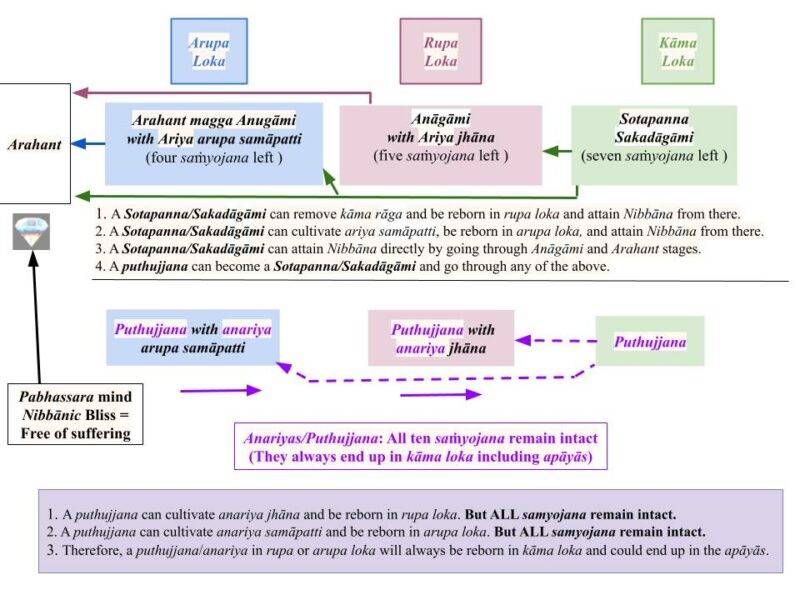
An average human (puthujjana), unaware of Buddha’s teachings, is trapped in the birth/death Sansaric process.
1 user thanked author for this post.
KeymasterYou are welcome!
March 24, 2024 at 8:28 pm in reply to: Discussion on “Cultivating Jhāna and Magga Phala – What Is the Difference?” #48718Keymaster“Mahāsudassana Sutta (DN 17)” has several interesting pieces of information:
1. @ marker 1.2.2: When the Buddha prepared for his Parinibbana in the small city of Kusinara, Ven. Ananda asked him to change his mind and select a large city.
- The Buddha told Ven. Ananda the following: Once upon a time, there was a king named Mahāsudassana. His capital was this Kusinārā, which at that time was named Kusāvatī.
- Then, the Buddha described various aspects of that kingdom in great detail.
2. Information relevant to the current topic is in Section “5. Jhānasampatti” @ marker 2.1.1.
- It describes how King Mahāsudassana cultivated jhanas. They were anariya jhanas, as we see below.
- The interesting point is that the description of the jhana is the same as for Ariya jhana descriptions in other suttas.
- @2.3.1 marker: “Atha kho, ānanda, rājā mahāsudassano mahāviyūhaṁ kūṭāgāraṁ pavisitvā sovaṇṇamaye pallaṅke nisinno vivicceva kāmehi vivicca akusalehi dhammehi savitakkaṁ savicāraṁ vivekajaṁ pītisukhaṁ paṭhamaṁ jhānaṁ upasampajja vihāsi.”
- He had cultivated all four jhanas.
- @ marker 2.13.3: “Upon passing away, King Mahāsudassana was reborn in a good place, a Brahmā realm.”
- @ 2.14.3: ” I myself was King Mahāsudassana at that time.”
1 user thanked author for this post.
March 23, 2024 at 4:36 pm in reply to: Discussion on “Cultivating Jhāna and Magga Phala – What Is the Difference?” #48707KeymasterHopefully, the following chart will help clarify the difference between Ariya and anariya jhana. I can make improvements before putting it in a post. Feel free to ask questions/suggest improvements.
Download/Print: “Ariya and Anariya Jhana“
The chart does not show that the time spent in the rupa and arupa loka is negligibly small. Furthermore, even in kama loka, most of the time is spent in the apayas. Thus, the term “Nibbānic Bliss.” It is bliss to be free of all that suffering!
2 users thanked author for this post.
KeymasterThank you! Looks good.
March 23, 2024 at 8:53 am in reply to: Discussion on “Cultivating Jhāna and Magga Phala – What Is the Difference?” #48703KeymasterIt is critical to understand the following. “Nibbana sukha” is NOT a “vedana that can be felt.”
- This world of 31 realms provides both sukha vedana and dukkha vedana. It is not possible to have just one without the other. Of course, the relative proportions can vary. For example, in the apayas, dukkha vedana is predominant. In Deva/Brahma realms, sukha vedana is predominant. In the human realm, both are present.
- The Buddha stated many times that his teachings are for the removal of arising of even a trace of dukkha. He NEVER promised to teach how to maximize “sukha vedana.”
- This rebirth process is like having a “chronic headache” that never goes away, even though, at times, a dose of painkillers can overcome it and even provide a “temporary high.” But that pain keeps coming back. If that “chronic headache” permanently disappears, one will have a huge sense of relief. That is a rough analogy for “Nibbanic sukha.”
Those who do not understand this fundamental concept are enticed by jhanic pleasures or the types of miracles one can perform with “supernormal iddhi powers.”
- “Jhanic experiences” are experiences in the Brahma realms. They are part of that “sukha/dukkha cycle.”
- What is the point of “performing miracles”? Devadatta impressed King Ajasattu by performing many miracles and ended up in an apaya.
Yet, it is hard to overcome these types of wrong views. This is human nature!
2 users thanked author for this post.
March 22, 2024 at 5:16 pm in reply to: Discussion on “Cultivating Jhāna and Magga Phala – What Is the Difference?” #48693KeymasterArahant Santati and Arahant Culapanthaka instantaneously attained iddhi powers upon attaining Arahanthood. They never cultivated jhanas.
- Also, Devadatta, a puthujjana, cultivated anariya jhana and attained iddhi powers but ended up in hell (niraya.)
- Therefore, the subjects of jhana and iddhi powers are incomprehensible to anyone but a Buddha. See “Acinteyya Sutta (AN 4.77)“: “jhāna visayo acinteyyo..”
- Jhana or iddhi powers may or may not be realized while cultivating the path. If one gets them, those are bonuses. That should not be the goal.
Discussing iddhi powers and/or trying to cultivate them is useless.
- It is likely that we all cultivated the highest anariya jhanas, samapattis, and iddhi powers at various times in our deep past. What do we have now to show for them?
- Until we are free from births in the apayas (i.e., attain at least the Sotapanna Anugami stage), all those “achievements” go to waste! See “Why a Sotāpanna is Better off than any King, Emperor, or a Billionaire“
2 users thanked author for this post.
March 22, 2024 at 10:11 am in reply to: Discussion on “Cultivating Jhāna and Magga Phala – What Is the Difference?” #48691KeymasterYes. When one contemplates Dhamma concepts, one’s wisdom (panna) grows, and defilements gradually decrease. That is “Vipassana meditation.”
- That change can manifest in bodily feelings. I have experienced these effects and still do. They can get very intense before wearing out. Once one gets close to higher magga phala (above the Anagami stage), these “bodily sensations” should diminish. Then, they should become more of “mental joy” without bodily sensations.
- This is why many people are fooled by such “bodily feelings.” I have heard many people describe Jhanic experiences in various Sri Lankan programs. A common theme is that they are overjoyed by such “bodily sensations” and believe it is “Nibbanic sukha.” Most of them likely experience “anariaya jhana” even though they engage in contemplating anicca, dukkha, anatta. As I emphasize, even the first Ariya jhana can be experienced only by an Anagami, because kama raga anusaya must be removed to get to the first Ariya jhana. Unlike the Sotapanna stage, confirming the attainment of the Anagami stage is easy: Just watch an adult or X-rated movie and check whether lust does not arise!
- “Nibbana sukha” is without feelings. It is the absence of any stress.
2 users thanked author for this post.
March 22, 2024 at 7:20 am in reply to: Discussion on “Cultivating Jhāna and Magga Phala – What Is the Difference?” #48680KeymasterI recommend reading the two posts in “Elephant in the Room 2 – Jhāna and Kasina“
- Please feel free to ask questions. Point to the post and bullet number if it is a specific question about what I wrote in those two posts.
- P.S. I may need to revise those two posts to point to new posts on “distorted saññā.” Also, if there are legitimate objections, I will revise as necessary. Please don’t hesitate to comment if you see anything objectionable.
1 user thanked author for this post.
March 21, 2024 at 11:59 pm in reply to: Discussion on “Cultivating Jhāna and Magga Phala – What Is the Difference?” #48674Keymaster“Only a person who has entered the jhanas can truly know. It would be interesting to hear the opinion of a meditator..”
- You are saying that only those who cultivate jhana are “meditators.” These are the ingrained wrong views!
-
AuthorPosts


