

Forum Replies Created
-
AuthorPosts
-
Lal
KeymasterThank you, Sammasambodhi Gami and Dosakkhayo, for the reference.
- Some of the minor suttas may have been lost. The following background could be helpful to remember.
1. As summarized in “Incorrect Theravada Interpretations – Historical Timeline“:
- 161-137 BCE: For the first time in history, King Dutugemunu united all of Sri Lanka under one kingdom.
- I did not mention this there, but he built a seven-story library in the Mahāvihāra monastery in Anuradhapura. His mistake was to collect all the Tipitaka copies spread out in temples around the country and deposit them in that library.
- That library was burned: King Mahāsena (277-304 CE) as I stated in the above post.
- Of course, there must have been other “partial copies” in other temples. But it is possible that some suttas were lost at that time.
2. Another factor is the following. Before the British took over Sri Lanka in the 1800s, the island had been under partial control of the Dutch and Portuguese, who discouraged the practice of Buddhism. The temples were decaying, and the bhikkhu population decreased; see #5 of “Elephant in the Room” – Direct Translation of the Tipiṭaka.”
- If it were not for the British civil servants, more Tipitaka suttas could have been lost. They collected copies of Tipitaka texts spread throughout the country and sent them to the museum in London to be preserved; see #6 in that post.
- The point is that the whole Tipiṭaka was written on specially prepared ōla (palm) leaves. They typically deteriorate over 100 years or so and need to be rewritten. See “Preservation of the Buddha Dhamma.” Some suttas may not have been rewritten and thus be lost.
3. The above information, while not critical, helps to provide an understanding of the obstacles and “lucky breaks” involved in preserving the Tipitaka.
- We may not have all the original texts, but we probably have enough essential and critical texts.
2 users thanked author for this post.
KeymasterExcellent essay. Thank you, Gad.
1 user thanked author for this post.
KeymasterThe Church’s (Vatican) influence on science issues is no longer there. Of course, it led to Galileo’s death in the 1600s because his scientific findings were deemed to “go against the Church.”
- There is not yet enough concrete evidence to discard the “Big Bang theory. ” If the evidence is irrefutable, scientists will give it up.
- I believe that will happen within the next few years.
2 users thanked author for this post.
KeymasterThe Pali version and the English translation at Sutta Central: “Assutavā Sutta (SN 12.61)“
The main point the Buddha tried to explain is the following:
- Our physical bodies change relatively slowly, especially after the teenage years.
- However, our minds change even moment-to-moment. Like a monkey jumping from tree to tree, our minds quickly jump from one arammana to another. Think about it. Within a day, one’s mindset can change from a relaxed mindset to an angry mindset to a generous mindset and back and forth many times.
- But one firmly believes one’s mind is one’s own, even more than to think of one’s body as one’s own.
This point needs to be addressed in detail at some point. A mind works like a machine, according to specific rules. Even though we think it is “my mind”, it really is not. It can “change on a dime” based on one’s mindset and the type of arammana coming to it.
- For example, if one is in an angry mindset, it takes only a bit of provocation even to kill another human.
- Most rapes take place because of that: if the conditions get set up, even a “moral person” could be triggered to commit rape.
That is quite clear among animals, who don’t have developed brains to slow their actions. However, some humans act like animals because they are not used to being “mindful.”
- Because the mind works like a machine, it will AUTOMATICALLY stop engaging in “apayagami actions” after reaching the Sotapanna stage or stop getting attached to sensual pleasures after the Anagami stage.
- There is no “me” controlling such actions. It happens automatically.
1 user thanked author for this post.
KeymasterTobi wrote: “An estimate published in the Astrophysical Journal concludes that there may currently be dozens of radio-capable civilizations in the Milky Way, with 36 being the most likely number.”
- I am not sure how they can calculate the number of civilizations, let alone those “capable of using radio.” Can you provide the reference? Of course, it is not a critical issue, but I am just curious.
- Astrology primarily uses spectroscopy (light emitted by stars) to come to conclusions about stars and planets. Of course, planets do not emit light, so they need to use indirect methods to find planets, and that is why it was only in 1992 that scientists found the first planet outside the solar system.
- The closest star with planets is more than four light-years away. A light-year is a distance traveled by light in a year. That is an astounding distance! I don’t think humans will be able to travel to even the closest planetary system (outside our solar system) within the next 100 years or may be ever. See “Could humanity send astronauts to Alpha Centauri“
P.S. Tobi emailed me the following paper: “The Astrobiological Copernican Weak and Strong Limits for Intelligent Life.” Thanks, Tobi.
- Of course, it is an indirect estimate. To quote the paper: “Most famously, Drake (1965) developed an equation which in principle can be used to calculate how many Communicating Extra-Terrestrial Intelligent (CETI: pronounced “chetee”)
civilizations there may be in the Galaxy..” - The Drake equation seems to provide a vastly underestimated number. According to the Buddha, life exists on most planetary systems, each with 31 realms like ours. Think about the following: As I mentioned above, science did not find evidence for a single planet outside our solar system until 1992. With time, more evidence in support of the Buddha Dhamma will come from science.
KeymasterThanks, Gad.
- However, both those refer to Ven. Moggallana cultivating the first arupāvacara samāpatti, “ākāsānañcāyatana samāpatti.”
- That does not refer to the account of Ven. Moggallana “getting lost in space.” That happened after he developed all the abhinna powers.
The Moggallana Samyutta in the Samyutta Nikāya has nine suttās that describe step-by-step how Ven. Moggallana attained Ariya jhānās and samāpattis in sequence, starting with the first Ariya jhāna. The Sutta Central reference you gave at the end is one of those suttas.
- I explained that in #9 of the post, “Pannāvimutti – Arahanthood without Jhāna.”
1 user thanked author for this post.
KeymasterI am not sure whether there is a single sutta that says so.
- But the inference can be made by studying various relevant suttas. I will provide a few below. Perhaps others can add to this collection, and I can write a post. These issues keep coming up, so it would be good to have one post that summarizes what is in the suttas.
“Cūḷanikā Sutta (AN 3.80)“, “Rohitassa Sutta (SN 2.26)“, “Acinteyya Sutta (AN 4.77).”
- In the first one, the Buddha tells Ven. Ananda about the “mahāsahassī lokadhātu” (a region of space) with a billion stars with planetary systems like ours. As I understand, that is the “maximum range” of a single Buddha. But there can be many Buddhas even now, in other such “mahāsahassī lokadhātu” in the universe. Our Milky Way galaxy has 100 billion stars. Thus, even within our Milky Way galaxy, there could be living Buddhas right now. The English translation used the word “galaxy” for a collection of only 1000 planetary systems, which is wrong.
- There is also a sutta, which describes Ven. Moggalana took off to “look for the end of the world.” He got lost on the way, and the Buddha had to rescue him. I don’t remember the name of that sutta.
That is why, in the last sutta quoted above, the Buddha says figuring out the universe’s structure is “not achievable” for humans. Anyone who tries to do that “will go mad or get frustrated” (see the starting verse of that sutta).
2 users thanked author for this post.
KeymasterThank you, Gad.
- The post is “Abnormal Births Due to Gandhabba Transformations.”
1 user thanked author for this post.
KeymasterThe following post is by Sammasambhodi Gami:
Following is an excellent sermon by most Ven. Waharaka Thero on Anapana Sati bawana:
(Huge merits to Mr. Janith Fernando Sir for the English translations)
‘Anāpāna-sati’ – a brief clarification
My note: Please post links like the above (English translations of Waharaka Thero’s discourses by others in this thread. Please do not open new threads.
1 user thanked author for this post.
KeymasterYes. It is. That is the basis.
It will become even more clear if you try to connect births to gati, as I mentioned in my previous comment:
- “Bhava and Jati” arise according to “gati“: “Gati to Bhava to Jāti – Ours to Control” and “Gati (Habits/Character) Determine Births – Saṃsappanīya Sutta.”
There are more posts on this critical aspect. See, for example, “Patisandhi Citta – How the Next Life is Determined According to Gati” and “Saṃsāric Habits, Character (Gati), and Cravings (Āsava).”
- When someone died during the time of the Buddha, people used to ask the Buddha about that person’s rebirth by asking, “What was the birth, and what was the gati that led to it?” I must have mentioned some suttas with that quote within those posts.
- Kammic energy (or Paticca Samuppada) dictates how the physical bodies are tailored to generate “distorted saññā” according to the “developed gati” and the corresponding birth.
1 user thanked author for this post.
KeymasterI am happy you have grasped the key ideas regarding “distorted saññā.” I have made some slight changes to the format in your comment to make the points clear.
1. Your conclusion in #1 is correct.
2. Your conclusion in #2 is also correct. Even though suddhāṭṭhaka (atoms and molecules in the language of modern science) would not have “good or bad” qualities, feces made of them would be perceived differently by (the physical bodies of) humans and pigs.
- Kammic energy causes human bodies to produce a “bad smell” for feces because human birth originated from “good kamma.” Furthermore, if a human eats feces, he/she will get sick. The human physical body arises that way due to kammic influence.
- On the other hand, a pig’s body can thrive on eating feces, and a pig likes the smell of feces. That is a manifestation of the “birth matching the gati that led to it.”
3. So, your conclusion in #3 is correct.
- In another example, a lion’s birth is according to “vicious gati.” It is possible that the kamma that led to the birth of a lion was a violent crime like killing another human.
- On the other hand, engaging in moral deeds leads to birth as a human or a Deva. Cultivating (Ariya or anariya) jhana leads to the birth of a Brahma.
- “Bhava and Jati” arise according to “gati“: “Gati to Bhava to Jāti – Ours to Control” and “Gati (Habits/Character) Determine Births – Saṃsappanīya Sutta.”
P.S. I just revised the topic of this thread to “The Connection Between Akusala and Rotten Births.” That matches the discussion better.
2 users thanked author for this post.
KeymasterI wanted to clarify why I declined to answer this question. Sometimes, having a general idea about the external world is good. In a few suttas, the Buddha gave an overview of the universe. He said our solar system is one of an uncountable number of planetary systems (cakkavala.)
- He also taught that in a “loka vinasaya” (destruction of our solar system), a cluster of 1000 planetary systems like ours gets destroyed. That matches modern science, saying that when a star gets old and blows up in a supernova, many nearby stars (planetary systems) are also destroyed.
- I mentioned that in the introduction to Agganna Sutta: “Buddhism and Evolution – Aggañña Sutta (DN 27)“
However, it does not make sense to examine the finer details of the universe. Doing so will consume all our energy. We must mainly focus on understanding how pancupadanakkhadha (i.e., suffering) arises and working to stop that process.
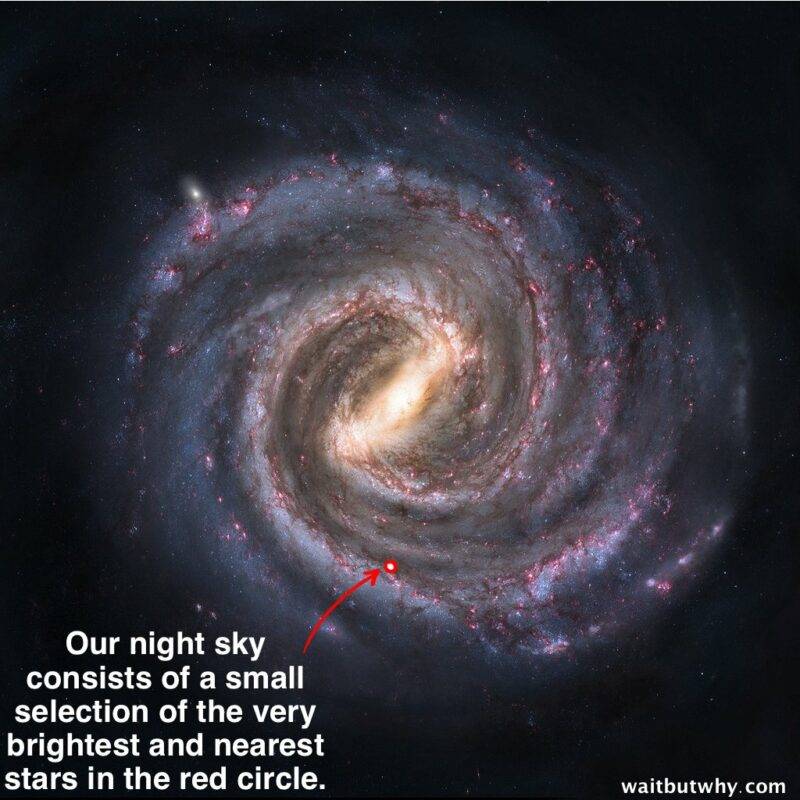
- The following is a picture of our Milky Way galaxy. We can see (with the naked eye) only a couple of thousand stars, but there are hundreds of billions of stars in our galaxy. Furthermore, there are about an equal number of GALAXIES in our universe. Thus, there is a whole galaxy for each star in our galaxy. It is truly mind-boggling.
- Will we ever be able to investigate even a fraction in our lifetime?
 Keymaster
No. I don’t spend time analyzing such things. There is no benefit.
KeymasterMy description applies to any planetary system with living beings. Each has 31 realms associated with it.
- Although scientists have not yet found a system outside the solar system, there are countless others in the universe.
- It is not easy to find life outside the Solar system. The closest “planetary system” is more than four light years away. That means it takes over four years to travel to that system, EVEN IF a spaceship travels at the speed of light. The fastest speed by a spacecraft is 163 km/s, compared to the speed of light of 300000 km/s.
3 users thanked author for this post.
KeymasterAn arupa Brahma has a hadaya vatthu made of a suddhāṭṭhaka.
- Arupa loka means there are no other rupa made of suddhāṭṭhaka.
- However, ANY living entity has to have a “hadaya vatthu,” which is the “seat of the mind.”
1 user thanked author for this post.
-
AuthorPosts


