
Forum Replies Created
-
AuthorPosts
-
Lal
KeymasterYes. Even though Bhikkhu Bodhi wrote that book on Abhidhamma (a translation, as I pointed out), he may not fully believe that Abhidhamma is the “word of the Buddha.”
- It would be good if he gets to read that post and learn about that Tipitaka reference in the Vinaya Pitaka.
- Again, thanks to TripleGemStudent for emailing me that reference.
1 user thanked author for this post.
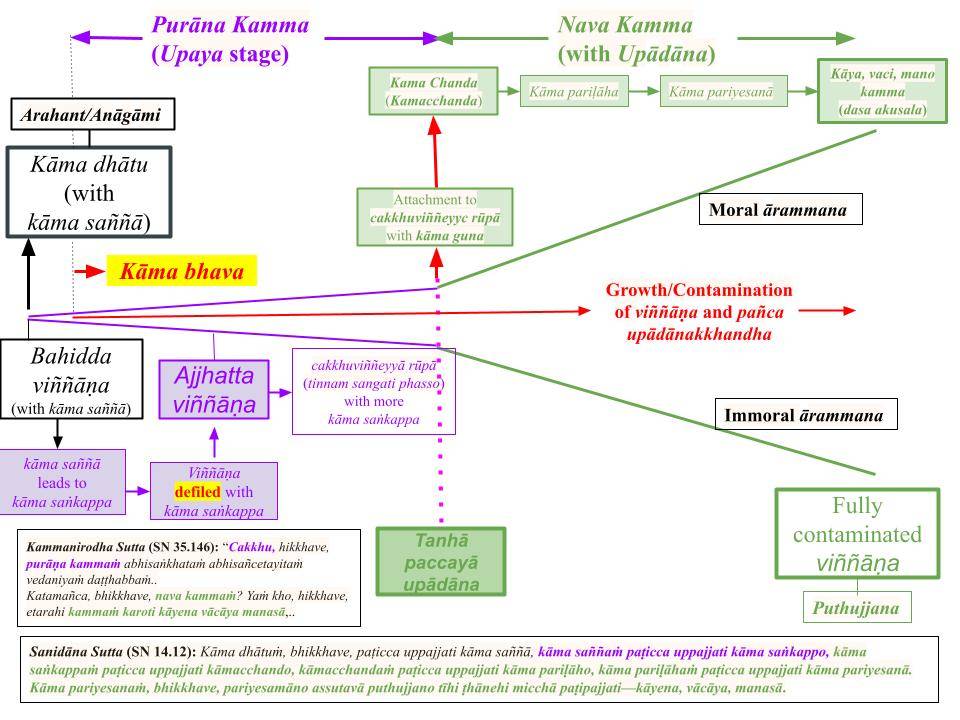
June 24, 2024 at 10:38 am in reply to: Post on “Upaya and Upādāna – Two Stages of Attachment” #50462KeymasterYes. Bahidda vinnana is NOT kamma vinnana; bahidda vinnana is a vipaka vinnana.
- Kamacchanda is the same everywhere. It is a strong attachment to sensual pleasures.
1 user thanked author for this post.
KeymasterAn Arahant does generate the bahidda kaya with bahidda vinnana. I need to revise the figure and #5 of “Purāna and Nava Kamma – Sequence of Kamma Generation” post. The revised figure is shown below. Let me know if there are remaining questions so that I can answer them when I revise that post.
1 user thanked author for this post.
KeymasterQ1, Q2, Q3: Ajjhatta kāya = ajjhatta rupa, ajjhatta vedana, ajjhatta sanna, ajjatta sankhara, ajjhatta vinnana AND Bahidda kāya = bahidda rupa, bahidda vedana, bahidda sanna, bahidda sankhara, bahidda vinnana.
- In other words, ajjhatta and bahidda kāya are parts of the panca upadanakkhandha. In many instances, the Buddha referred to panca upadanakkhandha as “kāya” in the sense of “collection.” For example, “kāye kāyānupassi viharati” refers to the contemplation of panca upādānakkhandha. P.S. In the same way, “vedanāsu vedanānupassi viharati” refers to the contemplation of the types of vedanā in panca upādānakkhandha. “Citte cittānupassi viharati” refers to the contemplation of citta (overall effect of vedana, sanna, sankhara, vinnana.) “Dhamme dhammānupassi viharati” refers to the contemplation of all those concepts.
- In the suttas (and in Abhidhamma), each of the entities rupa, vedana, sanna, sankhara, and vinnana (components of the pancakkhandha (or panca upadanakkhandha) are shown to have 11 components: atita, anāgata, paccuppanna, ajjhatta, bahiddha, oḷārika, sukhuma, hīna, paṇīta, dūre, santike.
- P.S. Here, “atita, anāgata, paccuppanna” is one way to separate out. Ajjhatta,bahiddha, or oḷārika, sukhuma or hīna, paṇīta or dūre, santike are other ways. There is overlap among them. For example, Ajjhatta rupa includes atita, anāgata, and paccuppanna types/variations of rupa.
That is discussed in detail for rupa in the post “Difference Between Physical Rūpa and Rūpakkhandha.” (a similar division of 11 types holds for vedana, sanna, sankhara, and vinnana.) The following is extracted from that post:
- Altogether there are 11 types included in rūpakkhandha. The Khandha sutta (SN 22.48) (among many other suttā) summarizes what is included in rūpakkhandha. “Yaṃ kiñci, bhikkhave, rūpaṃ atītānāgatapaccuppannaṃ (atita, anāgata, paccuppanna) ajjhattaṃ vā bahiddhā vā oḷārikaṃ vā sukhumaṃ vā hīnaṃ vā paṇītaṃ vā yaṃ dūre santike vā, ayaṃ vuccati rūpakkhandho.”
- The 11 types are past, future, current, internal, external, coarse, subtle, good, bad, far, and near.
This is a bit complex but essential issue. It took me some time to figure out the details. I may have made some contradictory statements in the two posts you mentioned. I will take a look at them and make the necessary corrections ASAP. Thank you for pointing them out.
- This is why I plan to discuss these aspects in more detail in the upcoming posts. (A bit more understanding of Abhidhamma can help, so I am now spending some time on that aspect.) They are deeper aspects that connect the “distorted sanna” concept with Satipatthana/Anapanasati.
- I know that you are trying hard to get a handle on these issues. I assure you that I will get into these issues. But please keep posting comments so I know which areas/concepts need more clarification.
1 user thanked author for this post.
KeymasterIn the first post in “Elephant in the Room 1 – Direct Translation of the Tipiṭaka,“ I have explained this issue by giving an example.
- I see that I forgot to add that post to that section. I just now added it.
- Here is that post: “Distortion of Pāli Keywords in Paṭicca Samuppāda.”
- Please read that post and ask questions on unclear bullet numbers.
No. Chanting suttas is not the way to learn. After learning the meanings embedded in those verses, one could chant them with understanding.
No, the Commentaries will not help either. First, one needs to sort out which Commentaries are reliable. For example, Visuddhimagga is not. I mentioned the reliable Commentaries included in the Tipitaka in those posts. However, even those cannot be understood without some basics.
1 user thanked author for this post.
KeymasterGood observations.
Main points to consider:
1. There is no need to read the whole Tipitaka. The three main main sections (Pitaka) serve different purposes.
- It is the Sutta Pitaka that needs laypeople’s attention the most.
- The Vinaya Pitaka is mainly for the bhikkhus. However, the background of the reason the Buddha established a given Vinaya rule can be informative. For example, the rule not to translate the Tipitaka into Sanskrit was based on a request by two Brahmins who were knowledgeable in the Vedas. See #13 of “Misinterpretation of Anicca and Anatta by Early European Scholars.” Furthermore, there are two books on Thergatha and Therigatha (verses by male and female Arahants) how they cultivated their paths and the concepts they struggled with, etc.
- The Abhidhamma Pitaka is for those who like to be thorough and want to “dig deeper.” Even then, it is not necessary (or even possible) to read all of it.
2. Tipitaka cannot be read like reading a set of novels or even textbooks on various mundane subjects. One must (at least until the Sotapanna stage) rely on a Noble Person (Ariya) to explain the basic concepts.
- First of all, most suttas are highly condensed. Even someone with a knowledge of Pali will not be able to grasp the concepts/ideas embedded in the suttas.
- It gets much worse if one tries to read the “word-by-word” English translations, as I have explained in many posts: “Elephant in the Room 1 – Direct Translation of the Tipiṭaka“
3. For example, I read comparatively little of the Pali Tipitaka in the first few years of this website’s existence. I mainly listened to the discourses by Waharaka Thero and a few others on the internet.
- Shortly after Waharaka Thero‘s passing, I started allocating significant time to reading relevant suttas in the Pali Tipitaka.
- Both the English and Sinhala translations of the Tipitaka were useless for me.
- Of course, before coming into contact with Waharaka Thero‘s desanas, I had read both English and Sinhala translations (in my school days in the early years) and had many issues to resolve. The incorrect translations caused many inconsistencies.
- While in Sri Lanka, I learned Buddhism as a subject until high school, and I studied Abhidhamma and Pali on my own. Luckily, it is easier for those good in the Sinhala language to learn Pali; there are many common words (for example, all the terms in Paticca Samuppada are the same in Pali and Sinhala.) But all that stopped after high school until I retired in 2009. Only after retiring did I start looking into Buddha Dhamma again and was fortunate to come across Waharaka Thero‘s discourses on the internet. Of course, I had been in the USA for most of that time.
I hope that will help clarify some questions. Please feel free to ask questions.
3 users thanked author for this post.
KeymasterI just came across the following informative video. It is an account of an investigation by a cardiologist (Dr. Miachael Sabom) who interviewed many patients with NDE experiences.
Dr. Sabom has also written two books, “Recollections of Death: A Medical Investigation” and “Light and Death,” on the subject.
- He says the first book is “more scientific,” and in the second, he probably tried to connect to concepts in Christianity.
KeymasterGood point, Taryal!
1 user thanked author for this post.
KeymasterThe following post is on free will and determinism: “Free Will in Buddhism – Connection to Sankhāra.”
2 users thanked author for this post.
KeymasterMany Pali words can have somewhat different (but related) meanings. That is why it is foolish to do “word-by-word” translations.
- As one’s understanding increases, one can see the applications of such different meanings in different contexts. A specific meaning could express the meaning better in a particular situation.
1 user thanked author for this post.
KeymasterThe deeper point is the “joy of sex” is all mind-made.
- But it will take an effort to fully comprehend that.
- See “Sotapanna Stage via Understanding Perception (Saññā).” I will try simplifying that in the new section: “Meditation – Deeper Aspects.”
- One should get there gradually: “Transition to Noble Eightfold Path.”
1 user thanked author for this post.
Keymaster“I understand that attā could mean “of benefit” in other cases, but it does not seem applicable here based on the rest of the sutta.”
- It is up to each person to decide (same for your interpretation of “amhe.”)
- But I would be interested to hear how the rest of the sutta is incompatible (you don’t need to, only if you like to do so).
- The whole point is that pancupadanakkhandha (panca upadanakkhandha or the “craving for the five aggregates”) is useless. That only leads to future suffering, even though it may seem enjoyable at the moment.
- By the way, the name of the sutta is correctly translated as “It’s Not Yours.” None of the five entities arising in mind (rupa, vedana, sanna, sankhara, vinnana) are to be “taken as yours.” Contaminated versions of those entities arise in the mind based on root causes (raga, dosa, moha) and prevailing conditions. When all root causes (raga, dosa, moha) are removed, one (an Arahant) will still see, hear, etc., but only “pure, uncontaminated versions of rupa, vedana, sanna, sankhara, vinnana would arise in mind.”
- This website is all about explaining that future suffering will not end until one understands that “those entities are not to be taken as yours” because they provide no value/benefit but only suffering in the end. The “mind-made versions” of external rupa seem to have beauty, pleasing sound, taste, smell, and touch, but those “sanna” are not real.
KeymasterFirst, when you provide a link, please select the target “new window” (in the link panel) so the reader can see both your comment and the link. You did that correctly for the sutta link but did not for the post link (which I just fixed.)
You asked: “May I know how we can derive the interpretation of “of value to us” from this line?”
- “Amhe” means “belonging to us/ of value to us/ ours” and NOT “us.”
But you should be able to see how silly that translation is when you read the verses in context (“Natumhāka Sutta (SN 22.33)“):
“Suppose a person was to carry off the grass, sticks, branches, and leaves in this Jeta’s Grove, or burn them, or do what they want with them.
Would you think:
‘This person is carrying us off, burning us, or doing what they want with us’?”
- People are carrying off grass, sticks, branches, and leaves. How can grass, sticks, branches, and leaves be “us”?
June 19, 2024 at 9:27 am in reply to: Man without a Brain – a true story of a French civil servant #50357KeymasterKeymasterThank you for the essay, Dosakkhayo.
- Because of my travel schedule, I do not have time to comment properly, but the following are some key points.
1. Your description of a pancadvara citta vithi followed by three manodvara citta vithi is correct.
2. The whole PS process runs within EACH javana citta, i.e., “avijja paccaya sankhara” to the end.
3. In subsequent javana cittas, all relevant terms grow in strength. For example, vinnana, namarupa, etc, grow in strength. Furthermore, those changes are taken into account in Tadarammana (T) at the end of each javana series.
The real-time PS process is discussed in the following section: “Paṭicca Samuppāda During a Lifetime.”
The changes in Tadarammana (T) are discussed in the posts here: “Search Results for: temporary bhavaṅga state.”
- For the kind of analysis you did, it is necessary to understand the concept of a “temporary bhavaṅga state.” As more citta vithi run, the mindset (T) changes with the flow of javana citta.
You can ask questions as you read those posts. Take your time, and don’t rush. It takes time to absorb some of these concepts.
1 user thanked author for this post.
-
AuthorPosts


