

Forum Replies Created
-
AuthorPosts
-
August 15, 2024 at 9:53 am in reply to: Validity of current interpretation of Satipatthana Sutta #51406
Lal
KeymasterYes. The brain is not the root cause of saññā or consciousness, even though it plays a role.
- “Saltiness” is a “saññā” generated by our physical and mental bodies, both arising via Paticca Samuppāda. These saññā are not inherent in any of the sensory inputs; that is why I use the term “distorted saññā.“
- The “sweetness of sugar,” “beauty of a woman,” “handsomeness of a man,” “particular smell of a rose,” etc. etc., are ALL “distorted saññā” created via Paticca Samuppāda.
- Understanding that will help immensely with getting rid of “kāma rāga.“
- People steal, kill, rape, lie, …based on this mirage.
1 user thanked author for this post.
August 15, 2024 at 7:31 am in reply to: Validity of current interpretation of Satipatthana Sutta #51403KeymasterI had the following exchange with Grok, another AI Chatbot.
Me: “Salt is NaCl. How does the “saltiness” in salt come from two atoms Na and Cl?”
Grok:
Ah, the age-old question of how two seemingly innocuous elements conspire to create the flavor bomb we call salt. Here’s the lowdown:-
Sodium (Na): By itself, sodium isn’t particularly tasty. In fact, it’s quite reactive and would rather not be alone.
-
Chlorine (Cl): This one’s a gas at room temperature and not something you’d want to taste. It’s the stuff that makes bleach, not a seasoning.
When these two get together, magic happens:-
Ionic Bonding: Sodium, eager to lose an electron, and chlorine, desperate to gain one, form an ionic bond. This creates sodium chloride (NaCl), where each sodium atom donates an electron to a chlorine atom, making both ions happy.
-
Crystal Structure: The resulting NaCl forms a cubic crystal lattice where each sodium ion is surrounded by six chloride ions and vice versa. This structure is key to its saltiness.
-
Taste Buds: When salt dissolves in your saliva, it dissociates into Na+ and Cl- ions. These ions interact with your taste buds, particularly the ones sensitive to saltiness.
-
Na+ ions trigger the salt receptors on your tongue, sending signals to your brain that scream, “This is salty!”
-
Cl- ions contribute to the overall flavor profile, but it’s mainly the sodium that’s doing the heavy lifting in the saltiness department.
-
So, the “saltiness” comes from:-
The Ionic Interaction: The way these ions interact with water (saliva) and your taste receptors.
-
Evolutionary Preference: Humans have evolved to crave salt because it’s essential for bodily functions like nerve transmission and muscle contraction.
Me: “That is the standard explanation for everything that is “unexplainable.” It’s the same about consciousness. How can a bunch of molecules lead to consciousness with feelings of joy? Of course, they say it is an emergent property. I don’t think that is a good answer.”
Grok:
Ah, the age-old dance between the material and the mystical, the neurons and the numinous! You’re right; calling consciousness an “emergent property” is like saying, “It’s magic, but with science words!” Here’s a playful take on why this might not satisfy everyone:-
The Emergence Cop-Out: Imagine if every time someone asked how a car works, you replied, “It’s an emergent property of metal, rubber, and gasoline.” Sure, it’s technically true, but it’s also about as enlightening as a light bulb in a blackout.
-
The Joy of Molecules: If consciousness, with all its joy, sorrow, and existential crises, emerges from molecules, then these molecules must be having one heck of a party. Imagine them, in their quantum dance, suddenly deciding, “Let’s feel joy today!” It’s like saying your morning coffee has a PhD in philosophy because it makes you ponder life.
-
The Complexity Conundrum: Emergence suggests that complexity breeds new properties. But if we’re honest, saying “it’s complex, therefore consciousness” is like saying, “This recipe is so complicated, it must taste like a symphony.” Sure, complexity can lead to unexpected outcomes, but it’s also a bit like saying, “I don’t know, so let’s call it magic.”
-
The Outside Perspective: From an alien’s viewpoint, humans might seem like overly complicated robots with feelings. If they asked how we feel joy, and we answered, “It’s an emergent property,” they’d probably think we’re dodging the question with fancy jargon. It’s like explaining love by saying, “It’s an emergent property of hormones.” While true, it misses the poetry of human experience.
-
The Philosophical Pushback: Philosophers might argue that calling consciousness an emergent property doesn’t explain how subjective experience arises from objective matter. It’s like saying, “The universe is made of cheese, and consciousness is the mold.” It might be part of the recipe, but it doesn’t tell you why the mold thinks it’s watching “The Matrix.”
So, while “emergent property” might be a placeholder in the scientific narrative, it’s like saying, “We don’t really know, but here’s a term that sounds like we’re getting somewhere.” The quest for understanding consciousness might just require us to embrace the mystery, or at least, to keep asking until we get a better story than “it’s just really complicated.”Conclusion: Scientists have no clue about both issues!August 15, 2024 at 5:55 am in reply to: Validity of current interpretation of Satipatthana Sutta #51402KeymasterAs we have discussed, there are many such “dual use” words.
- The problem is to use one meaning in all situations. We see that issue in many English translations.
August 14, 2024 at 3:24 pm in reply to: Validity of current interpretation of Satipatthana Sutta #51397Keymaster1. Yes. Paccupaṭṭhita comes from “paccaya” + “upaṭṭhita” meaning “arose” via Paticca Samuppada (cause and effect.)
- That means any sensory input comes in because we have a “vipaka body” that can receive such inputs.
- That happens to anyone born with a human physical body. It also comes in with “distorted sanna.”
- Attachment to that “distorted sanna” can trigger new kamma accumulation, if one does not know that “distorted sanna” is an illusion/mirage.
2. Yes. “Manasan” is the “bahidda stage” with “distorted sanna.” “Hadayan” is the “ajjhatta stage” where the mind attaches to that “distorted sanna.” For an Arahant, the mind does not get to the “ajjhatta stage.”
- For those who are not aware of the 9 stages of contamination of citta: “Citta, Manō, Viññāna – Nine Stages of a Thought.”
1 user thanked author for this post.
August 14, 2024 at 8:50 am in reply to: Validity of current interpretation of Satipatthana Sutta #51386KeymasterPaccupaṭṭhita sati is where a mind starts upon receiving a sensory input (arammana) anywhere in this world (kama, rupa, or arupa loka.)
- It comes with the “distorted sanna.”
- The mind of an Arahant stops there automatically since the mind has eliminated all ten samyojana.
- For all others, the mind may reach the ajjhatta (defiled) state, and its strength depends on how many samyojanas are left.
“Q. I’m curious about why there’s an arrow drawn from bahidda vinnana to arahant phala citta in the chart ‘Purana and Nava Kamma -4’.”
- That is the basis of Satipatthana.
- For a human, the goal is to go from the right to the left (in the “kama loka” portion of the chart) and reach the bahidda vinnana or the paccupaṭṭhita sati. That is where the mind is free of most defilements. One needs to contemplate the anicca, dukkha, anatta nature to reach that point, and one would automatically released from the kama loka, i.e., one will become an Anagami.
- Some (like Bahiya or Santati) can quickly go through all the stages of Nibbana and even attain the Arahant stage.
- It is when transitioning from the ajjhatta stage to the bahidda stage that one clearly “sees and comprehends” (janato passato) how our suffering originates when we attach to the “distorted sanna.” This is the real meaning of “sandiṭṭhiko.” In the “Upavāṇasandiṭṭhika Sutta (SN 35.70)” Venerable Upavāna asks the Buddha, “What is the meaning of sandiṭṭhiko dhammo or why Buddha Dhamma is called “sandiṭṭhiko“? He is referring to the verse, “svākkhāto bhagavatā dhammo sandiṭṭhiko akāliko ehipassiko opaneyyiko paccattaṁ veditabbo viññūhī”ti.”
- The Buddha explains @ marker 2.1: “Idha pana, upavāṇa, bhikkhu cakkhunā rūpaṁ disvā rūpappaṭisaṁvedī ca hoti rūparāgappaṭisaṁvedī ca.” Here, rūpappaṭisaṁvedī happens at the bahiddha stage and rūparāgappaṭisaṁvedī happens (and the mind gets attached) only if gets to the ajjhatta stage.
- If someone can understand that, he/she would have “seen the origin of ‘san‘ (defilements)” and become sandiṭṭhiko, i.e., at least a Sotapanna. In other words, one can also see that attachment to mind-made “distorted sanna” is the root cause of all suffering! See “Mūlapariyāya Sutta – The Root of All Things” and “Fooled by Distorted Saññā (Sañjānāti) – Origin of Attachment (Taṇhā).”
1 user thanked author for this post.
Keymaster“Is this the correct translation, and if it is so, why would this be a rule – why would monks be more respected than nuns?”
- I don’t think I should try to explain such things. Some issues are discernible only to a Buddha.
In the “Gotamī Sutta (AN 8.51)“, Buddha says:
“Ānanda, if females had not gained the going forth from the lay life to homelessness in the teaching and training proclaimed by the Realized One, the spiritual life would have lasted long. The true teaching would have remained for a thousand years. But since they have gained the going forth, now the spiritual life will not last long. The true teaching will remain only five hundred years.
- But Buddha’s predictions did come true. The “peak period” of the Buddha Sasana lasted only 500 years.
- Also see “Counterfeit Buddhism – Current Mainstream Buddhism.”
5 users thanked author for this post.
Keymaster1. The statement, “They say that the above things provide evidence that our memories are stored in the brain.” is not true.
- Does anything you quoted above say that?
- I think they only say, “They say that the above things show that it is likely that our memories are stored in the brain.”
- They have zero evidence that our memories are stored in the brain.
2. All they have found is that the brain plays a role in recalling memory.
- As I have explained, the brain does play a significant role in recalling memory: “Brain – Interface between Mind and Body”
- However, memories are “stored” in vinnana dhatu (nama loka).
3. Key evidence that the memories are not in the brain:
- If memories are in the brain, all memories will be destroyed upon the death of the physical body. How can children recall their past lives?
- How do people have Near-Death Experiences (NDE) and Out-of-Body Experiences (OBE)? No brain activity in those cases.
- How can a few people recall past events in great detail? “Recent Evidence for Unbroken Memory Records (HSAM).” No scientist has explained these accounts. They have only documented those accounts.
KeymasterYes. Of course.
- They cannot engage in in any “kaya kamma” (stealing, killing, etc.) either since they don’t have a physical body.
- They cannot speak lies etc., too, since they do not have mouths. But they can generate vaci sankhara and mano sankhara. See “Correct Meaning of Vaci Saṅkhāra.”
2 users thanked author for this post.
August 13, 2024 at 8:50 pm in reply to: Validity of current interpretation of Satipatthana Sutta #51376KeymasterThe “Mahāsatipaṭṭhāna Sutta (DN 22)” is not even in the niddesa version; it is in the uddesa version and requires many fundamental concepts to understand. I have realized that the description I have given in “Maha Satipaṭṭhāna Sutta” is a superficial one. However, it is a good start. We need to discuss some more background material, and the following chart points out some key points.
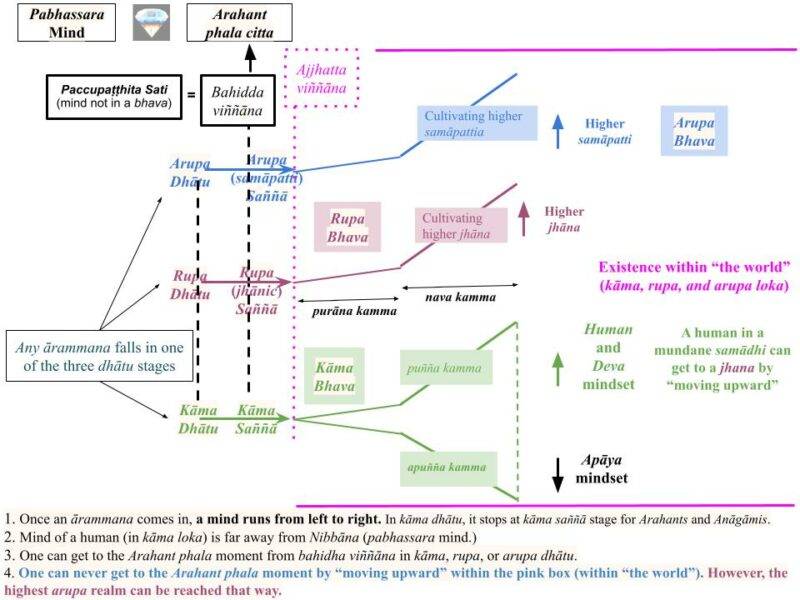
Download: “Purana and Nava Kamma -4“
1. A sensory event (arammana) in this world causes a mind to first land on one of three “dhatu” or “initial stages” in one of the three lokas: kama loka, rupa loka, or arupa loka.
- Since humans are in kama loka, our minds start at the “kama dhatu” stage. A rupa loka Brahma‘s mind will fall on the “rupa dhatu” stage, etc. The following steps happen in rapid succession without us being aware. I will only focus on the human mind.
- Immediately, it gets to the “kama sanna” stage with the “distorted sanna.” This is the “bahidda vinnana” stage, and if it can be stopped there (as is the case for Arahants), it is the “paccupaṭṭhita sati” per Dosakkhayo’s question.
2. The following steps ALWAYS occur for a puthujjana (an average human.)
- The mind enters “kama bhava” with “ajjhatta vinnana” and proceeds to get “increasingly defiled.” I provided the following chart on July 30, 2024 at 10:07 am:
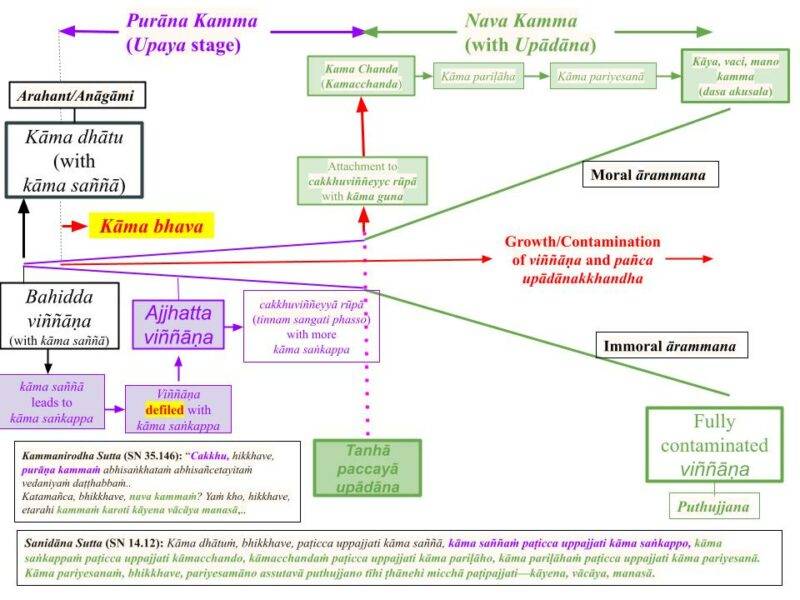
Download/Print: “Purāna and Nava Kamma – 2- revised“
- It is from the post: “Purāna and Nava Kamma – Sequence of Kamma Generation” which I highly recommend. Of course, one needs to keep going back to earlier posts to “fill in gaps.”
3. I provided following information in my comment on July 31, 2024 at 3:58 pm:
___________
“1. When a sensory input (arammana) comes in, the mind first experiences “bahiddha vinnana.” The term “bahiddha” means “bahira + iddha” where “bahira” means external and “iddha” means ” to get established.”
- A human mind (or vinnana) is first established in the “dhatu” or “initial stage,” where a “set of distorted kama sanna” is automatically experienced regardless of whether or not one has any magga phala.
- That is what gives the “sweetness of sugar,” “beauty/handsomness” of a woman/man, etc.
2. That “kama sanna” then triggers “kama sankappa” (mainly mano abhisankhara) based on one’s samyojana/anusaya.
- For example, since all ten samyojana are intact in a puthujjana, they generate the strongest “kama sankappa.“
- A Sotapanna has removed three samyojana, and hence the attachment will be less, etc..
- Since this “attachment” is based on one’s ditthi, tanha, and mana, it is called “ajjhatta” (“ajjha” for “oneself” and “atta” for “taking it to be fruitful.”
- Since an Arahant has no samyojana (or ditthi, tanha, and mana) left, that mind will not get to this stage, i.e., no pancupadanakkhandha (PUK) gets started.
3. The “ajjhatta vinnana” is the beginning of the accumulation of a PUK.
- In the next step, the mind makes its own version of the “external rupa” received. This is the “cakkhuvinneyya rupa” for visual input (as indicated in the figure.)
- In most suttas, by “rupa” it is meant the “cakkhuvinneyya rupa.” P.S. This is the rupa that is of “anicca nature,” not the “external rupa.” This “rupa” (it is related to the “namarupa” in PS) arises in the mind only because that mind has not fully grasped the “anicca nature” (of course, that happens at the Arahant stage).
4. In the next step, “kama guna” arises based on one’s gati at that moment.
- Thus, the same person may be attracted to a sensory event while drunk, for example, but may not while in a “good mindset.”
5. The mind gets to the “tanha paccaya upadana” stage only if the attachment is strong in the above step.
- This is really the time the PUK (pancupadanakkhandha) starts. This is the “upadana” stage where “new or nava kamma” are accumulated, as indicated at the top of the figure.
- Thus, the stage before that is called the “upaya stage.” No significant kamma is accumulated in this stage, as indicated by the narrow expansion of the “cone.”
- Strong kamma are accumulated in the “nava kamma stage” with kaya, vaci, and mano abhisankhara. That is indicated by the “widening cone” starting at the “tanha paccaya upadana” stage.
- Also, the “expansion” indicates “punna kamma” and the downward indicates “apunna kamma” or immoral kamma.
6. The “purana kamma” (or “upaya“) stage arises automatically according to one’s samyojana/anusaya. We don’t have direct control over that stage.
- However, in the “nava kamma” (or “upadana“) stage, kamma is accumulated consciously.
- The mind gets increasingly contained as it goes through the steps shown.
- In the “cleansing process” (or cultivating “sila” or “indriya samvara“), one needs to start at the rightmost stage.
7. I have provided more information in the comment above the one with the figure.
- As discussed there, the removal of samyojana/anusaya, (as well as one’s gati) happens by cultivating mindfulness/sila/indriya samvara AND understanding the details of this kamma accusation process, i.e., how a PUK arises with an arammana.
- Reading the links given will help you understand the process.
- Also see “Ārammaṇa (Sensory Input) Initiates Critical Processes.” (especially #11). However, one will eventually need to read posts in the time sequence given in “New / Revised Posts” from around 7/29/23.”
_______
4. A few more points to clarify the first chart on the top:
- The processes in the right-hand portion of the chart (bounded by the pink lines) occur in the world of 31 realms, i.e., kama loka, rupa loka, and arupa loka.
- For example, an anariya yogi can keep the mind on the “upward trajectory” and get to the lowest realm in the “rupa loka,” i.e., first jhana. That requires much effort since one cannot allow the mind to “fall back.” That is why they had to go deep into jungles and away from the distractions! Once there, they can proceed up the ladder to reach even the highest arupa samapatti.
- Then, they will be reborn in the Brahma realm, corresponding to the highest jhana/samapatti they attained.
- However, since they had not eliminated nay samsaric bonds (samyojana), they always are reborn in the human realm after their lifetime in such a Brahma realm.
5. Now, here is the critical information necessary to cultivate Satiptthana Bhavana:
- A puthujjana must first comprehend the fundamentals of Buddha Dhamma (Noble Truths/Paticca Samuppada/Tilakkhana) and attain the Sotapanna stage.
- Sotapanna can start cultivating Satiptthana by first comprehending the charts above.
- As the charts indicate, the human mind automatically runs from the left to the right, getting increasingly defiled. Now, one must first engage in “indriya samvara” or “indriya bhavana” (moral discipline of a Sotapanna or “ariyakanta sila“) and start going backward (from right to left)!
- One must abstain from apunna kamma and not go downward.
- Once overcoming the “expanded cone” (which represents the drastic expansion after the “tanha paccaya upadana” step in PS), one must engage in formal meditation (Vipassana/insight mediation), i.e., contemplation of anicca, dukkha, anatta nature.
- That is the process to reach the “bahidda vinnana” or the “paccupaṭṭhita sati” stage at the beginning of kama dhatu.
- From here, one can engage in Vipassana/insight mediation and reach a higher magga phala.
- Some people automatically get to the first jhana once reaching the “paccupaṭṭhita sati” stage. They will experience the “distorted sanna” (jhanic sukha) of the first jhana. Many people attach to that and get to the “nava kamma” stage in rupa loka and get stuck there.
- However, if one attains the Anagami stage from the “paccupaṭṭhita sati” stage in kama loka, then they will land on the “paccupaṭṭhita sati” stage of the rupa loka. They must cultivate Vipassana/insight mediation and could get to the Arahant stage. Otherwise, they can go through the arupa samapatti stages using the same basic process.
6. A Sotapanna may reach the Arahant stage without going through any jhana/samapatti.
- Or they could attain a jhana and get to the Arahant stage from the rupa loka level.
- A few go through all rupa loka jhana and arupa loka samapatti and become ubhatovimutta Arahants.
I hope the above will help get a general idea.
5 users thanked author for this post.
August 13, 2024 at 8:03 am in reply to: Validity of current interpretation of Satipatthana Sutta #51371KeymasterThe verse “‘atthi kāyo’ ti vā panassa sati paccupaṭṭhitā hoti” requires a detailed explanation. Let me think about how to do that.
1 user thanked author for this post.
KeymasterYes. Thank you! I just corrected it.
- Small unintentional errors like that can cause confusion. So, please make sure to point those out. That will help avoid confusion. Much merits to Dosakkhayo!
1 user thanked author for this post.
KeymasterGood points by Taryal and y not.
1. Yes. Our physical bodies are made to be compatible with our perceptions. We taste honey as sweet, and it is also nutritious.
- On the other hand, we taste rotten meat to be yucky, and we will also get sick if we eat it. Our bodies are not “compatible” with extracting nutrition from rotten meat.
- On the other hand, pigs like the taste of rotten meat, and their bodies are compatible with extracting nutrition from it.
2. Here is a profound point to consider: Everything in the material world is made of suddhāṭṭhaka, which are the “basic building blocks” according to Buddha Dhamma (sort of like atoms are building blocks according to science, but an atom is made of billions of suddhāṭṭhaka.)
- A suddhāṭṭhaka has eight components: pathavi, āpo, tejo, vāyo and vaṇṇa, gandha, rasa, oja.
- Anything in the material world is of all EIGHT components. However, the relative amounts of the eight components vary. For example, a stone is mostly pathavi, but it has all eight components; in a stone, pathavi dominates and all others are at low levels. For example, crocodiles eat mud and are able to extract nutrition from it.
- The “attracting qualities” (sweetness, pleasing colors, etc) in our food comes from the four components of vaṇṇa, gandha, rasa, oja. Specifically, the sweetness in honey comes from rasa.
3. As the post “The Origin of Matter – Suddhāṭṭhaka” explains, the eight components in a suddhāṭṭhaka have origins in the mind (specifically in javana cittas.) The following #9 is extracted from that post:
“9. The mind creates four types of gati (pathavi, āpo, tejo, and vāyo) due to avijjā or ignorance. We like to have possession of things made out of these units because we do not comprehend the “unfruitful nature” of such impermanent things.
- The craving for material things leads to four more gati due to taṇhā. Due to our tendency to think highly (“varnanā karanava” in Sinhala), another gati of “vaṇṇa” is created as different manifestations of the four primary bhūta of pathavi, āpo, tejo, and vāyo. Similarly, three more units of gandha, rasa, and oja are created due to taṇhā. Those correspond to our desire to be in touch with them and be “fooled” (gandha), keep them close (rassa), and re-generate them (oja).
- It will take too much space to explain these in detail, but I hope you get the basic idea. Further information at “Bhūta and Yathābhūta – What Do They Really Mean.” See #5 there, clarifying the transition from “gati” to “bhuta” to “mahā bhūta” stages.”
4. Here is the most profound point: Our physical bodies are not the primary part of us. Instead, it is the “mental body” or the “manomaya kaya” (gandhabba). The main part of the manomaya kaya is a single suddhāṭṭhaka, made of the same eight components. That is the hadaya vatthu, where our thoughts (cittas) arise.
- However, unlike in inert matter like a rock, the hadaya vatthu has all our “human gati” associated with it.
- That is why we are instinctively attracted to the “sweetness of honey,” “sight of a beautiful person,” etc.
- A pig’s hadaya vatthu has all its “pig gati” associated with it.
- P.S. The ” distorted saññā” is associated with the hadaya vatthu!
- This is a deep point, but it could be helpful.
8 users thanked author for this post.
August 11, 2024 at 4:51 pm in reply to: ChatGPT seems to know more than western scholars – Paṭicca Samuppāda #51354KeymasterIt seems that in the days of the Buddha, everyone knew that words like phassa, sankhara, cetana, vedana, and sanna meant samphassa, abhisankhara, sancetana, samphassa-ja-vedana, and “distorted sanna” in most situations. However, Abhidhamma specifically makes that distinction.
- Only in a few suttas are the specific words in the latter set defined. But such suttas are in the Tipitaka, as Taryal pointed out.
- However, until Ariya explains them, the terminology is too confusing for others to figure out. Furthermore, one should be able to figure out whether vipaka vinnana or kamma vinnana (for example) applies in the given situation. That is why it is critical to not only be aware of those specific usages (janato) but to comprehend them (passato). See “Jānato Passato” and Ājāniya – Critical Words to Remember”
KeymasterGetting into an anariya jhana means transcending the kama loka temporarily.
- However, unless those jhana cittas run continuously, a mind can “fall back” to kama loka in between jhana cittas. If the mind continuously generates jhana cittas, one is in a jhana samapatti.
- As a mind keeps ascending to higher jhana samapatti, it starts separating from the kama loka. That means it start dropping “bodily functions” at higher jhana samapatti.
That should explain the following I wrote above:
1. “Rahogata Sutta (SN 36.11)” : When in the first jhana samapatti, speech stops; in the second jhana samapatti, vitakka vicāra (i.e., vaci sankhara) stop; in the third jhana samapatti, pīti stops; in the fourth jhana samapatti, assāsapassāsā stops.
- Thus, it makes sense to equate assāsapassāsā there with breathing. Breathing stops while in the fourth jhana samapatti and the physical body is now kept alive by kammic energy.
- P.S. This explains how a yogi can “come out of the physical body” with the manomaya kaya (or gandhabba) while in the fourth jhana samapatti. All functions of the physical body stop, and one is like a rupa loka Brahma!
_____________
Now, to address Lang’s question: “Let’s say that a person is in an anariya jhana samapatti, which means that during that time he is in a temporary rupavacara bhava.
Is the upadana paccaya bhava step still operating in this case? And if so is jhana the object of upadana?”
Yes. An anariya yogi‘s mind latches onto the mindset of the first jhana as soon as it transcends kama loka.
- However, there is no need to “upadana” a specific arammana to get to the first jhana. One can focus on a neutral object (one must also suppress all immoral and sensual thoughts) to transcend the kama loka, and it automatically latches onto the mindset of the first jhana.
- With practice, one can stay in the first jhana without dropping back to kama loka, and then one is in the first jhana samapatti.
A Sotapanna can transcend the kama loka permanently by eliminating kama raga and attaining the Anagami stage of Nibbana. That happens via cultivating Satipatthana/Anapanasati. The mind of an Anagami may or may not automatically get into the first jhana, which corresponds to the mindset of a Brahma in the first realm in the rupa loka. If the Anagami does not get into a jhana, his mind will stay at the “kama dhatu” stage and NEVER get to the “kama bhava.”
- There could be “panna vimutta” Arahants who have not cultivated jhana. Their minds will also stay at the “kama dhatu” stage and NEVER get to the “kama bhava,” “rupa bhava,” or even “arupa bhava.”
- These are not necessary things to learn. But it is good to have an idea.
2 users thanked author for this post.
Keymaster1. “Rahogata Sutta (SN 36.11)” : When in the first jhana samapatti, speech stops; in the second jhana samapatti, vitakka vicāra (i.e., vaci sankhara) stop; in the third jhana samapatti, pīti stops; in the fourth jhana samapatti, assāsapassāsā stops.
- “Cūḷavedalla Sutta (MN 44)“: “Assāsapassāsā kho, āvuso visākha, kāya saṅkhāro, vitakkavicārā vacīsaṅkhāro, saññā ca vedanā ca cittasaṅkhāro”ti.”
- This suggests that Assāsapassāsā = kāya saṅkhāra = breathing.
- (Note: The above verse applies only to jhana samapatti and NOT to jhana.)
2. However, “Ānāpānassati Sutta (MN 118):”kāye kāyānupassī, bhikkhave, tasmiṁ samaye bhikkhu viharati ātāpī sampajāno satimā vineyya loke abhijjhādomanassaṁ. Kāyesu kāyaññatarāhaṁ, bhikkhave, evaṁ vadāmi yadidaṁ—assāsapassāsā. “
- Here, assāsapassāsā = Kāyesu kāyaññatarāhaṁ (meaning “another kāya in kāya“).
- As I understand, “another kāya in kāya” here refers to ajjhatta/bahidda kāya at the beginning of a pancupadanakkhandha kāya. I have not yet discussed that concerning Anapanasati. But it is related to ajjhatta/bahidda vinnana , which we discussed.
3. I am not certain whether assāsapassāsā convey two different meanings in the two situations. I tend to think that there are two meanings: In the first case, breathing stops while one is in the fourth jhana samapatti. The meaning in the second case is entirely different.
1 user thanked author for this post.
-
AuthorPosts


