Forum Replies Created
-
AuthorPosts
-
Lal
KeymasterYou are correct. The term “bhava diṭṭhi” appears in a few suttas. I should have looked it up.
- My way of learning is to understand concepts rather than looking up definitions. Your initial question can be resolved by examining what “bhava” means.
Your initial question was: “If a Sotāpanna eliminates ucchedadiṭṭhi, and thus vibhavataṇhā is removed at the Sotāpanna stage, why isn’t bhava taṇhā eliminated as well?”
- One with uccheda ditthi does not believe in rebirth. However, they have kama raga. Does not kama raga lead to “bhava” within this lifetime? Specifically, they are in “kama bhava” during this lifetime. One cannot be in a bhava without having tanha for it.
- In other words, “kama tanha” leads to “kama bhava.” In PS, “tanha paccaya upadana,” “upadana paccaya bhava.”
- P.S. In fact, a Sotapanna has not removed not only kama tanha, but also rupa tanha and arupa tanha. Kama tanha (and kama raga) is removed at the Anagami stage and rupa and arupa tanha (associated with rupa raga and arupa raga) removed only at the Arahant stage.
In the second comment you wrote: “What I wanted to ask is, if one becomes a Sotapanna by eliminating all ditthi (wrong views), why does bhava ditthi still remain?”
- As I mentioned in my first comment, a Sotapanna has not removed all of ditthis. One becomes a Sotapanna by removing the ten types of miccha ditthi and sakkaya ditthi. They may have other minor ditthis.
- However, bhava diṭṭhi does not remain in a Sotapanna.
- Sotapanna has kama raga/kama tanha (and thus remains in kama bhava), not because he has bhava diṭṭhi. As we have discussed, the root cause of kama tanha is “distorted sanna.”
- We are bound to this world by ditthi, tanha, and mana. The ten samyojana can be divided among them as follows: Three “ditthi samyojana“: sakkaya ditthi, vicikiccha, silabbata paramasa. Tanha associated with four: kama raga, patigha, rupa raga, arupa raga. Mana is associated with three: asmi mana, uddhacca, and avijja.
You wrote: “I think that bhava tanha refers to rupa raga and arupa raga because in the Vibhanga it says, ‘Rūpadhātu arūpadhātu paṭisaṁyutto rāgo sārāgo cittassa sārāgo—ayaṁ vuccati “bhava taṇhā”’. Therefore, when there is kama tanha, there is no bhava tanha.”
- Based on my above clarification, I don’t see how that definition can hold. We need to keep in mind that there could be minor issues with the Commentaries (Vibhanga is a Commentary included with the Tipitaka; this is correct most of the time). However, I don’t see how bhava tanha can be restricted to rupa loka and arupa loka.
- It is possible that the confusion comes from the categories in the following sutta: “Taṇhā Sutta (Iti 58)“: “Tisso imā, bhikkhave, taṇhā. Katamā tisso? Kāma taṇhā, bhava taṇhā, vibhava taṇhā—imā kho, bhikkhave, tisso taṇhā”ti. So, it is correct that there are those three types.
- However, as I understand, kāma taṇhā is part of bhava taṇhā due to the reasons I provided above. Also see “Kāma Tanhā, Bhava Tanhā, Vibhava Tanhā.”
2 users thanked author for this post.
Lal
KeymasterThese are issues that only a Buddha can fully understand. However, we can try to get an idea with the following observations.
1. It is not necessary to become a bhikkhu/bhikkhuni to attain any magga phala. Of course, once attaining Arahanhood, one must become a bhikkhu/bhikkhuni within seven days because a “householder” cannot “bear” Arahanthood for longer than that.
- We know that many women and men attained all stages of magga phala without becoming bhikkhu or bhikkhuni.
2. Women did not live alone, especially in the days of the Buddha. So, bhikkhunis‘ living quarters were near those of the bhikkhus. The Vinaya Pitaka provides accounts of various issues associated with that issue. We also note that the Buddha enacted more Vinaya rules for bhikkhunis than bhikkhus.
3. As you pointed out, we also know that the prediction of the Buddha was correct.
1 user thanked author for this post.
Lal
KeymasterLet me put your questions in a different order.
“What is bhavadiṭṭhi?”
- I don’t think there is such a term in the Tipitaka.
” Isn’t a Sotāpanna attained by eliminating all diṭṭhis?”
- No. One becomes a Sotapanna by removing the ten types of miccha ditthi and sakkaya ditthi. They may have other minor ditthis.
“If a Sotāpanna eliminates ucchedadiṭṭhi, and thus vibhavataṇhā is removed at the Sotāpanna stage, why isn’t bhavataṇhā eliminated as well?”
- Why do you think the removal of uccheda ditthi leads to the removal of bhava tanha?
- Uccheda ditthi means not believing in the rebirth process. Would not one with uccheda ditthi have kama raga (and thus bhava tanha)?
2 users thanked author for this post.
July 30, 2024 at 1:10 pm in reply to: Validity of current interpretation of Satipatthana Sutta #51097Lal
KeymasterIf one cannot see the drawbacks of carrying a physical body burdened with all kinds of problems (injuries, sicknesses, aches, pains, etc.), one would not worry about stopping the “arising of such a body” in the future.
- Furthermore, we need to look at the “whole picture.”
- Do you think you will be reborn human again and again? On the contrary, the Buddha stated that only an unimaginably tiny fraction of humans are reborn in the “good realms” (human, Deva, Brahma.)
- See “How the Buddha Described the Chance of Rebirth in the Human Realm.”
4 users thanked author for this post.
July 30, 2024 at 10:07 am in reply to: Validity of current interpretation of Satipatthana Sutta #51095Lal
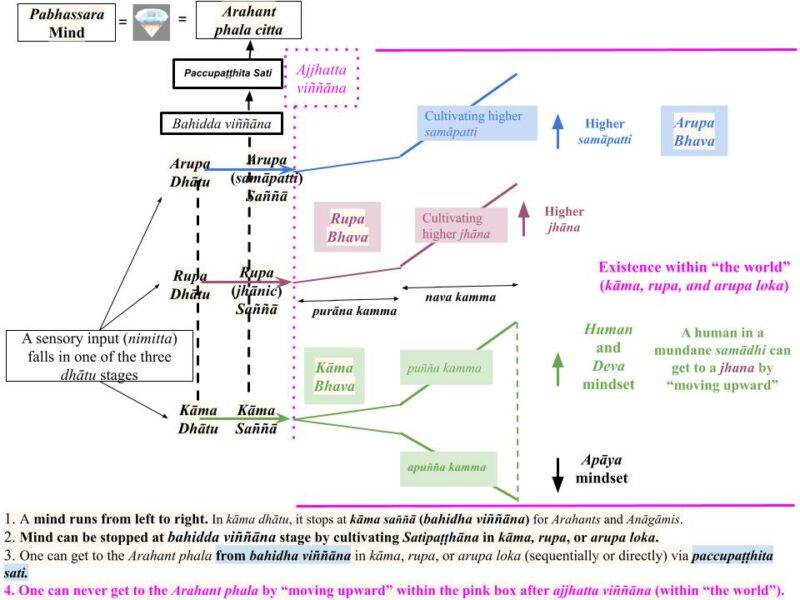
KeymasterThe following figure can be helpful:

Download/Print: “Purāna and Nava Kamma – 2- revised“
It is from the post: “Purāna and Nava Kamma – Sequence of Kamma Generation” which I highly recommend. Of course, one needs to keep going back to earlier posts to “fill in gaps.”
- All posts in sequence are in “New / Revised Posts.”
3 users thanked author for this post.
July 30, 2024 at 9:26 am in reply to: Validity of current interpretation of Satipatthana Sutta #51089Lal
KeymasterThe two types of vedana are discussed in detail here: “Vedanā (Feelings) Arise in Two Ways“
- The basic idea in bahiddha and ajjhatta versions of rupa, vedana, sanna, sankhara, and vinnana is simple.
- Let’s consider a “taste” (rasa rupa). The first impression of a taste is formulated by the brain (based on the sensors in the tongue) and is sent to the “seat of the mind (hadaya vatthu).” The human body (more accurately, the blueprint for it) is made by kammic energy to provide a sweet taste for sugar, for example. That is the “distorted sanna.” If it is a “real sanna,” tigers or lions would also like that taste, but they do not. So, this is the “bhaddha rupa” received initially by hadaya vatthu. Thus, the initial cittas (bahiddha citta) generated are based on that “undefiled, but still with distorted sanna.” The vinnana there is “bahiddha vinnana” with corresponding cetasika (corresponding to “bahiddha sankhara ” and “bahiddha dhamma.”)
- But that “sweetness of sugar” may trigger attachment to that taste in anyone with kama raga samyojana/anusaya intact. By the way, there will be variations at the individual level. For example, while an “attractive woman” is perceived similarly by all, different people may prefer certain types of “beauty.”
- P.S. Based on that attachment, the mind makes its version of the “bahiddha rupa.” That “mind-made rupa” is the ajjhatta rupa. However, that is not the “final version of the ajjhatta rupa.” The mind may be stuck contemplating its attractiveness, generating further mano sankhara. If the attachment is strong, it gets to the “upadana” stage, when strong kamma is done with mano, vaci, and kaya sankhara. This is where a lot of details come in: ““Sotapanna Stage via Understanding Perception (Saññā).”
- Based on that attachment, “ajjhatta versions” of all those entities arise automatically. We don’t have direct control over that. P.P.S. We have control over the “expansion of the vinnana” only after the “upadana” stage; this is where “sila” or “indriya samvara” plays a crucial role; see below.
- We must gradually change our gati to be attached to such sensory inputs to stop that from happening.
- Two factors can contribute to changing our “gati.” (i) We can forcefully stop eating tasty foods. While that can help if done gradually, forcing it may cause “patigha” or “agitation of mind.” Furthermore, that, by itself, cannot eliminate “kama raga samyojana/anusaya.” (ii) But if one can understand the mechanism of how the “tastiness of sugar” arises due to “distorted sanna,” then one can see that one has been “fooled by that distorted sanna.” See “Fooled by Distorted Saññā (Sañjānāti) – Origin of Attachment (Taṇhā). ” This is the foundation of insight mediation of Vipassana. It is only the knowledge or wisdom (panna) that can eliminate/remove various types of samyojana/anusaya from the mind.
- However, (i) above also plays a key role. Restricting the practice only to Vipassana may not work. Controlling one’s sensory faculties (same as “sila” or “indriya samvara“) plays a crucial role in the practice.
3 users thanked author for this post.
July 30, 2024 at 7:27 am in reply to: Validity of current interpretation of Satipatthana Sutta #51086Lal
Keymaster“Here it is more of questioning the exact words. Since only the words “kaye kaya” is swapped with “vedanasu vedana” in the vedana section, if you say that “kaye kaya” means “a part of kaya” then would “vededanasu vedana” also mean “a part of vedana”?”
- Of course. “Vededanasu vedana” means “a part of vedana.” That is to indicate two types of vedana arising.
- Same applies to “cittesu cittanupassana.” In the initial “bahiddha stage,” there is undefiled citta (yet with “distorted sanna.“) For those with unbroken samyojana/anusaya, defiled cittas arise in the “ajjhatta stage” only a split second later automatically.
- The same applies to “dhammesu dhammanupassana.” In the initial “bahiddha stage,” there is undefiled dhamma (yet with “distorted sanna.“) For those with unbroken samyojana/anusaya, defiled dhammas arise automatically in the “ajjhatta stage” only a split second later.
- Here, “defiled” means with raga, dosa, or moha.
3 users thanked author for this post.
July 30, 2024 at 6:20 am in reply to: Validity of current interpretation of Satipatthana Sutta #51081Lal
Keymaster“Does “vedanāsu vedanā” mean “a part of vedana”? If yes then which part?”
- There are two types of vedana: In the initial stage, “bahiddha vedana” (sukha, dukkha, adukkhamasukha) is experienced also by Arahants. In the next stage (next moment) mind-made “ajjhatta vedana” (somanassa, domanassa, upekkha) is experienced by those with samyojana/anusaya left, i.e., such vedana do not arise in Arahants.
- Have you read the posts I recommended? It is unlikely that you have.
July 29, 2024 at 6:09 pm in reply to: Validity of current interpretation of Satipatthana Sutta #51075Lal
KeymasterPathfinder raised the question about how the “Paṭikūlamanasikāra pabba” section of the “Mahāsatipaṭṭhāna Sutta (DN 22)” tallies with the concepts of ajjhatta kaya and bahiddha kaya. The English translation in the above link does not have the complete text for that section. So, I will use the link provided by Pathfinder: “Mahāsatipaṭṭhāna Sutta (DN 22).” I have linked to that section: Section D.
Let me try to explain briefly the connection.
English translation of the first two paragraphs is correct: “Again, monks, a monk reflects on this very body, that is covered with skin and full of impurities of all kinds from the soles of the feet upwards and from the hair of the head downwards, considering thus: ‘In this body, there are hairs of the head, hairs of the skin, nails, teeth, skin, flesh, sinews, bones, marrow, kidney, heart, liver, pleura, spleen, lungs, intestines, mesentery, stomach with its contents, feces, bile, phlegm, pus, blood, sweat, fat, tears, grease, saliva, nasal mucus, synovial fluid and urine.’
Just as if there were a double-mouthed provision bag, full of various kinds of grains and seeds, such as hill-paddy, paddy, mung-beans, cow-peas, sesame seeds and husked rice, and as if there were a man with discerning eyes, who, after having opened that bag would examine the contents, saying: “This is hill-paddy, this is paddy, these are mung-beans, these are cow-peas, these are sesame seeds and this is husked rice”; in this same way, monks, a monk reflects on this very body, that is covered with skin and full of impurities of all kinds from the soles of the feet upwards and from the hair of the head downwards, considering thus: “In this body, there are hairs of the head, hairs of the skin, nails, teeth, skin, flesh, sinews, bones, marrow, kidney, heart, liver, pleura, spleen, lungs, intestines, mesentery, stomach with its contents, faeces, bile, phlegm, pus, blood, sweat, fat, tears, grease, saliva, nasal mucus, synovial fluid and urine.”
______
The next paragraph in Pali: “Iti ajjhattaṃ vā kāye kāyānupassī viharati, bahiddhā vā kāye kāyānupassī viharati, ajjhattabahiddhā vā kāye kāyānupassī viharati, samudayadhammānupassī vā kāyasmiṃ viharati, vayadhammānupassī vā kāyasmiṃ viharati, samudayavayadhammānupassī vā kāyasmiṃ viharati, ‘atthi kāyo’ ti vā panassa sati paccupaṭṭhitā hoti. Yāvadeva ñāṇamattāya paṭissatimattāya anissito ca viharati, na ca kiñci loke upādiyati. Evaṃ pi kho, bhikkhave, bhikkhu kāye kāyānupassī viharati.”
- This is a highly condensed verse that needs to be explained in detail. But I will point out the essential aspects.
1. Here, “kāye kāyānupassī viharati” refers to “a part of the pancupadanakkhandha (PUK).”
- Kaya = PUK.
- “kāye kāya” refers to other kāya within the PUK. It is the initial stage of PUK, which starts with an arammana. The bahiddha kaya arises first (with “distorted sanna“) and is immediately followed by the ajjhatta kaya (according to the samyojana/anusaya present in that mind.)
2. The next part, highlighted in blue above, refers to the root causes for the origination of our physical bodies (as explained in the first two paragraphs).
- First, our physical bodies cannot arise without the mental body (gandhabba) arising at the cuti-patisandhi moment (when human existence was grasped.)
- There, “samudaya dhamma” refers to examining the root causes of the arising (“samudaya”) of the mental body (gandhabba). To stop that from happening in the future (“vaya dhamma”) one needs to understand the roles of the bahiddha kaya and ajjhatta kaya.
3. The subsequent phrase “‘atthi kāyo’ ti vā panassa sati paccupaṭṭhitā hoti” requires a detailed explanation.
- Once that process is understood, “Yāvadeva ñāṇamattāya paṭissatimattāya anissito ca viharati, na ca kiñci loke upādiyati.” OR (as the English translation correctly says): “In this way, he lives detached (from sensory attractions), without clinging to anything in the world, because now with cultivated wisdom (ñāṇamattāya) he realizes the root cause of craving is “distorted sanna.”
Of course, #3 requires a detailed explanation.
_______
This is why the Buddha stated, “My Dhamma has never been known to the world.”
- This is really a deeper aspect, but if understood, it will help immensely to eliminate “kama raga” or “craving sensual pleasures.”
- All our cravings are mind-made, based on “distorted sanna.“
2 users thanked author for this post.
July 29, 2024 at 4:06 pm in reply to: Validity of current interpretation of Satipatthana Sutta #51071Lal
KeymasterI am afraid that there is more involved in the correct explanation of the “Mahāsatipaṭṭhāna Sutta (DN 22)”.
It is indeed the statement you made in:
“Qns 1:
Several translations interpret ajjhattaṁ and bahiddhā as internal and external, it could well be wrong.”
_________
Ajjhattaṁ and bahiddhā in this context do not refer to internal and external. In particular, the Pali word for external is Bāhira.
- You need to read the posts I suggested above to understand the meanings of ajjhatta and bahiddha.
_____________
I know that only a few people may have understood the correct meanings.
- This is the first time that I pointed out the connection to the interpretation of the Mahāsatipaṭṭhāna Sutta (DN 22).
- I will try to write a post in two weeks to try to explain the connection a bit more. Next week’s post will focus on the connection between Buddha Dhamma and Vedic literature.
However, in the meantime, I will be happy to answer questions from those who may have at least partially understood the concepts of ajjhatta and bahiddha.
Lal
KeymasterYou wrote: “The second meaning of vibhava tanha, which is opposite to bhava tanha, is the tanha that seeks to eliminate the ‘conditioned bhava (kamma bhava and uppatti bhava)’ that can only be removed through the cessation of kammic energy.”
- Kammic energy can never be “removed” or “ceased.” P.S. Once energy is created, it will either bring about an effect (if the conditions are satisfied) or fade with time. For example, Angulimala killed almost a thousand people, but since he had attained Arahanthood, that kammic energy could not bring a “bhava” during his life or at death.
- Accumulated kammic energy cannot bring a rebirth (or even any temporary bhava during a lifetime) for an Arahant because the “upadana paccaya bhava” step (together with all the steps in PS) does not work.
So, I don’t see a “second meaning to vibhava tanha.”
1 user thanked author for this post.
July 29, 2024 at 9:19 am in reply to: Validity of current interpretation of Satipatthana Sutta #51061Lal
KeymasterTripleGemStudent wrote: “I thought what’s said was simple, practical and another way to say how anapana sati / satipatthana can be practiced / carried out. I would also like to add “not just realizing something negative”, but also positive and neutral. Or sukha (sōmanassa), dukkha ( dōmanassa), adukhamasukha (upekkha) using the teachings on the “all” (sabba) to reflect / contemplate on the tilakkhana nature of what has arisen and know it’s cessation.”
- This is a critical point to think about deeply.
1. A Paticca Samuppada process starts with a sensory input (arammana.)
- An arammana leads to a sukha , dukkha , or adukhamasukha vedana first. This is the “bahidda vinnana” stage. Here, sukha and dukkha vedana arise ONLY due to the physical body. All other types (seeing, hearing, taste, etc.) only lead to adukhamasukha vedana. However, ALL kinds of arammana trigger “distorted sanna.”
- This “distorted sanna” gives a false perception” that sugar is sweet or a particular woman is attractive.
- That happens in the mind of anyone born a human. That set of “distorted sanna” is associated with any human body, and thus arises also in an Arahant.
2. In the next moment (within a split second), that “distorted sanna” triggers one’s samyojana/anusaya.
- That leads to the arising of “mind-made vedana” which are sōmanassa, dōmanassa, or upekkha (neutral) and the initial attachment occurs at the “ajjhatta vinnana” stage.
- Then, the mind keeps attaching to that arammana to varying degrees, depending on the situation.
- If the mind gets firmly attached, it gets to the “tanha paccaya upadana” stage, and that is when “new kamma” or “nava kamma” accumulation starts.
- See “Ārammaṇa (Sensory Input) Initiates Critical Processes.” See the figure in #7.
- P.S. Since an Arahant has no samyojana/anusaya left, this step (and subsequent steps) DO NOT occur in an Arahant‘s mind.
3. I have been trying to explain this concept because it is critically needed to cultivate Satipatthana Bhavana correctly.
- In the “Mahāsatipaṭṭhāna Sutta (DN 22)” the following verse appears repeatedly: “Iti ajjhattaṁ vā kāye kāyānupassī viharati, bahiddhā vā kāye kāyānupassī viharati” in the Kāyānupassana section.
- Similarly, “Iti ajjhattaṁ vā vedanāsu vedanānupassī viharati, bahiddhā vā vedanāsu vedanānupassī viharati” appears in the Vedanānupassanā section (@11.11), “Iti ajjhattaṁ vā citte cittānupassī viharati, bahiddhā vā citte cittānupassī viharati” appears in the Cittānupassanā section (@12.18), and “Iti ajjhattaṁ vā dhammesu dhammānupassī viharati, bahiddhā vā dhammesu dhammānupassī viharati” appears in the Dhammānupassanā section.
4. Therefore, if anyone wants to understand the correct version of Satipaṭṭhāna, one needs to understand the concept of “distorted sanna,” bahidda vinnana, ajjhatta vinnana, etc.
- Of course, one needs to study this from the beginning in the “Sotapanna Stage via Understanding Perception (Saññā)” including the background material there.
5. Feel free to ask questions from any of those old posts. Please provide the link to the post and the relevant bullet number.
- Note: My old posts in the “Maha Satipaṭṭhāna Sutta” section do not discuss these aspects. It is a “first-level” to be grasped.
July 28, 2024 at 5:26 pm in reply to: Validity of current interpretation of Satipatthana Sutta #51057Lal
KeymasterSkywander wrote: “I agree, yet, for some of us, the concentration needed to successfully do vipassana is out of our skills.”
- Each person can do Vipassana at their level of understanding.
- The simplest way is to read a post from this website or listen to a verbal discourse while paying complete attention. The engagement and interest will grow if one starts grasping even a single concept.
- I know of many people who listen to discourses while doing household work. Others read posts on this website without paying much attention or not reading the suggested links. Those are bad habits.
- At the beginning of numerous suttas the Buddha started with the following verse: “taṁ suṇātha, sādhukaṁ manasikarotha, bhāsissāmī” which means, “Listen and pay full attention, I will speak.”
___________
Skywander wrote: “The problem I have when I try to do real vipassana is that by examining citta and dhammas my mind ends lost in itself.”
- This is the same issue as above.
- Vipassana can be done while sitting at a table reading a post on the computer. Just make sure to pay complete attention.
- Initially, it is best to pick a post (or section) where you have some understanding. Pick a time when distractions are minimal.
- If it helps, you could ” watch the breath” for a few minutes to calm the mind. People in Asian countries start a meditation session by offering flowers/lighting a candle to the Buddha and reciting a few verses. That helps calm the mind, too.
- As you make progress, you will be able to sit somewhere and contemplate a Dhamma concept. That is the Vipassana I do every day. Whenever needed, I get up to look up a sutta or do an online search. The goal is to increase one’s understanding, not to be forced to sit like a statue.
- Once getting some traction, this will become a habit. I wake up thinking about a Dhamma concept and go to sleep thinking about a Dhamma concept. Then I do that throughout the day too. Of course, not everyone can do the latter. I can do that since I am retired!
6 users thanked author for this post.
Lal
KeymasterYes. Dosakkhayo’s above comment provides some critical insights. Let me expand on that a bit more.
- One’s physical and mental bodies arise according to the type of kamma responsible for bringing this existence (bhava) and birth (jati.)
- For example, a pig is born according to lowly, immoral actions done as a human. Such kamma (probably done with greed) produces an existence that likes “lowly tastes.” Thus, eating garbage/feces produces an “enticing sanna” in a pig. However, that “distorted sanna” cannot lead to strong immoral deeds (akusala kamma) in a pig (or any being in an apaya).
- Strong javana cittas that can bring good or bad outcomes can arise mostly in humans. This is a key nugget from Abhidhamma.
- Now, a human bhava (and jati with a physical body) arises due to a “good kamma vipaka” (via punna abhisankhara), but still “contaminated with kama raga or craving for sensual pleasures.” Therefore, the human body produces an “enticing sanna” only for sugar, cake, pizza, etc., but NOT for garbage/feces. Yet, if a human engages in immoral deeds to acquire such tasty foods by engaging in “lowly deeds” (like stealing or taking bribes, for example) on a regular basis, that can lead to acquiring enough akusala kamma to bring a “pig birth” via a “pig existence.”
A key point is that the “distorted sanna” is according to the birth.
- Beings in different realms are born with corresponding “distorted sanna” built-in.
- In another example, rupavacara Brahmas automatically generate “enticing sanna” with their “jhanic thoughts.” Their existence arose due to the cultivation of jhana as humans.
2 users thanked author for this post.
July 28, 2024 at 2:42 pm in reply to: Validity of current interpretation of Satipatthana Sutta #51052Lal
KeymasterI will say three things to consider:
1. Keeping the mind focused on the breath (or a water bowl, ball of clay, etc., as in mundane versions of kasina meditation) can stop it from wandering into sensual, angry, or ignorant thoughts. The latter three things cause a mind to be agitated and stressful.
- Therefore, I agree that forcefully keeping the mind on a “neutral object” will stop the mind’s agitation and have a calming effect (Samatha.)
- If one lives a moral, simple life (i.e., abstain from akusala kamma over a long time) while simultaneously engaging in such mundane techniques (breath, kasina), one can even attain “mundane jhanas.”
- That is what ancient yogis did. They went deep into jungles (to be away from women and other sensual attractions), lived simple lives, and cultivated anariya jhana using the breath or mundane kasina techniques. So, they will be reborn in a Brahma realm and live a peaceful life there. But at the end of that lifetime, they will return to kama loka and can be reborn in the apayas. So, it is a temporary solution.
2. The above procedure cannot cultivate the wisdom (panna) necessary to attain any magga phala.
- I would love for anyone to explain how that could be possible.
3. Focusing the mind on examining Dhamma concepts will address both of the above issues. This is called “insight meditation” or Vipassanā.
- It will keep the mind away from sensual, angry, or ignorant thoughts and help to calm it (Samatha).
- It will cultivate wisdom (panna) that will remove ingrained defilements (samyojana/anusaya) from the mind and lead to magga phala.
- With the cultivation of panna, one’s mind automatically abstains from akusala kamma. Thus, one may automatically enter Ariya jhana with this practice. Even in the absence of entering any jhana, one is certain to attain magga phala.
- However, the time taken will depend on each person. Do not expect quick results.
__________
The goal of a Buddhist is to attain magga phala and end the suffering in the rebirth process!
- Regarding #2, some say, “Do the breath meditation to calm the mind,” and then do Vipassanā.
- Of course, that will work if they understand how to do Vipassanā. But my observation (observing those who attend meditation retreats like Goenka-type) is that they never do real Vipassanā. Most of such programs lead to only Samatha. Does anyone know of someone who has attained a magga phala by attending such “meditation retreats”?
P.S. It is quite likely that anyone who translates “Ānāpānapabba” as “Section on Respiration” will not know how to do Vipassanā!
6 users thanked author for this post.
-
AuthorPosts