
Forum Replies Created
-
AuthorPosts
-
Lal
KeymasterThank you, Gad!
I tried to locate the sutta you quoted. I found “Sambuddha Sutta (SN 48.28).”
- That does not seem to be the one quoted.
But here is another sutta that discusses Paññāvimutti Arahants: “Susimaparibbājaka Sutta (SN 12.70).”
- Many people, even during the time of the Buddha, associated all Arahants with supernormal powers, etc.
- But, in reality, only relatively few Arahants had supernormal powers.
But ALL Arahants are free of suffering. That is the critical point. That is what the Buddha explained to wanderer Susīma in the above sutta.
1 user thanked author for this post.
Keymaster“However, majority of the websites and YouTube videos readily concede that such practice is not given in the suttas.”
- That is correct.
“ I also do not intend to mean that these people meditating on kasinas have been taken for a ride…”
- But that is true if that means “meditating on kasina objects like breath or a clay ball.”
1. Using kasina objects for meditation is advised in Buddhaghosa’s Visuddhimagga. Some Theravadins have embraced that wrong practice.
- Buddhist mediation does not involve ANY worldly objects, including breath.
2. “Dasa kasiṇāyatana” are listed in the “Paṭhamakosala Sutta (AN 10.29).”
- Those anariya meditation techniques were there when the Buddha (Bodhisatta) was born. Many yogis cultivated them and attained rebirths in various Brahma realms (in rupa loka and arupa loka.)
- At marker 5.2: “Evaṁsaññinopi kho, bhikkhave, santi sattā.” OR “Some sentient beings perceive like this.”
- At marker 5.3: “Evaṁsaññīnampi kho, bhikkhave, sattānaṁ attheva aññathattaṁ atthi vipariṇāmo.” OR “But even the sentient beings who perceive like this decay and perish.” By that, it means those yogis who cultivated such meditations and reborn in Brahma realms undergo decay and death.
- At marker 5.4: “Evaṁ passaṁ, bhikkhave, sutavā ariyasāvako tasmimpi nibbindati.” OR “Seeing this, a learned noble disciple grows disillusioned with it.” Thus, they will no longer use such techniques.
3. Thus the sutta points out the futility of such kasina meditations.
- The keyword referring to kasina is “sañjānāti.” For example, at marker 4.3: “Pathavī kasiṇameko sañjānāti” means focusing one’s mind on a pathavi (clay ball.) In particular, “vāyo kasiṇameko sañjānāti” refers to breath meditation.
- Things will become clear when you understand the meaning of “sañjānāti.”
- See “Cognition Modes – Sañjānāti, Vijānāti, Pajānāti, Abhijānāti”
P.S. The phrase “aññathattaṁ atthi vipariṇāmo” can be understood by reading the post “Aniccaṁ Vipariṇāmi Aññathābhāvi – A Critical Verse.”
KeymasterYes. Patience and enduring hardships are critically important not only in anger but also when facing inevitable difficult situations.
- The “Sabbāsava Sutta (MN 2)” explains several ways to do that.
- Sections 2 and 4 are especially important in the above link in this regard.
KeymasterIt is good to try to analyze/investigate like what you did. That is part of insight meditation.
- However, in this particular case, there is an aspect that we need to learn, which cannot be sorted out by using mundane ideas like elementary particles in science.
- Neva + saññā + nā + saññā means “they have saññā for a time period, but may not have saññā for a while.” As we know, saññā is a “universal cetsika” that arises with any citta. Thus, it means those Devas do not have cittas arising for brief periods (like in “full Nibbana” or like in an Arahant in “nirodha samapatti.”)
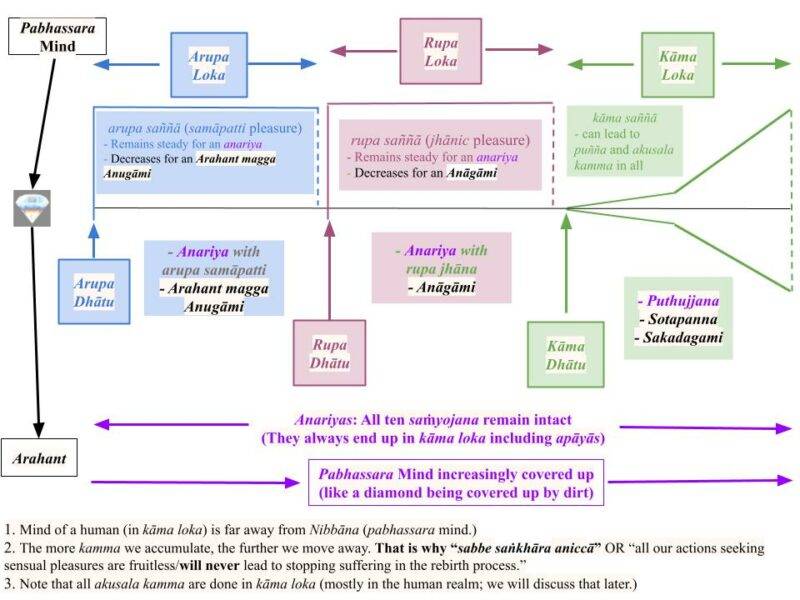
- As a lifestream proceeds up to the rupa loka and then to the arupa loka, one gets closer and closer to Nibbana (the “pabhassara citta.”) However, all anariyas, no matter how far upward they proceed, “fall back” to kama loka. That is because they have not broken any anusaya or samyojana.
- On the other hand, an Ariya proceeding up the jhana/samapatti ladder goes upward while breaking various anusaya and samyojana on the way. Thus, when they get to the Nevasaññānāsaññāyatana stage, they can get to “nirodha samapatti.” That can be done only by an ubhatovimutta Arahant.
2 users thanked author for this post.
KeymasterTitikkhati does mean something like “patience” or “endure a hardship.”
If a weak person harasses a strong person, the strong person can stop the weak person by using his power.
- However, in some cases, a strong person may endure that harassment to avoid a possible bad outcome for both.
- Yet no one can challenge a strong person, guarded by the teaching.”
KeymasterYou are welcome! I understand that some of these concepts (terminology) may not be easy for the Western audience to grasp.
- Six Deva realms mean there are six categories of Devas, ranging from “Cātummahārājika Devas” to “Paranimmita vasavattī devas.” See “31 Realms of Existence.”
- Sixteen rupa loka Brahmas means 16 categories ranging from “Brahma Parisajja devas” to “Akanittakha devas.” In many suttas, Brahmas are called a type of Deva. Births in these realms correspond to various levels of jhana cultivated. See #7 of “Jhāna – Finer Details.”
- The four arupa loka Brahmas means four categories ranging from “Ākāsānancāyatana devas” to “Nevasaññānāsaññāyatana devas.” Births in these four realms correspond to four levels of arupavacara samapatti cultivated. See “31 Realms of Existence.”
1 user thanked author for this post.
Keymaster1. Humans can see only those beings in the human and animal realms.
2. Devas (in the six Deva realms) and Brahmas (those in the 16 “rupa loka” realms) can visit the “human world” and see the humans. During the time of the Buddha, many Devas and Brahmas visited to listen to the Buddha. But there is no incentive for them to visit, but it is possible.
- We cannot see them even if they visit because they have delicate, subtle bodies. They can make themselves seen by humans.
1 user thanked author for this post.
Keymaster1. “Bhava” means the duration of an existence. A Deva and a Brahma are born once during a “Deva bhava” and a “Brahma bhava,” respectively. However, within a “human bhava,” a human can be born many times with a “physical human body,” and the same applies to an animal.
- A human gandhabba is born at the beginning of a human bhava and lives until the end of that bhava. That human gandhabba is born with a physical human body many times during that bhava.
- In contrast, a Deva is born only once during a “Deva bhava.” The same applies to a Brahma.
2. The hells (nirayas) may not be at the center of the Earth but well below the Earth’s surface.
3. It depends on what you mean by a “world.” There is a human world, an animal world, etc. There are six Deva realms, and their aggregate could be called “Deva world.” But all 31 realms combined could also be called the “world.”
4. and 5. These questions imply that you need a better understanding of what bhava means. I explained it in #1 above. Also see “Bhava and Jāti – States of Existence and Births Therein.”
2 users thanked author for this post.
KeymasterThank you, Gad!
1 user thanked author for this post.
KeymasterThe length of the human bhava (as well as for any animal bhava) is not fixed (unlike for the Deva and Brahma realms). See “31 Realms of Existence.”
- The “Mahāpadāna Sutta (DN 14)” states that during Buddha Vipassī’s time, the human lifespan was 80,000 years, i.e., a human living for 80,000 years on average. Thus, a human bhava can last even more.
- That sutta shows how the human lifespan can vary from 80,000 to around 100 years (during Buddha Gotama’s Sasana). I have read elsewhere (don’t remember the reference) that it can decrease to as low as 10 years.
1 user thanked author for this post.
KeymasterThe following post explains how one creates one’s future lives:
“Origin of Life – One Creates One’s Own Future Lives“
- That post is the last one in a series on the “Origin of Life.” The series discusses many “theories of life” and compares them with those of the Buddha.
2 users thanked author for this post.
Keymaster“No first starting point could be found. We program ourselves.”
- Yes. I am glad you understood that critical point!
KeymasterYes, you are correct. Contrary to what I wrote above, it was customary to build statues in East Asia well before the Buddha, as is obvious from the many old statues of deities in India. However, it became a “Buddhist custom” well after the Buddha’s Parinibbana.
Thank you for the reference. The following is the link:
- However, as I mentioned above, it is not a “Jataka story.” It happened during Buddha Gotama’s life.
- There is a sutta in Samyutta Nikaya providing the same account. If someone has that reference, please post it.
2 users thanked author for this post.
KeymasterI removed the first link for the paper since it does not work.
- Anyway, the idea that we live in a simulation is not consistent with Buddha Dhamma.
- By definition, there must by an agent “launching the simulation.” Who is that? Who created that agent?
- This is the same idea as that of a “Creator.”
3 users thanked author for this post.
KeymasterNo. I don’t think that is true. There was no such custom at that time to ban it.
- But he clearly advised using the Bodhi tree and stupas with dhatus embedded in them.
2 users thanked author for this post.
-
AuthorPosts


