
Forum Replies Created
-
AuthorPosts
-
Lal
KeymasterYes. Saññā can be of many types.
- Some (kāma saññā) can lead to “defiled actions, speech, and thoughts” or “kamma accumulation” that can bring their vipaka in the future.
- However, some saññā depend on our viewing angle (like in the case of your pictures), and they do not necessarily lead to kamma accumulation. Of course, such confusion can be a hindrance to “samadhi.”
KeymasterThe first two pictures of Tobi provide good examples of how the same picture can lead to two different saññā.
- Labeling in the second set makes it easier to “see” (i.e., provide the saññā) of a young man and a young woman.
- Now, replace the two labels “ear” and “chin” with “eye” and “nose.” Then you can “see” an old man and an old woman.
I have seen the “young/old woman” picture in a book. I don’t remember the name of the book.
1 user thanked author for this post.
KeymasterCakkhu viññāṇa in “Cakkhuñca paṭicca rūpe ca uppajjāti cakkhu viññāṇaṃ“ is already an ajjhatta viññāṇa. However, nava kamma (with strong kammic energy) accumulation starts after the “tiṇṇaṃ saṅgati phasso” step.
- That may not be explained well in the old posts like “Indriya Make Phassa and Āyatana Make Samphassa.”
It is explained better in the newer post, “Purāna and Nava Kamma – Sequence of Kamma Generation.” See #6 of that post.
- I need to go out for a few hours. You can read those two posts carefully and ask further questions. I will have more time later to explain it better if you have questions.
1 user thanked author for this post.
July 7, 2024 at 7:08 am in reply to: Post on “Saññā Gives Rise to Most of the Vedanā We Experience” #50692Keymaster“I think this types of saññā can be called bahidda saññā.”
- Yes. That is exactly right.
- “Bahidda” comes from “bahira” + “iddha,” where “bahira” is external and “iddha” means “get established.” Note that “iddhi” is different and means “supernormal powers.”
- Thus, “bahidda sanna” is a sanna that arises due to external sensory inputs and automatically “established” or ‘manifested’ in a sentient being. Kama sanna (like the taste of food or the beauty of a woman) is built into our human bodies. They give rise to “mind-made vedana” or “samphassa-ja-vedana.”
- Puthujjana (or even a Sotapanna) may attach to such “mind-made vedana” because they do not understand that they are not “real” at a deeper level. Once that mechanism is understood, one realizes that one has been “tricked” by nature!
The “bahidda sanna” evolves into “ajjhatta sanna” for all those who have not fully grasped the above.
- Here “ajjhatta” comes from “ajjha” + “atta” where “ajjha” means “oneself” and “atta” means “beneficial/meaningful.”
- Those below the Anagami stage (who have not fully grasped how “bahidda sanna” arises, would automatically be attached to that “bahidda sanna,” thinking it would benefit oneself.
- That is what I tried to explain in that post. Yes. You seem to have gotten the idea!
1 user thanked author for this post.
July 7, 2024 at 6:51 am in reply to: Discussion on “Cultivating Jhāna and Magga Phala – What Is the Difference?” #50691KeymasterYou are making progress.
You wrote: ” I still have a sexual appetite and am still a bit lazy about formal meditation,..”
- Sexual apatite goes away only at the Anagami stage. Our bodies are “made’ (via Paticca Samuppada) to generate sexual urges. Our minds (more accurately, the seat of the mind or hadaya vatthu) are also “made” to create a sanna of “sweetness of sugar” or “pleasant smell of a rose.” Read and understand the new post: “Saññā Gives Rise to Most of the Vedanā We Experience.”
- The tendency to engage in meditation will increase as you gain more understanding. Remember, meditation is not restricted to sitting down and doing a “formal meditation session.” While that should be done too, one must constantly think about how defilements arise in everyday situations and avoid harmful actions, i.e., “being mindful all the time.”
You wrote: “I’m not picky about eating as long as it’s appropriate, my clothes are simple, the important thing is neat and polite, I don’t use hair or body perfume, everything is simple and I think it reduces my attachment and makes me much more relaxed. “
- Yes. That happens naturally and gradually as one’s understanding increases.
2 users thanked author for this post.
KeymasterQuestion 1: “Magga here means Path?”
- Yes.
By the statement, “As we know the solution to the calculation 3×2 = 3+3 or 2+2+2” if you mean 2 for magga and phala, then there are 8 for the four stages of Sotapanna, Sakadagami, Anagami, Arahant.
Question 2: Yes. The description is generally correct.
You are making progress. Keep it up!
2 users thanked author for this post.
KeymasterYash wrote: “True ! but such people can counter question the Dhamma by asking the same question.
“If you are a Sakadagami and will be born in a Heavenly plane, why don’t you die?”
- But we know that a Sakadagami who dies will be reborn as a Sakadagami. He will not attain Arahanthood by dying! So it is not the same.
KeymasterEssentially, any realm in this world has anicca, dukkha, and anatta nature. Sometimes, asubha is also used to characterize the world.
The following summarizes it all. Only a pabhassara mind does not have any of those characteristics.
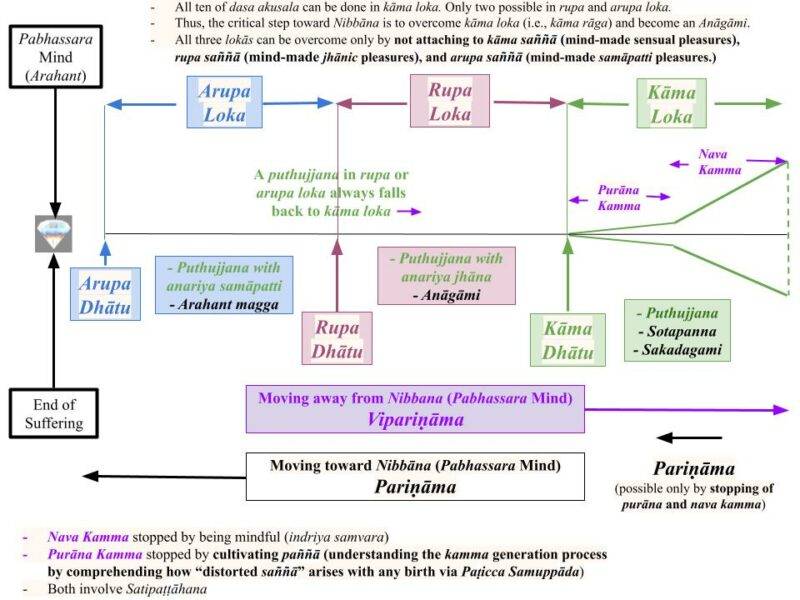
The above chart is from the post “Vipariṇāma – Two Meanings.”
Yash asked: “Are Jhanas also of Asubha Nature?”
- Yes. They do. The mindset of jhanas is the sama as those in rupa loka realms.
1 user thanked author for this post.
KeymasterPathfinder wrote: “Let’s say we can be born a brahma and live as a brahma permanently (no rebirth), would you still say that this is anicca?”
- But impermanence is a part of anicca nature.
- Any existence in this world (including a Brahma) is a sankhata, and every sankhata has a finite lifetime. At a deeper level, any existence arises via kammic energy generated in the mind. That cannot give rise to a permanent entity because it was created by a finite energy. When that energy runs out, any existence comes to an end.
- So, Yash’s particular statement you quoted is not entirely correct. We cannot even assume a sankhata to be permanent.
2 users thanked author for this post.
July 3, 2024 at 7:16 pm in reply to: Can an Anagami be reborn anywhere in the Rupa Loka or only in the Pure Abodes? #50641KeymasterI don’t understand your questions in your first comment. In the second comment, you seem to indicate that there are contradictions in my post, but I can’t sort them out.
- First, please copy and paste your first comment into a word processor and correct the grammar.
- Then, break that one paragraph into questions if you have multiple questions.
- Under each question, ask the question and point out any issues with my statements in my post that could be relevant.
July 3, 2024 at 5:01 pm in reply to: Can an Anagami be reborn anywhere in the Rupa Loka or only in the Pure Abodes? #50635KeymasterAn Anagami (who has removed kama raga and patigha samyojana) will be born in a “suddhāvāsa” (“pure abodes”) reserved for them, and NOT in any other realm in rupa loka. See #6 of the post below.
- A Sotapanna/Sakadagami who has cultivated Ariya or anariya jhana will be reborn in a Brahma realm (according to the jhana cultivated), and those are NOT “suddhāvāsa” (“pure abodes”). However, they also do not “come back” to kama loka.
- Those anariya yogis who do not have magga phala but cultivated anariya jhana will be reborn in a Brahma realm (according to the jhana cultivated), but they “come back” to kama loka, i.e., they will be reborn in the human realm at the end of that Brahma existence.
- Details in “Ariya Jhāna and Anariya Jhāna – Main Differences.”
1 user thanked author for this post.
Keymaster1. We don’t know how the developers use the feedback they get from AI based on what AI learns.
2. We also don’t know how the developers select which material AI can access.
3. AI is designed to mimic the neural net in human brains to look for “logical patterns” in data.
- The neural net in a human brain is much more efficient than that in an AI. Our brain uses a few watts of power, whereas an AI uses billions of times more power. While AI systems will improve with time, they will not be able to match the design power of nature (kammic energy).
4. Our brains (and the neural system there) help us make decisions. But just like the AI, our neural systems (i.e., the brains) are as good as we train them. While the brain does not generate thoughts, it helps the mind (located in hadaya vatthu in the manomaya kaya or gandhabba) to make decisions.
- Let us take a mundane example. Consider two people: One spends the day watching useless movies, and the other spends time learning things and building new skills. It should be clear to anyone “which brain will win” at the end.
- In the same way, a given AI is as good as the information it gets.
- This is why AI will NEVER achieve human intelligence. It may pass standard tests like the SAT (college entrance exam) or even bar exams for lawyers; it has already done so). But that mainly involves “remembering” and making “logical decisions based on what is learned.”
- However, AI cannot generate paradigm-changing ideas like Newton or Einstein, let alone the Buddha. That is what “human intelligence” really is!
1 user thanked author for this post.
KeymasterThank you for posting that revealing conversation with Meta AI!
- It shows that AIs are at least getting information from websites like this and are not sticking with a narrow focus.
- For example, most English websites restrict the meaning of “anicca” to a single English word of “impermanence.” Even though impermanence is a part of anicca nature, anicca has a broader and deeper meaning. The AI seems to have grasped that.
- The output of an AI program is based on the information it is exposed to. One good outcome is that the AI can filter out the noise and get to deductions based on logic. But if it is not exposed to “correct information,” it cannot make such paradigm-changing deductions on its own. That is the difference between an AI and a human.
- For example, once a Sotapanna discovers the “previously unheard teachings of a Buddha,” he or she can make progress on their own. But an AI cannot do that. If someone explains how to make further progress, the AI can summarize that updated information again, and so on. It solely depends on the information it has access to.
- The danger is that those programming the AI can put guardrails or stop providing some information, restricting what AI can access.
1 user thanked author for this post.
July 3, 2024 at 7:07 am in reply to: My Conversation with a Materialist Teacher who strangely believes in God #50626Keymaster“To be honest, we can’t really control what other people do. So we should stop worrying about them and focus on ourselves.”
- That is true. There are two aspects to it, though.
1. One cannot fully help others until one frees oneself first. For example, if a group of people are trapped in a deep hole, one must first get out. Then, he can help others.
2. However, those who are like-minded and have the same goal can help each other. In the above example, others can lift someone and make him advance to help him get out.
- Soon after attaining Buddhahood, the Buddha started seeking those who helped him in his efforts (in his past lives). See “Animisa Locana Bodhi Poojawa – A Prelude to Acts of Gratitude.”
2 users thanked author for this post.
KeymasterYes. For example, an Anagami likes to see bhikkhus and other disciples and discuss things with them, but does not want to watch adult movies or discuss tasty foods.
- Anariya yogis who still have kama raga anusaya/samyojana will still not generate sensual thoughts while trying to get into the jhana or while in the jhana.
2 users thanked author for this post.
-
AuthorPosts


