
Forum Replies Created
-
AuthorPosts
-
Lal
KeymasterThe physical body of an Arahant is subject to the same biochemistry as any other human body.
- Of course, an Arahant would not consume any drugs or alcohol. But if he did, the biochemical reactions in the body would be the same.
We need to remember that the workings of kammic energy dictate “nature’s laws.” All biochemical processes take place according to kammic laws.
- Both mental and physical bodies in human bhava (any bhava) are according to the gati that led to grasping that human bhava in kama loka.
- One’s gati are according to the (abhi)sankhara cultivated. That lead to “bhava paccaya jati” according to Paticca Samuppada (“pati iccha” leading to “sama uppada.”) That is a critical outcome of Paticca Samuppada.
- See “Paṭicca Samuppāda – “Pati+ichcha”+“Sama+uppāda”
- This is a critical point to understand.
1 user thanked author for this post.
KeymasterI don’t know the accuracy of that statement in Wikipedia.
- If it is true, then it must be “Asura god.”
1 user thanked author for this post.
July 12, 2024 at 3:19 pm in reply to: Post on “Distorted Saññā Arises in Every Adult but Not in a Newborn” #50861KeymasterYes. It is true that “distorted saññā” is “built-in” to our mental AND physical bodies by kammic energy (via Paṭicca Samuppāda.)
- However, that “distorted saññā” in the mental body (specifically the “seat of the mind” or hadaya vatthu) cannot be triggered until the hadaya vatthu receives a sensory input.
- As we have discussed in that post you quoted, that sensory signal must be first processed by the brain. Depending on the status of brain development, some signals do not get processed or sent to the hadaya vatthu. That is the main point I tried to convey in that post. Also see “Brain – Interface between Mind and Body.”
- Only after seven years of age (when the brain is fully developed), the hadaya vatthu receives most sensory signals.
1 user thanked author for this post.
KeymasterIt is a good summary. However, there is another aspect to be considered.
- Because of the reasons you discussed, there is an innate sanna of “me” and “mine” in all humans regardless of whether they believe in a soul (sassata ditthi) or believe that death of the physical body is the “end” (uccheda ditthi). This is one of the ten samyojana (asmi mana) that will disappear only at the Arahant stage.
- That innate sanna of “me” and “mine” arises because of a “distorted sanna” that is also “built-in” to our bodies.
3 users thanked author for this post.
KeymasterHello Skywander!
Regarding what you wrote: “Another thing I felt was really off was the “only seven more rebirths after one attains sotapanna”. The samsara is so vast, the difference between a sotapanna and arahant is so large, it didn’t feel natural than all sotapanas would always need only seven more rebirth..”
- You are right. The suttas refer to a maximum of seven “bhava,” which differs from “jati” or births. See “Bhava and Jāti – States of Existence and Births Therein.”
- More technical information in “Aṭṭha Purisa Puggalā- Eight Noble Persons” where the topic is discussed in #5.
_____
You asked: “If possible, Lal, could you tell me if there is some important piece of key information to understand the Suttas that Venerable Waharaka Thero taught, but you haven’t been able to put into the website?”
- I don’t understand this question. Why wouldn’t I write about anything that would be important? All the fundamental/critical concepts Waharaka Thero discussed are on the website.
- If you are asking whether I have understood Waharaka Thero’s explanations, I think so.
1 user thanked author for this post.
KeymasterYes, I see nothing wrong with what you wrote. Now, try to understand the concepts by thinking about real-time situations. You may have understood already.
- It is the Idappaccayātā Paṭicca Samuppāda that runs moment-to-moment. It describes how our minds respond to a sensory input (arammana). It describes temporary “bhava” and “jati“ within a lifetime: “Idappaccayātā Paṭicca Samuppāda – Bhava and Jāti Within a Lifetime.” That is the first post in the section I recommended: “Paṭicca Samuppāda During a Lifetime.”
- The “Uppatti Paticca Samuppada” is a summary of how what happens over many lives leads to grasping a “bhava” and corresponding “jati” (at the cuti-patisandhi moment) according to all “kammic energies” (bhava energies) accumulated via innumerable Idappaccayātā Paṭicca Samuppāda cycles over many past lives.
A mind becomes active only with an arammana. Most of the suttas explain the workings of the mind upon receiving an arammana. Those interested should search for “arammana” using the “Search” box on the top right and read some of them.
- Mind is all about responding to arammana.
- When we sleep or while unconscious, the mind is not active.
_________
I will copy and paste what I wrote in one of the comments above. Those interested should read it carefully, including the links.
1. “Bhava” is the kammic energy that can sustain an existence. “Bhava” is two types: (i) During a lifetime, one can get into a”temporary existence” (temporary bhava) where more kammic energy corresponding to that type of existence is accumulated. (ii) That accumulated “bhava energy” can lead to a new existence at the cuti-patisandhi moment via “bhava paccaya jati.”
2. The primary mechanism of “bhava energy” formation is “namarupa formation.” This is where “nama” and “rupa” are combined by the mind, and kammic energy is produced in javana cittas. The critical steps are “avijja paccaya sankhara” through “vinnana paccaya namarupa.”
- However, one does not automatically start “avijja paccaya sankhara.” It begins with a sensory input (arammana) coming to the mind and the mind getting attached to it, for example, “cakkhunca paticca rupeca uppjjati cakkhu vinnanam.” The attachment starts with the mind generating “samphassa-ja-vedana” via “distorted sanna.”
- That always happens within a lifetime via Idappaccayata PS. See “Paṭicca Samuppāda During a Lifetime.”
- However, once attached to an arammana and getting to the “tanha paccaya upadana” step, the mind starts accumulating new kamma, beginning at the “avijja paccaya sankhara” step. See “Taṇhā Paccayā Upādāna – Critical Step in Paṭicca Samuppāda” for details. I mentioned this post in another recent thread, but you don’t seem to have read it. See my comment on July 10, 2024 at 8:27 am in “Compilation of my thoughts.”
3. Accumulated kammic energy can lead to a new existence at the cuti-patisandhi moment via “bhava paccaya jati,” as mentioned in #1 above. Sometimes, the “Akusala-Mūla Uppatti Paṭicca Samuppāda” process is used to explain it.
- However, grasping a new existence at the cuti-patisandhi moment also happens in an Idappaccayata PS process. That also begins with a sensory input (arammana) coming to the mind and the mind getting attached to it, for example, “cakkhunca paticca rupeca uppjjati cakkhu vinnanam.”
- However, in this case, once reaching the “tanha paccaya upadana” step, the mind moves to the “bhava paccaya jati” step and grasps that new existence. In this case, there is no time to accumulate “more new kamma,” as in #2 above. Here, grasping a new existence also involves generating “samphassa-ja-vedana” via “distorted sanna.”
- Whether it is new kamma generation or grasping a new existence, a mind MUST attach to an arammana, and that is ALWAYS triggered by “distorted sanna.”
Paticca Samuppada is complex. It is not linear most of the time. However, it is stated linearly to explain the main concepts.
1 user thanked author for this post.
KeymasterDosakkhayo wrote:
“From what I have learned in 50836, bhava in “bhava paccaya jati” is formed through the “vinnana paccaya namarupa” stage.
Is this the difference between the two?”
- I tried to explain that in my comment above. That is all I can do right now. If you take the time to read it carefully (including the links), you may be able to understand.
- As I wrote there, these concepts may not be easy to understand.
Think about the following. How long does it take a person to get a Ph.D. in nuclear physics or any area of science?
- A Ph.D. will take at least 25 to 30 years (starting in elementary school and proceeding through many stages), but that is in one specific field.
- Buddha Dhamma is much deeper than any area in science or modern science taken as a whole. Modern science only deals with matter. Buddha Dhamma, on the other hand, explains how matter is created by the mind! That is much harder.
However, fortunately, learning Buddha Dhamma is an entirely different process. Even a person without much formal education may be able to make progress. The issue is that it is easier for some people than others because they have done more work in previous lives (the concept of paramita.) Since we do not know how much of the paramita we have completed, we can only make the effort.
1 user thanked author for this post.
KeymasterIt is impossible to do that in a single comment or even a long post. I would have done it if that was possible! One needs to keep reading and understanding concepts. I myself am learning, too. Buddha Dhamma is like the deep ocean; one can go deeper with more understanding. Once in a while, you come across a “breakthrough,” like the concept of “distorted sanna,” which opens up a new, life-changing view. That is what happened to me in 2023.
- Don’t try to understand everything in one session. You seem to stress yourself out by doing “marathon sessions.” That is unhealthy, meaning it could be stressful and may affect the physical body, too.
- Please take the time to re-read what I wrote above and the links. I don’t think you even read what I wrote above carefully (let alone the links) before responding!
- Try to understand the concepts, and avoid hanging onto every word I write. Sometimes, it is difficult to express ideas in words, and what I write in a particular sentence could be misinterpreted. (Of course, if I write something with apparent errors or contradictions, it is OK to point that out.) If you read a post in its entirety (and the links), you should be able to get the general idea.
1 user thanked author for this post.
KeymasterDosakkhayo asked: “If “vinnana paccaya namarupa” and “bhava paccaya jati” are separate and independent stages, how are they different?”
Two terms that are the hardest to understand in Paticca Samuppada are “namarupa formation” and the concept of “bhava.”
1. “Bhava” is the kammic energy that can sustain an existence. “Bhava” is two types: (i) During a lifetime, one can get into a”temporary existence” (temporary bhava) where more kammic energy corresponding to that type of existence is accumulated. (ii) That accumulated “bhava energy” can lead to a new existence at the cuti-patisandhi moment via “bhava paccaya jati.”
2. The primary mechanism of “bhava energy” formation is “namarupa formation.” This is where “nama” and “rupa” are combined by the mind, and kammic energy is produced in javana cittas. The critical steps are “avijja paccaya sankhara” through “vinnana paccaya namarupa.”
- However, one does not automatically start “avijja paccaya sankhara.” It begins with a sensory input (arammana) coming to the mind and the mind getting attached to it, for example, “cakkhunca paticca rupeca uppjjati cakkhu vinnanam.” The attachment starts with the mind generating “samphassa-ja-vedana” via “distorted sanna.”
- That always happens within a lifetime via Idappaccayata PS. See “Paṭicca Samuppāda During a Lifetime.”
- However, once attached to an arammana and getting to the “tanha paccaya upadana” step, the mind starts accumulating new kamma by starting at the “avijja paccaya sankhara” step. See “Taṇhā Paccayā Upādāna – Critical Step in Paṭicca Samuppāda” for details. I mentioned this post in another recent thread, but you don’t seem to have read it. See my comment on July 10, 2024 at 8:27 am in “Compilation of my thoughts.”
3. Accumulated kammic energy can lead to a new existence at the cuti-patisandhi moment via “bhava paccaya jati” as mentioned in #1 above. Sometimes the “Akusala-Mūla Uppatti Paṭicca Samuppāda” process is used to explain it.
- However, grasping a new existence at the cuti-patisandhi moment also happens in an Idappaccayata PS process. That also begins with a sensory input (arammana) coming to the mind and the mind getting attached to it, for example, “cakkhunca paticca rupeca uppjjati cakkhu vinnanam.”
- However, in this case, once reaching the “tanha paccaya upadana” step, the mind moves to the “bhava paccaya jati” step and grasps that new existence. In this case, there is no time to accumulate “more new kamma,” as in #2 above. Here, grasping a new existence also involves generating “samphassa-ja-vedana” via “distorted sanna.”
- Whether it is new kamma generation or grasping a new existence, a mind MUST attach to an arammana, and that is ALWAYS triggered by “distorted sanna.”
Paticca Samuppada is complex. It is not linear most of the time. However, it is stated linearly to explain the main concepts.
1 user thanked author for this post.
KeymasterVery good!
KeymasterNo. Akasa dhatu is in between things made of suddhatthaka.
- Akasa = space. All material things are in space. Akasa is infinite.
1 user thanked author for this post.
July 10, 2024 at 12:38 pm in reply to: Post on “Saññā Gives Rise to Most of the Vedanā We Experience” #50823KeymasterLang asked: “So, we don’t attach to “distorted sanna“, but to samphassa-ja-vedana right?”
- Yes. I had not expressed this correctly in my initial response. I just revised it to make it clear.
- “samphassa-ja-vedana” arises due to “distorted sanna” for those who have not broken the corresponding samyojana/anusaya.
Lang asked: “I must say I am still digesting the concept of “distorted sanna” (working my way through slowly), so, about my other question: can we call it “uppatti bhavanga sanna“?”
- Yes. You could say that. Anyone born with a human body will have the “kama sanna” common to all of us: Sugar or a nice meal tastes good, feces smells bad while a rose smells good, there are handsome men and beautiful women, etc.
July 10, 2024 at 12:09 pm in reply to: Post on “Saññā Gives Rise to Most of the Vedanā We Experience” #50819KeymasterLang wrote:
“So, attachment is really attachment to a vedana, and I can see that via paticca samuppada (the niddesa version):
…salayatana paccaya samphassa-ja-vedana, samphassa-ja-vedana paccaya tanha …”
- Yes. Attachment is to samphassa-ja-vedana.” I highlighted that to make it clear.
____
Lang asked:
“Do we also attach to sanna? I thought the flow would be:
sanna –> vedana –> tanha
Also, we discussed “distorted sanna”. If we can make up a phrase, can we call “distorted sanna” “uppatti bhavanga sanna“?”
- What you wrote, “sanna –> vedana –> tanha” can be written as “distorted sanna –> samphassa-ja-vedana –> tanha”
- In the suttas just “sanna” appears. Those who have not broken the corresponding samyojana/anusaya ALWAYS attach to the “samphassa-ja-vedana” generated by that “distorted sanna.” I like to use “distorted sanna” to emphasize that it is not real. However, it is built into our bodies via Paticca Samuppada; thus, it feels real!
Keymaster1. Q1. Does pabhassara citta start in kama or rupa or arupa dhatu? Or it just does not start in any dhatu?
- Pabhassara citta is not present in any dhatu (kama dhatu, rupa dhatu, or arupa dhatu; those are the “initial state of mind upon receiving a sensory input or arammana.)
- To clarify further, the mind of someone born in kama loka (humans, including Arahants who were born human) will always fall on kama dhatu first. A rupa loka Brahma‘s mind will first fall on rupa dhatu, and an arupa loka Brahma‘s mind will first fall on arupa dhatu.
- Furthermore, if a human is in a rupacavara jhana, his mind will also fall on rupa dhatu upon receiving a new arammana.
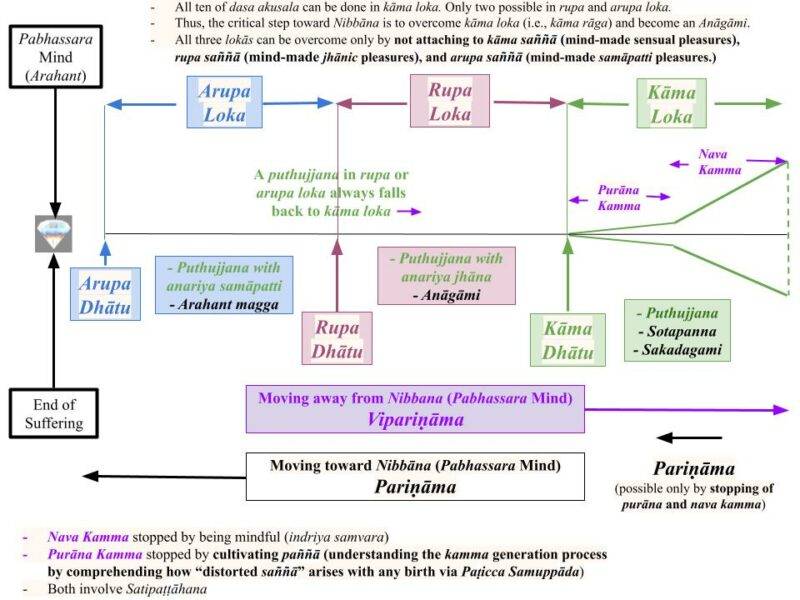
This figure from “Vipariṇāma – Two Meanings.”
- As you can see, the “pabhassara citta” does not fall into any of the three “dhatu” or “loka.”
- It is experienced only at the Arahant-phala moment or later in “Arahant-phala samapatti.”
_______
2. step 2: ajjhatta vinnana “sanna ->sankappa”
- This description is correct.
- The bahidda vinnana has “distorted sanna” but no defilements (raga, dosa, moha.)
- We mainly restrict our general discussions to kama dhatu, especially in the following.
- Bahidda vinnana becomes an ajjhatta vinnana in a split second for anyone with the five lower samyojana. Thus, an Arahant or Anagami would not enter the “ajjhatta vinnana” stage.
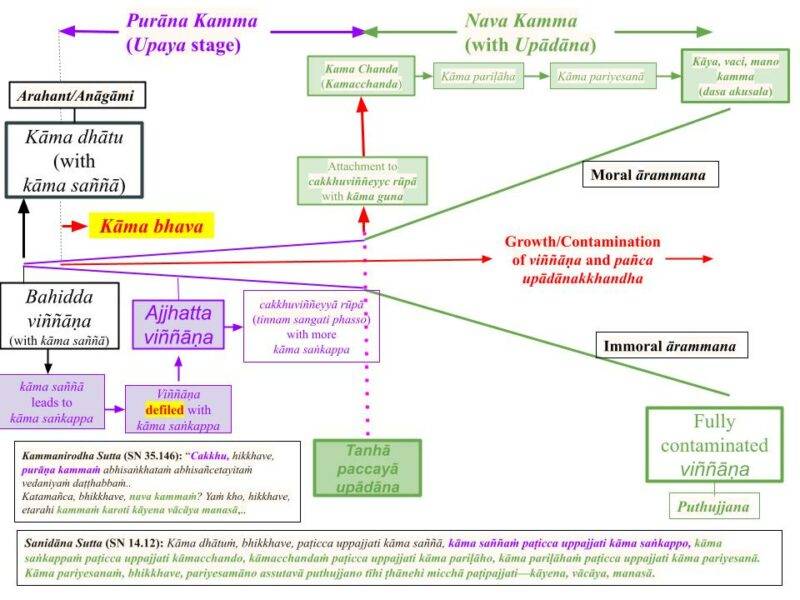
The above chart is from “Purāna and Nava Kamma – Sequence of Kamma Generation.”
Once get into the “ajjhatta vinnana” stage, a mind can further contaminate rapidly via several stages, as shown in the above chart.
- Those steps are listed in #10 of the above post. They are essentially the same as Dosakkhayo listed in steps 1 through 5.
- That “expansion” is indicated in the chart.
- Up to the “tanha paccaya upadana” step, the expansion is slow, i.e., kamma accumulation is slow. But at the “tanha paccaya upadana” step, one starts accumulating kamma consciously (with vaci and kaya abhisankhara.) That is why it is called the “nava (new) kamma” stage. Kammic energies to bring vipaka in future lives are generated here.
- As shown in the chart, kamma accumulation accelerates with kamacchanda, kama parilaha, etc., ending with dasa akusala.
- See “Taṇhā Paccayā Upādāna – Critical Step in Paṭicca Samuppāda” for details.
1 user thanked author for this post.
July 9, 2024 at 8:11 pm in reply to: Post on “Saññā Gives Rise to Most of the Vedanā We Experience” #50809KeymasterI thought of providing a bit more information to make things clear.
The question was: “Furthermore, can bahiddha rupa, vedana, sanna, sankhara, and vinnana be referred to as pancakkhandha, and, in the same way, can ajjhatta rupa, vedana, sanna, sankhara, and vinnana be referred to as pancupadanakkhanda?”
- The “pure pancakkhandha” would have no defilements (raga, dosa, moha) and also no “distortions.” That is the same as the “pabhassara citta” we discussed.
- That arises for the first time when one attains the Arahant phala.
- After attaining the Arahant phala, the mind returns to the “kama dhatu” stage with uppatti bhavanga that one was born with.
- Some Arahants can get back to the “Arahant phala citta” or “pabhassara citta,” at later times, which is called “Arahant phala samapatti.”
Unless an Arahant is in a jhana or Arahant phala samapatti, their mind is in the uppatti bhavanga they were born with.
- Then, upon getting a sensory input, their minds also receive the “kama sanna” associated with any human uppatti bhavanga. That is the “bahidda vinnana” state (with the corresponding “distorted sanna” and the rupa, which is also “distorted” per that sanna.) That is why it is not the same as “pure pancakkhandha.”
- However, Arahant‘s mind will not get to the next stage of “ajjhatta vinnana” because it will not attach to the “distorted sanna” or specifically “distorted kama sanna” in this case.
- For a puthujjana, the “ajjhatta vinnana” is only the starting point of mind contamination. It can get further defiled within a fraction of a second, depending on the “kama gati” present at that time. It can go through several stages of contamination before it becomes “vinnana upadanakkhandha” (which is simply referred to as “vinnana” in most suttas.)
That contamination process is discussed in the following posts:
- Each Citta Starts with Distorted Saññā (with chart B2)
- Contamination of the Human Mind Based on a Sensory Input (with chart B3)
- Contamination of a Human Mind – Detailed Analysis (with chart B3)
Those posts are in the section: “Recovering the Suffering-Free Pure Mind“
1 user thanked author for this post.
-
AuthorPosts


