
Forum Replies Created
-
AuthorPosts
-
Lal
KeymasterIt is good to try to analyze/investigate like what you did. That is part of insight meditation.
- However, in this particular case, there is an aspect that we need to learn, which cannot be sorted out by using mundane ideas like elementary particles in science.
- Neva + saññā + nā + saññā means “they have saññā for a time period, but may not have saññā for a while.” As we know, saññā is a “universal cetsika” that arises with any citta. Thus, it means those Devas do not have cittas arising for brief periods (like in “full Nibbana” or like in an Arahant in “nirodha samapatti.”)
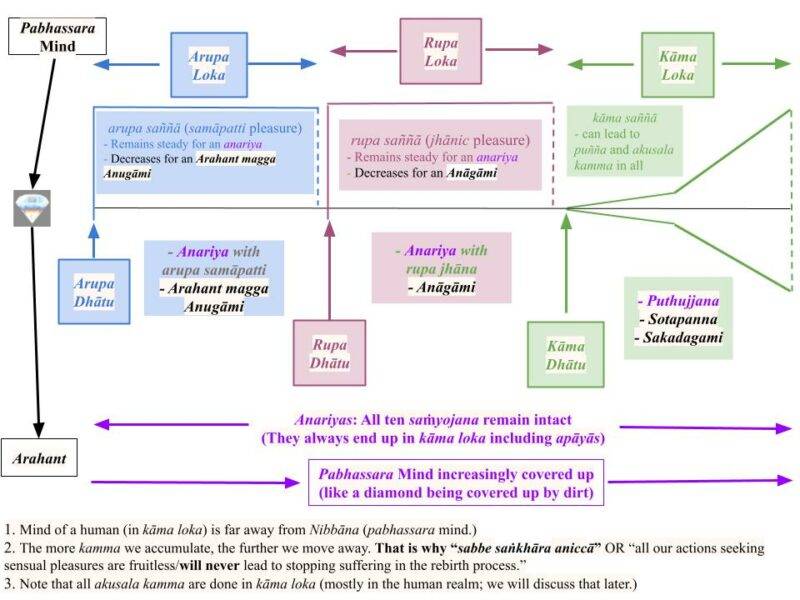
- As a lifestream proceeds up to the rupa loka and then to the arupa loka, one gets closer and closer to Nibbana (the “pabhassara citta.”) However, all anariyas, no matter how far upward they proceed, “fall back” to kama loka. That is because they have not broken any anusaya or samyojana.
- On the other hand, an Ariya proceeding up the jhana/samapatti ladder goes upward while breaking various anusaya and samyojana on the way. Thus, when they get to the Nevasaññānāsaññāyatana stage, they can get to “nirodha samapatti.” That can be done only by an ubhatovimutta Arahant.
2 users thanked author for this post.
KeymasterTitikkhati does mean something like “patience” or “endure a hardship.”
If a weak person harasses a strong person, the strong person can stop the weak person by using his power.
- However, in some cases, a strong person may endure that harassment to avoid a possible bad outcome for both.
- Yet no one can challenge a strong person, guarded by the teaching.”
KeymasterYou are welcome! I understand that some of these concepts (terminology) may not be easy for the Western audience to grasp.
- Six Deva realms mean there are six categories of Devas, ranging from “Cātummahārājika Devas” to “Paranimmita vasavattī devas.” See “31 Realms of Existence.”
- Sixteen rupa loka Brahmas means 16 categories ranging from “Brahma Parisajja devas” to “Akanittakha devas.” In many suttas, Brahmas are called a type of Deva. Births in these realms correspond to various levels of jhana cultivated. See #7 of “Jhāna – Finer Details.”
- The four arupa loka Brahmas means four categories ranging from “Ākāsānancāyatana devas” to “Nevasaññānāsaññāyatana devas.” Births in these four realms correspond to four levels of arupavacara samapatti cultivated. See “31 Realms of Existence.”
1 user thanked author for this post.
Keymaster1. Humans can see only those beings in the human and animal realms.
2. Devas (in the six Deva realms) and Brahmas (those in the 16 “rupa loka” realms) can visit the “human world” and see the humans. During the time of the Buddha, many Devas and Brahmas visited to listen to the Buddha. But there is no incentive for them to visit, but it is possible.
- We cannot see them even if they visit because they have delicate, subtle bodies. They can make themselves seen by humans.
1 user thanked author for this post.
Keymaster1. “Bhava” means the duration of an existence. A Deva and a Brahma are born once during a “Deva bhava” and a “Brahma bhava,” respectively. However, within a “human bhava,” a human can be born many times with a “physical human body,” and the same applies to an animal.
- A human gandhabba is born at the beginning of a human bhava and lives until the end of that bhava. That human gandhabba is born with a physical human body many times during that bhava.
- In contrast, a Deva is born only once during a “Deva bhava.” The same applies to a Brahma.
2. The hells (nirayas) may not be at the center of the Earth but well below the Earth’s surface.
3. It depends on what you mean by a “world.” There is a human world, an animal world, etc. There are six Deva realms, and their aggregate could be called “Deva world.” But all 31 realms combined could also be called the “world.”
4. and 5. These questions imply that you need a better understanding of what bhava means. I explained it in #1 above. Also see “Bhava and Jāti – States of Existence and Births Therein.”
2 users thanked author for this post.
KeymasterThank you, Gad!
1 user thanked author for this post.
KeymasterThe length of the human bhava (as well as for any animal bhava) is not fixed (unlike for the Deva and Brahma realms). See “31 Realms of Existence.”
- The “Mahāpadāna Sutta (DN 14)” states that during Buddha Vipassī’s time, the human lifespan was 80,000 years, i.e., a human living for 80,000 years on average. Thus, a human bhava can last even more.
- That sutta shows how the human lifespan can vary from 80,000 to around 100 years (during Buddha Gotama’s Sasana). I have read elsewhere (don’t remember the reference) that it can decrease to as low as 10 years.
1 user thanked author for this post.
KeymasterThe following post explains how one creates one’s future lives:
“Origin of Life – One Creates One’s Own Future Lives“
- That post is the last one in a series on the “Origin of Life.” The series discusses many “theories of life” and compares them with those of the Buddha.
2 users thanked author for this post.
Keymaster“No first starting point could be found. We program ourselves.”
- Yes. I am glad you understood that critical point!
KeymasterYes, you are correct. Contrary to what I wrote above, it was customary to build statues in East Asia well before the Buddha, as is obvious from the many old statues of deities in India. However, it became a “Buddhist custom” well after the Buddha’s Parinibbana.
Thank you for the reference. The following is the link:
- However, as I mentioned above, it is not a “Jataka story.” It happened during Buddha Gotama’s life.
- There is a sutta in Samyutta Nikaya providing the same account. If someone has that reference, please post it.
2 users thanked author for this post.
KeymasterI removed the first link for the paper since it does not work.
- Anyway, the idea that we live in a simulation is not consistent with Buddha Dhamma.
- By definition, there must by an agent “launching the simulation.” Who is that? Who created that agent?
- This is the same idea as that of a “Creator.”
3 users thanked author for this post.
KeymasterNo. I don’t think that is true. There was no such custom at that time to ban it.
- But he clearly advised using the Bodhi tree and stupas with dhatus embedded in them.
2 users thanked author for this post.
Keymaster1. There were no Buddha statues for many years after the Parinibbana of the Buddha. Soon after Buddha’s Parinibbana, stupas with Buddha’s remains (dhatu) were built.
- Statues of the Buddha were built hundreds of years after the Parinibbana of the Buddha. There were Buddhist Greek Kings in India after Alexander, for example, King Milinda. That is when the tradition of building Buddha statues started (Greeks are famous for making statues of their deities).
2. I asked Grok (Musk’s AI) about that, and the following is the answer:
“King Menander, also known as Milinda in Indian sources, was a Greco-Bactrian and later Indo-Greek King who ruled a large territory in the Northwestern regions of the Indian Subcontinent. While there are no direct historical records stating that King Menander started the practice of making Buddha statues, there is evidence that Greco-Buddhism flourished during his reign. Greco-Buddhist art, which began to appear around the 1st century BCE, combined Hellenistic artistic styles with Buddhist themes, resulting in statues of the Buddha that incorporated Greek artistic elements, such as realistic human forms and drapery.The earliest surviving Buddha statues discovered at the site of Jamal Garhi in ancient Gandhara date to the 1st or 2nd century CE, which is after the reign of King Menander. However, it is plausible that the Greco-Buddhist artistic tradition that led to the creation of these statues might have been influenced by the patronage of Buddhism by Indo-Greek kings like Menander. King Menander is noted for having become a patron and convert to Greco-Buddhism, and his reign is remembered for its connection to the spread of Buddhism in the region.”3. In the following video, a child describes her life as a Deva during the time of the Buddha (in Sinhala.) She says the Buddha was different than depicted in the current Buddha statues (@21 minutes).- As a Deva, she was able to “go inside” stupas and see dhatu (remains of the Buddha) enclosed in golden containers.
- She also says the Buddha statues we have today do not match the Buddha’s features. That makes sense. Statues of the Buddha were built hundreds of years after the Buddha’s Parinibbana.
4. Furthermore, worshipping symbols REPRESENTING the Buddha were there at the time of the Buddha. There is the following account in the Tipitaka (I forget the name of the sutta):
- People brought many things to offer to the Buddha at Jetavanarama. If the Buddha was not there, they went back disappointed. When Ven. Ananda mentioned this to the Buddha; the Buddha asked for a Bodhi tree to be planted there and instructed people to make offerings to that Bodhi tree. It was called “Ananda Bodhi. ” It was just a symbol representing the Buddha. One’s feelings are based on one’s reverence for the Buddha, not for the symbol.
5. Looking at a Buddha statue gives me peace of mind. If it is conducive to meditation, one could use it for that purpose.
4 users thanked author for this post.
April 27, 2024 at 12:15 pm in reply to: Regarding the website, is there something wrong with the HTTPS certificate? #49533KeymasterThanks for letting us know.
The website has the HTTPS certification, as seen from the web address.
- Has anyone else seen the same issue?
April 26, 2024 at 7:36 am in reply to: Discussion on “Cultivating Jhāna and Magga Phala – What Is the Difference?” #49516Keymaster“Is there any easiest way to attain jhanas?”
- It depends. Some people can get to jhanas easily. They had cultivated jhana in recent past lives. Still, one must get the mind to a calm state where sensual thoughts (kama sankappa) or immoral thoughts (akusala citta) do not arise. Anariya yogis do that by focusing the mind on a neutral object like the breath or a kasina object. Bhikkhus do that by avoiding akusala kamma/thoughts and contemplating the unfruitfulness/dangers of craving sensual pleasures.
- The same techniques must be used over a long time to attain jhana for those who do not easily get to jhana.
- The best approach is to engage in Vipassana (insight) mediation. One may or may not “cultivate jhana” (i.e., have the ability to get into a jhana at will) but one will make progress toward attaining a magga phala. Generating “jhana cittas” on and off (which likely happens to many people) is different from being able to get into a jhana at will (which requires spending time specifically to “practice the jhana“). I will have more information in the post to be posted later today.
“Should we just focus on the peace of mind while in the meditation and jhanas will appear?”
- Yes. Once the mind gets detached from the “kama loka,” it will automatically go to the higher “rupa loka” at least temporarily. But generating jhana cittas continuously (i.e., being able to get into “jhana samapatti“) requires practice.
- Anariya yogis‘ minds only temporarily detach from kama loka even if they can stay in jhana samapatti for long times. Thus, they can “lose the ability to get into jhana” if they go back to the “old ways” of engaging in akusala kamma/excessive sensual pleasures.
P.S. New post on jhana: “Jhāna – Finer Details“
2 users thanked author for this post.
-
AuthorPosts


