
Forum Replies Created
-
AuthorPosts
-
Lal
KeymasterEven though ditthi and sanna vipallasa are critical concepts, only one sutta discusses the types of vipallasa: “Vipallāsa Sutta (AN 4.49).”
- There are some descriptions in the Tipitaka Commentaries.
- I feel that some of the related suttas have been lost. The Tipitaka survived only because some civil servants of the British government in Sri Lanka and other Asian countries collected and preserved whatever copies they could find. See “Preservation of the Dhamma.”
- However, we can compile a coherent description using related material from other suttas. I will try to do that in the revised version of the post “Vipallāsa (Diṭṭhi, Saññā, Citta) Affect Saṅkhāra.”
1 user thanked author for this post.
KeymasterYes. NDE experiences are interpreted in a very different way probably due to the following.
Even though we highly value our dense physical bodies, bearing them is stressful in addition to giving rise to body aches, injuries, etc. Even breathing takes an effort even though we are used to it.
- When the mental body (gandhabba) separates from the physical body, it is said to provide great relief. Furthermore, one can move without effort, even traveling far just by thinking!
- That leads many “NDE experiencers” to believe that they had gone to the “afterlife” for a brief time. Since most people believe in going to heaven after death, they believe they experienced a bit of “heavenly existence.”
- Of course, we know that gandhabba is human, just without a physical body.
KeymasterYou are right. I just did a search and could not find it.
- I wrote that post long ago based on a discourse by Waharaka Thero.
- The verse does make sense. “uppāda vayaṭṭhena aniccā” means “anicca lakkhana is embedded in udaya (arising due to causes and conditions) and vaya (can be stopped from arising by removing causes and conditions) of a sankhata.”
- Here, “vayaṭṭhena” is “vaya aṭṭhena” where “aṭṭhena” means “the reason” or ‘because of”.
- Thus, “uppāda vayaṭṭhena” means “because whatever is arising in this world can be stopped from arising.”
- It is possible that the verse is in another Commentary on the Tipitaka. Also, that post needs re-writing. One more thing added to the “To-Do” list.
1 user thanked author for this post.
KeymasterYes. The sutta analyzes various other cases that lead to different types of ditthi.
- What you quoted above “By dint of keen, resolute, committed, and diligent effort, and right application of mind, they experience an immersion of the heart of such a kind that they recollect that past life, but no further. “
That whole section needs to be explained in detail.
- This is about a yogi who had been born a Brahma in the previous life, and believed Maha Brahma created him in that previous life.
- After dying from that realm, he is reborn a human and cultivates pubbe nivāsānussati ñāna. To quote: “Agārasmā anagāriyaṁ pabbajito samāno ātappamanvāya padhānamanvāya anuyogamanvāya appamādamanvāya sammāmanasikāramanvāya tathārūpaṁ cetosamādhiṁ phusati, yathāsamāhite citte taṁ pubbenivāsaṁ anussarati, tato paraṁ nānussarati.” OR “By dint of keen, resolute, committed, and diligent effort, and right application of mind, they experience an immersion of the heart of such a kind that they recollect that past life, but no further.” See “Brahmajala Sutta (DN 1).”
- Then he can recollect only that previous birth as a Brahma and comes to a wrong view of Partial Eternalism. That particular yogi can only see that single Brahma birth as a previous birth.
- In the section I referred to in my previous comment, the sutta describes three sets of yogis who could look back at their past HUMAN LIVES for three different time ranges. Please read the sutta carefully.
Anyway, this is a complex sutta and requires a detailed analysis. This is my last comment on this issue. I don’t have the time necessary to analyze the sutta in detail. The sutta provides a thorough analysis of how the two main wrong views of sassata ditthi and uccheda ditthi branch out into 62 wrong views.
- The bottom line (as I understand) is that without the cutupapāda ñāna, a given yogi cannot look at ALL his previous lives. Only Ariya yogis can have the cutupapāda ñāna.
KeymasterOn June 17, 2024 at 1:28 pm (comment #5304) I wrote the following:
Cubibobi’s comment: “Through meditation, we can all access the knowledge of our past lives, which in Pali we call paṭiccasamuppāda ñāṇa.”
Isn’t this knowledge called pubbe nivāsānussati ñāna in Pali?”
- Yes. It is.
- There are two types of related ñāṇa: (i) pubbe nivāsānussati ñāna and (ii) cutupapāda (cuti and uppatti) ñāna.
- With the first, one can see one’s past lives in the human realm. With the second, one can see all past lives, including those in the apayas.
- Anariya yogis cannot cultivate (ii). That makes their wrong view of sassata ditthi (a “permanent self” moving from life to life) stronger. However, it becomes easier for Ariyas who cultivate (ii) to see the dangers of the rebirth process.
________
Jittananto’s excerpt from the Brahmajala Sutta appears @ marker 1.32.1: “Brahmajala Sutta (DN 1).”
- Just before that, the sutta starts explaining how sassata ditthi (eternal view, i.e., that of a “soul-type entity” living forever) in yogis‘ who have cultivated pubbe nivāsānussati ñāna.
- That section starts @ marker 1.30.1: “Brahmajala Sutta (DN 1).”
- With pubbe nivāsānussati ñāna, those yogis can ONLY SEE their past lives as humans. So, they erroneously assume that they had been reborn human in ALL their previous lives (through innumerable maha kappas or eons!).
- Had they been able to cultivate the cutupapāda ñāna, they would not have grasped that wrong view.
KeymasterYes. That post needs revision. I will get it to it ASAP. Thank you!
1 user thanked author for this post.
KeymasterThe following essay is from Dosakkhayo:
I’ve been contemplating the connection between the Abhidhamma and Paticca Samuppada.I wonder if the relationship between “sankhara paccaya vinnana” and “vinnana paccaya namarupa” might be describing the javana citta from different perspectives.“Sankhara paccaya vinnana” seems to explain the cumulative effect of the javana citta, while “vinnana paccaya namarupa” describes the formation of the results of the javana citta.So, “vinnana paccaya namarupa” deals with Tadarammana citta.If a person becomes more attached to a given arammana, they will generate more citta vithi, feeding namarupa.I have illustrated this in a diagram with draw.io.Figure 1: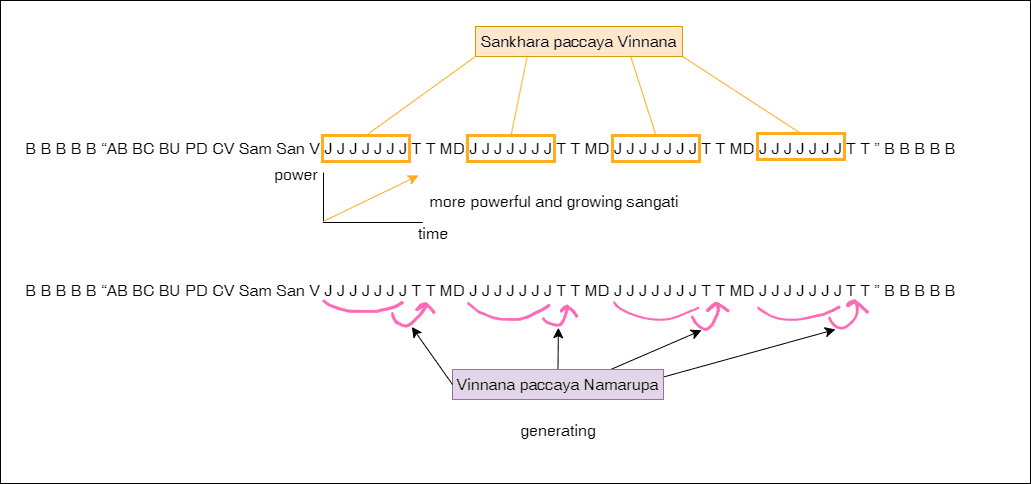 Figure 2:
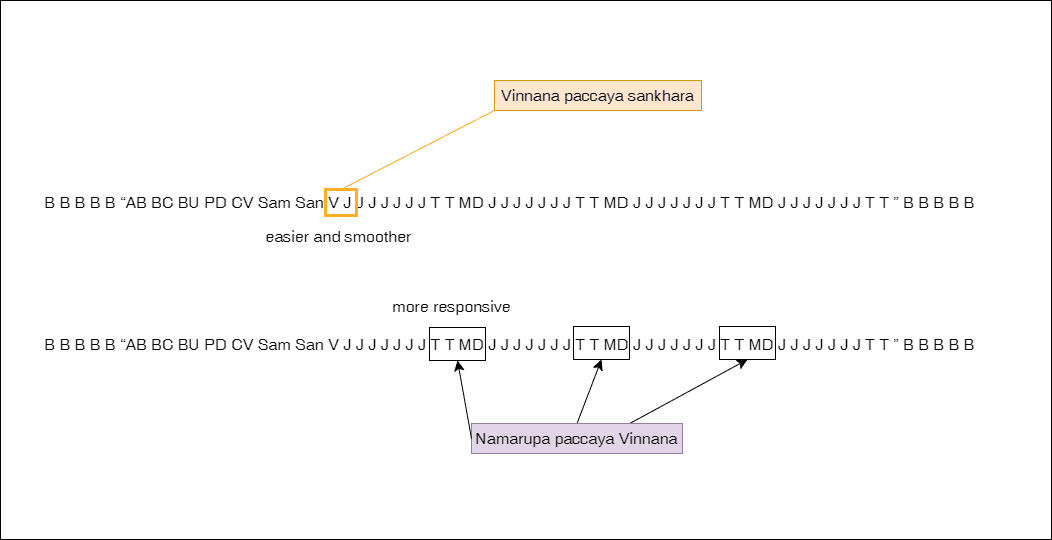 In Figure 1, the weakening of the sixth javana citta is not reflected.This is because it is a rule specific to the javana citta itself, not in the context of “sankhara paccaya vinnana.”The “sankhara paccaya vinnana” illustrates that more abhisankhara leads to the growth of a stronger kamma vinnana.Therefore, both “sankhara paccaya vinnana” and “vinnana paccaya namarupa” deal with the javana citta in different contexts.It’s similar to the relationship between hours and minutes: both describe time, but each deals with different units.If there are any mistakes, I would appreciate it if you could point them out. Thank you.Keymaster
I hope Pathfider’s earlier questions were resolved with the following comment by Taryal:
“Billions of cittas (and associated cetasikas) collectively form the mind that can think, feel and perceive. The process of Paticca Samuppada includes intentional thoughts.“
- Thank you, Taryal. That summarizes it well. P.S. In fact, cultivating Satipatthana/Anapanasati is all about intentional thoughts, speech, and actions.
- If there are remaining questions, feel free to ask.
______________
Jittananto’s question: “So what can we say about the divine eye?”
- The divine eye (Dibba cakkhu) is the ability of Devas to see long distances, including other realms (in real-time). Some yogis can cultivate that ability, too.
- That is a much lesser ability than cutupapāda ñāna, which is being able to see one’s own past lives (including those in other realms).
KeymasterIn the ultimate sense, a “lifestream” (my term) goes through all that suffering (with brief existences with “mind-made pleasures” such as sensual pleasures while in human/Deva realms and jhanic/samapatti pleasures while in Brahma realms). It does not make sense to say “WHO” went through it, because it was a different entity at each stage. See “What Reincarnates? – Concept of a Lifestream”
- That is why I wrote the following in my above comment: Any existence is GENERATED via the Paticca Samuppada process. No “fixed entity” goes through the rebirth process (samsara.)
1 user thanked author for this post.
KeymasterCubibobi asked: “Phassa actually happens at the pasada rupa –> hadaya vatthu, correct?”
- Yes.
- Good explanation. “Phassa ” takes place at the initial sensory contact. “Samphassa” happens in response to that sensory contact (if the mind attaches to that sensory input.)
1 user thanked author for this post.
KeymasterTaryal: “From an arahan’ts pov, “who” experiences samsara and “who” attains Nibbana? I do have a general understanding of this but something feels unclear to me.”
- In a mundane sense, we can say that the human who attained the Arahanthood attained “Nibbana.”
- We can also say that “who” experiences samsara at a given moment is whatever the lifeform is at that moment. It could be an animal, a human, a Deva, etc.
Any existence is GENERATED via the Paticca Samuppada process. No “fixed entity” goes through the rebirth process (samsara.)
Cubibobi: “Somewhere on the site is the story of a little girl who remembered her past bhava of a deva. Would that be an example of cutupapāda ñāna?”
- No. She did not have cutupapāda ñāna. That is an unusual case of a “rebirth account” by a child. Typically, children remember their last birth with a human body (with the same gandhabba, i.e., within the same human existence.) But in this case, she remembered possibly the last existence as a Deva, i.e., this was her first birth with a physical human body after she died as a Deva.
- Lang (Cubibobi) refers to the video discussed in the following comment: “Reply To: Lord Buddha statue.”
KeymasterNo. That was not done with cutupapāda ñāna. That person did not have cutupapāda ñāna. He could not recall HIS past lives.
- He learned some “mystic technique” to touch a dead person’s skull and tell where that person has been reborn. The Buddha agreed that his readings were correct.
KeymasterYes. It is unlikely that an anariya has the cutupapāda ñāna.
KeymasterThe issue about a “self” can be cleared up if the following is understood:
There are two phases to go through:
(i) At the Sotapanna stage, based on understanding the worldview of the Buddha, one realizes that there is no “permanent self” like a soul in Abrahamic religions or an “atma” in Hinduism. That is the same as removing wrong views. That is also connected to getting rid of sakkaya ditthi.
(ii) Even after getting rid of the wrong view, there is still a “wrong sanna (perception)” of a “me” or “I” left. That is also called “asmi māna” or simply “māna.” That goes away only at the Arahant stage. Everyone, even those who don’t believe in a soul (like materialistic scientists), has “asmi māna.” Furthermore, even an Anagami has asmi māna.
_______
Cubibobi’s comment: “Through meditation, we can all access the knowledge of our past lives, which in Pali we call paṭiccasamuppāda ñāṇa.”
Isn’t this knowledge called pubbe nivāsānussati ñāna in Pali?”
- Yes. It is.
- There are two types of related ñāṇa: (i) pubbe nivāsānussati ñāna and (ii) cutupapāda (cuti and uppatti) ñāna.
- With the first, one can see one’s past lives in the human realm. With the second, one can see all past lives, including those in the apayas.
- Anariya yogis cannot cultivate (ii). That makes their wrong view of sassata ditthi (a “permanent self” moving from life to life) stronger. However, it becomes easier for Ariyas who cultivate (ii) to see the dangers of the rebirth process.
KeymasterYes. Your summary is good.
You wrote: “I cautiously speculate that phassa arising from indriya might not be discussed at all in Paticca Samuppada.”
- That is correct. Phassa and samphassa are entirely different.
- Phassa is a cetasika that arises in ALL cittas. In contrast, samphassa means “defiled sensory contact,” which appears in Paticca Samuppada.
- Possible confusion arises due to the uddesa (brief) version of Paticca Samuppada: “salayatana paccaya phassa.” That really means “salayatana paccaya samphassa.”
- See “Difference between Phassa and Samphassa.”
You wrote: “The statement “the sun is not a planet” is astronomically true. And “the sun is anicca” is a Dhammically true statement. Both are true and they’re talking about the sun, but astronomy is not Buddha Dhamma. The same logic applies here. (Of course, Abhidhamma IS Buddha Dhamma.) That’s the reason even if one is good at Abhidhamma, they may not have gotten any magga phala.”
- That is quite true. Some people know how to recite Abhidhamma, but have not fully comprehended the ideas. My goal is to try to explain Abhidhamma concepts in simple language.
-
AuthorPosts


