
Forum Replies Created
-
AuthorPosts
-
Lal
KeymasterOf course. There have been many incompatibilities (and some remain) between Buddha Dhamma and science.
- However, Buddha Dhamma has been proven correct with time: “Dhamma and Science – Introduction.“
- As science makes progress, more incompatibilities will be removed.
- One critical remaining incompatibility is scientists’ wrong view that thoughts arise in the brain. But that is gradually changing. See, for example, “Dr. Brian Weiss on the Patient Who Made Him Believe in Past Lives” and “NDE, Jesus and Hell” (especially the YouTube video there.)
2 users thanked author for this post.
July 1, 2024 at 6:40 am in reply to: Useful Essays from DRARISWORLD and Other Websites – Part 2 #50602KeymasterI missed the following question from Jittananto yesterday:
“In the suttas, we see Lord Buddha and other venerable arahants talking about their abilities in various fields. Why would this not be considered pride in this case?”
- The Buddha (and Arahants) always tried to inspire others by pointing out the possibilities (what could be achieved if one puts in the effort).
- That is not pride; it was done with compassion.
2 users thanked author for this post.
KeymasterBuddha Dhamma is based on a very different paradigm and cannot be assessed using “mundane theories.”
- That MUST be kept in mind all the time.
- If one tries to explain concepts in Buddha Dhamma using scientific or philosophical theories, one will NEVER be able to comprehend Buddha Dhamma.
- However, that does not mean one cannot use “common sense.”
1 user thanked author for this post.
July 1, 2024 at 6:21 am in reply to: Conversation between a sensually bothered Sotapanna and an Anagami #50599KeymasterYes. Good essay!
- Also, see the comment I just posted in the thread “Jhāna Cultivation.”
2 users thanked author for this post.
Keymaster1. To attain jhāna, one must transcend the kāma loka.
- We are trapped in kāma loka because we crave “close contact” (taste, smell, and body touch). However, we also use the other two sense faculties to fulfill such desires. For example, watching adult movies or talking about tasty food is done with kāma rāga.
- To attain a jhāna, one must overcome such desires.
2. That can be done in two ways:
(i) One must see (with wisdom) that the consequence of having such desires is to be trapped in kāma loka. Also, based on such temptations, we may do immoral deeds and be reborn in an apāya.
(ii) Kama rāga arises based on kāma saññā. To eliminate kāma rāga, one must overcome kāma saññā. If kāma saññā is inherent, we cannot overcome it. But kāma saññā is “mind-made” and can be overcome. See “Saṅgīti Sutta (DN 33.)“: “Paṭhamaṁ jhānaṁ samāpannassa kāmasaññā niruddhā hoti.” OR “For someone who has attained the first absorption, sensual perceptions have ceased.”
- That is why I call it a “distorted saññā.”
2 users thanked author for this post.
KeymasterTaryal asked: “Why didn’t they make it easier to understand though?”
- To explain things in one’s own words, one must understand the underlying concepts well.
- Instead, most current translators resort to translating Pali words to English (probably using dictionaries written by “scholars” who did not understand Buddha Dhamma.)
The Commentaries in the Tipitaka are helpful if one has such a good understanding.
- There are English translations of the Tipitaka Commentaries. However, they are still not useful because the translator does not know the true meaning of a Pali word, per the context.
- For example, in some instances, “phassa” does not mean simple “contact” but “samphassa,” which means “defiled contact.” Yet, the translator does not know that. See, for example, “6. Analysis of Dependent Origination,” an English translation of the Commentary on Paticca Samuppada in Vibhanga Pakarana, a Tipitaka Commentary.
KeymasterSuch verses are probably from several suttas delivered to bhikkhus, especially when cultivating Satipatthana after the Sotapanna stage.
See, for example, “Mahāsatipaṭṭhāna Sutta (DN 22)“:
“Idha, bhikkhave, bhikkhu araññagato vā rukkhamūlagato vā suññāgāragato vā nisīdati pallaṅkaṁ ābhujitvā ujuṁ kāyaṁ paṇidhāya parimukhaṁ satiṁ upaṭṭhapetvā.”
- The translation in the link is not very good. But it conveys the point you pointed out.
It is not necessary to go to the wilderness to meditate. However, if someone has the time (like bhikkhus do), that is better since there are fewer distractions.
1 user thanked author for this post.
KeymasterAll discourses mentioned above are from those who learned from Waharaka Thero.
- However, there can be some differences in understanding.
2 users thanked author for this post.
KeymasterWhat Lang pointed out is correct. Let me explain a bit more.
1. “nāmarūpa paccayā salāyatana” is a step in Paṭicca Samuppāda. That holds whenever “nāmarūpa” arises via the sequence: ““avijjā paccayā saṅkhāra; saṅkhāra paccayā viññāna; viññāna paccayā nāmarūpa.”
2. The verse, “Katamā cāvuso, jāti? Yā tesaṃ tesaṃ sattānaṃ tamhi tamhi sattanikāye jāti sañjāti okkanti abhinibbatti khandhānaṃ pātubhāvo āyatanānaṃ paṭilābho, ayaṃ vuccatāvuso: ‘jāti’.” is a general term to describe how a partcular “jāti” arises.
- As I mentioned in my first comment above, this verse is analyzed in “Jāti – Different Types of Births” starting at #4. Let me summarize by quoting from that post.
“5. For opapatika (instantaneous) births in the Deva and Brahma realms, jāti is the ONLY stage involved. A Brahma or a Deva is born instantaneously, complete with “all parts of the body.”
- It needs a bit of correction. Not only jāti but also sañjāti is involved in creating a Deva or a Brahma in an opapatika birth.
- The same two steps are also involved in the birth of a human (or animal) gandhabba at the cuti-patisandhi moment. That is an opapatika birth, too.
- Thus, all life forms are generated in the first two steps (via opapatika births).
The rest of the steps, “okkanti abhinibbatti khandhānaṃ pātubhāvo āyatanānaṃ paṭilābho” are involved in the birth of a human (or animal) with a physical body. Let us consider the process needed for a human to be born with a physical body. That is another type of jāti.
- The gandhabba must enter a matching womb (okkanti). That can take days, months, or years after the gandhabba was born at the cuti-patisandhi moment.
- The rest of the steps are in #6 of that post. I will quote them below.
(iii) When pulled into a womb, the gandhabba merges with a zygote, which is the okkanti state.
(iv) Then, that embryo grows in the womb in the abhinibbatti stage.
(v) When all body parts are formed, that is the khandhānaṃ pātubhāvo stage, and a baby then comes out of the womb. That last stage is what we commonly call a “birth.”
(vi) The sensory faculties start working as āyatana after the baby is born. This is the last āyatanānaṃ paṭilābho stage.
Now, the second point that Lang made is that the baby’s sensory faculties (indriya) cannot become āyatana until its brain is fully developed.
- I discussed this point in detail in the following (more recent) post, “Distorted Saññā Arises in Every Adult but Not in a Newborn“
- I may need to make a few more revisions to the post “Jāti – Different Types of Births” to provide more clarity by referring to the newer post “Distorted Saññā Arises in Every Adult but Not in a Newborn.“
- Let me know if there are more questions before I do that.
1 user thanked author for this post.
KeymasterDosakkhayo has sent me the following figure to explain his question:
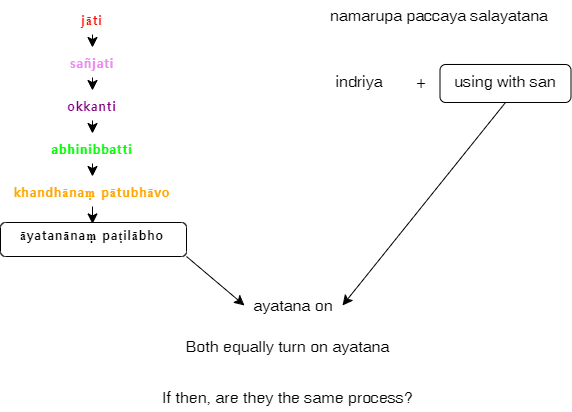
I understand the question now. It is a good question. I will explain it later today.
- If someone else can explain it, please do so. This is a good opportunity to test one’s understanding.
1 user thanked author for this post.
KeymasterIt is better if you can ask your question in a different way. I don’t understand the question.
KeymasterQ1. It does.
Q2. Idappaccayata Paticca Samuppada is the SAME as Paticca Samuppada.
- Uppatti Paticca Samuppada is a special case of Idappaccayata Paticca Samuppada.
#13. “angry bhava” arises in this life, with Idappaccayata Paticca Samuppada.
- “uppatti bhava” arises in Uppatti Paticca Samuppada. But that is still a unique application of the Idappaccayata Paticca Samuppada at the cuti-patisandhi moment.
KeymasterNo. They are different.
- The “nāmarūpa paccayā salāyatana” is one of the steps in Paṭicca Samuppāda.
- The verse, “jāti sañjāti okkanti abhinibbatti khandhānaṃ pātubhāvo āyatanānaṃ paṭilābho, ayaṃ vuccatāvuso: ‘jāti’” describes the birth of a human or animal with a physical body. See #4 of “Jāti – Different Types of Births.”
1 user thanked author for this post.
KeymasterHello Waisaka. Welcome to the forum!
Your English is good enough for me to understand. I revised some of your sentences to make them a bit more clear. I hope I did not change the meanings you wanted to express.
It seems that you were a meditator in your recent lives. That could be why calming your mind and entering Samadhi is easier.
_____
You wrote: “In the last few months, I have felt something unexplainable in my heart; I can’t explain it; it’s like upekkha but not upekkha. It’s like being unconditioned, like calm water with no ripples, no joy/sorrow…”
- That is very impressive. You are experiencing “niramisa sukha,” which is very different from “joyful experiences” due to mundane pleasures. See “Three Kinds of Happiness – What is Nirāmisa Sukha?“
- It is more like the relief you experience when a bad headache goes away. You feel a sense of calm.
________
You wrote: “So the essence of my question is, is the object of Nibbana accessed through the heart or mind?
Because I think Nibbana cannot be thought of, it can only be felt, is that true?”
- Yes. You are right. As you wrote, “Nibbana cannot be thought of, it can only be felt.”
- It is felt as a relief! It calms the mind.
______
I think you will be able to make significant progress.
- If you can learn English a bit more, reading the posts on this website will become easier. If you can spend part of your time reading simple English novels or even newspapers, that could help you learn English.
- While Google Translate is generally good, I don’t think it can correctly translate the Pali words written with English letters.
- To learn pronunciation, the following could be helpful:
KeymasterThat is correct. In one way of looking at the “big picture,” attachment to sensory inputs or arammana (with tanha and upadana) is the root cause of suffering.
- The amazing fact (that no one else has fully explained with Paticca Samuppada) is that our craving for “worldly pleasures” is based on a grand illusion; our perceptions (saññā) are inherently distorted. The Buddha called saññā a mirage in the “Pheṇapiṇḍūpama Sutta (SN 22.95),” and we discussed that in the post, “Sotapanna Stage and Distorted/Defiled Saññā.”
- Most sukha/dukkha (or, more precisely, somanassa/domanassa) vedana are “mind-made” based on “distorted saññā” built into our physical bodies (via Paticca Samuppada.)
The main points are as follows:
1. Everything in this world is made of “suddhāṭṭhaka” (sometimes written as suddhāshtaka).
- Suddhāṭṭhaka (“suddha” for “pure” or fundamental” + “aṭṭha” or “eight”) means a unit of matter consisting of eight fundamental entities: Four of these belong to the “bhūta” stage of pathavi, āpo, tejo, and vāyo arising due to avijjā. The other four of vaṇṇa, gandha, rasa, and oja arise due to taṇhā.
2. The latter four entities are the ones giving rise to the perception (saññā) or sense of “pleasure” in worldly things:
- Vaṇṇa, gandha, rasa, and oja, respectively, make some things give rise to attractive sights, smells, tastes, and “generative power.”
- The basic ideas are discussed in “The Origin of Matter – Suddhāṭṭhaka.“
3. The point mentioned in #2 gives rise to a “distorted saññā” of “tasty foods, beautiful sights, pleasing sounds, etc.
- Read again the post “Fooled by Distorted Saññā (Sañjānāti) – Origin of Attachment (Taṇhā),” and you may be able to get the idea.
- All matter (including our physical bodies) is based on suddhāṭṭhaka. That is how the “distorted saññā” is built into our physical bodies.
I will gradually discuss this profound point in detail in upcoming posts.
2 users thanked author for this post.
-
AuthorPosts


