

Forum Replies Created
-
AuthorPosts
-
August 2, 2024 at 9:44 am in reply to: Validity of current interpretation of Satipatthana Sutta #51150
Lal
KeymasterNo. Pancakkhandha (absent of distorted or defiled rupa, vedana, sanna, sankhara, vinnana) arise only in an Arahant while in “Arahant phala samaptti.” Only then do all those five entities arise in their “pure form.”
- While living day-to-day life, an Arahant also receives the “distorted kama sanna” (the sweetness of sugar, etc.) in the “distorted” bahiddha vinnana stage.
- For a puthujjana, that “distorted kama sanna” instantly turns into a “defiled” ajjhatta vinnana. That is because of the attachment to pancupadanakkhandha, which has been accumulated and still affects their minds.
- That is explicitly stated in the “Mahāpuṇṇama Sutta (MN 109)“: “Yo kho, bhikkhu, pañcasu upādānakkhandhesu chandarāgo taṁ tattha upādānan’ti” OR “The desire and greed for the five grasping aggregates is the grasping there.”
2 users thanked author for this post.
KeymasterJittananto wrote: “In this sermon, the Bhante explains that animals are capable of committing anantariya kamma. This is correct because in nature we see animals killing and devouring their parents.”
That is not correct. Animals cannot generate javana citta to create the necessary javana power to generate anantariya kammic energy. Abhidhamma explains this clearly, but let me try to explain it in simple terms.
The types of cittas that can be generated vary from realm to realm.
- We have discussed that even anariya Brahmas are inherently incapable of engaging in most akusala kamma since their kama raga anusaya remains hidden during that existence. They do not get the “distorted kama sanna” and thus are indifferent to mind-pleasing sights, tastes, etc. Of course, they do not have physical bodies to experience taste, smell, or body touches (including sex). They also cannot engage in kaya kamma (killing, stealing, etc) because they do not have “dense bodies.” “Brahma bodies” (subtle mental bodies) are generated to experience “distorted jhanic sanna” because they had cultivated anariya jhanas as humans, thinking that “distorted jhanic sanna” is of value.
- In the same way, animals are incapable of generating strong javana citta because their births (and bodies) are designed to experience suffering due to specific akusala kamma. They cannot engage in accumulating punna or papa kamma with strong kammic energies that can bring rebirth.
- In particular, they cannot engage in anantariya kamma to the “good side” (cultivating jhana/magga phala) or to the “bad side.”
- One way to understand this is to see that animals have no sense of “wrong views” (just like a newborn human baby.) Both cannot engage in the strongest types of akusala kamma, which are done with wrong views. See “Akusala Citta and Akusala Vipāka Citta.” This is an old post that needs to be expanded. I just revised it a bit for now.
- Primarily, humans are capable of engaging in strong kamma generation on both sides. Only a human can become a Buddha, and only humans who engage in the worst papa kamma (with tanhā, ditthi, māna) to be reborn in the worst apayas.
1 user thanked author for this post.
August 2, 2024 at 7:02 am in reply to: Post on “Chachakka Sutta – Six Types of Vipāka Viññāna” #51146KeymasterYes. Hojan is right. I just revised it as follows. Thank you both, and much merit!
2. About the first fourth of the “Chachakka Sutta (MN 148)” discusses the following steps: “Cakkhuñca paṭicca rūpe ca uppajjāti cakkhuviññāṇaṃ, tiṇṇaṃ saṅgati phasso, phassa paccayā vedanā, vedanā paccayā taṇhā.” (repeated for all six sense faculties.)
The sutta describes the automatic and instantaneous response to a new ārammana. In several posts, we discussed all those steps in detail. Very briefly, those steps are (just focusing on the cakkhu viññāna):
- With the coming together (contact) between cakkhu (or cakkhu pasāda rūpa) and a rūpa (which is a “snapshot” of that external rūpa created in the mind according to one’s samyojana/anusaya), cakkhu viññāna arises. Cakkhu is NOT the physical eyes, and rupa is not the “external rupa.” See “Purāna and Nava Kamma – Sequence of Kamma Generation” and other posts in the “Sotapanna Stage via Understanding Perception (Saññā)” section.
- If that rūpa triggers kāma guna, one may become interested in it (if one has the corresponding “san gati“). The next step only occurs if one has such matching gati for that rūpa or that ārammana. See “Kāma Guṇa – Origin of Attachment (Tanhā)” in the same section.
- If one has matching “san gati,” a corresponding “samphassa-jā-vēdanā” arises AUTOMATICALLY. See “Vipāka Vēdanā and “Samphassa jā Vēdanā” in a Sensory Event.“
- The next step, “vedanā paccayā taṇhā,” happens if that “samphassa-jā-vēdanā” is strong enough to take further action. We discussed that last step in “Kāma Guṇa – Origin of Attachment (Tanhā).”
2 users thanked author for this post.
KeymasterYou are right. I just revised it as follows:
(ii) Once the “distorted views” are eliminated, the next step is to eliminate the tendency to attach to the “distorted saññā” or “saññā vipallāsa.”
- Thank you!
2 users thanked author for this post.
KeymasterJittananto started the thread by asking: “The Bhante says that a deaf person cannot reach the sotāpanna stage. Do you agree?”
1. There are three types of humans: (i) tihetuka births, (ii) dvihetuka births, and (iii) ahetuka births.
- Those with a tihetuka birth (meaning the birth was due to a past kamma done with mundane alobha, adosa, amoha) can attain magga phala in this life.
- Those with a dvihetuka birth (meaning the birth was due to a past kamma done with mundane alobha and adosa) cannot attain magga phala in this life. However, they can accrue “good kamma” and may even get a tihetuka birth next time.
- Those with an ahetuka birth (meaning the birth was due to a past kamma done without akusala kamma but not with strong enough mundane alobha and adosa) are born with apparent mental and or physical deficiency. They cannot do either of the above. Note that ahetuka does not mean “without causes”; it just means not enough “potent good causes, even if no bad causes.)
2. It is not easy to determine whether a person is a tihetuka or a dvihetuka.
- However, it is fairly easy to identify an ahetuka. They are typically born with (i) a physical handicap (especially with one or more of the sensory faculties missing) or (ii) an apparent mental deficiency (very low IQ.)
- Even in case (i) above, there could be complications. For example, a baby may be born without the ability to see or hear. Still, the baby’s mental body may have cakkhu and sota pasada rupa intact, but one or both of those two senses may not work due to damage to the physical body parts (e.g., eyes, optical nerve, eardrum, etc.) while in the womb. In that case, it is still a tihetuka birth.
________
The next question is whether one can attain the Sotapanna stage by reading the correct Buddha Dhamma.
3. The four requirements for someone to attain the Sōtapanna stage of Nibbāna are Sappurisasaṃsevo, saddhammassavanaṃ, yonisomanasikāro, dhammānudhammappaṭipatti“. See #3 of “Four Conditions for Attaining Sotāpanna Magga/Phala.”
- As explained there, “To fulfill the first two requirements, it is necessary to associate with (Sappurisasaṃsevo) and learn from (saddhammassavanaṃ) a Noble Person (Ariya).”
- However, the translation of saddhammassavana (saddhamma savana) means “learn from that Noble Person by listening to his/her explanations.” Of course, in the days of the Buddha, that was the only way since written texts were not available.
- Thus, even though we cannot be definite about it, it is reasonable to assume that one could learn by reading texts, provided they are correct and written by an Ariya.
__________
Now, to the last question by Pathfinder: “However, if the last ariya dies while this site is still available, does it make sense that this site magically becomes unreadable? Yet we cannot comprehend the dhamma without a living ariya!”
- That question was addressed in the following thread: “How the Meanings Got Lost and How to Interpret.”
- See the comment by Taryal on July 28, 2024, at 1:05 am and my response to it.
6 users thanked author for this post.
KeymasterYes. I will discuss that in the next post.
KeymasterGood information. Thank you!
1 user thanked author for this post.
KeymasterGood information. Thank you!
KeymasterThey are related.
- All types of “bodies” (kaya) of living beings in various realms arise based on pancupadanakkhandha (PUK).
- Humans and animals have a dense physical body as well as a mental body. Devas have less dense physical bodies, and Brahmas have mostly the mental body.
- Kayagatasati Sutta points out that all types of “bodies” (kaya) have their origin in PUK.
- Satipatthana Sutta describes the way to stop the arising of any type of such bodies because none of them can provide a refuge from suffering in the rebirth process.
1 user thanked author for this post.
July 31, 2024 at 3:58 pm in reply to: Validity of current interpretation of Satipatthana Sutta #51111KeymasterSince I have the figure in my comment on July 30, 2024 at 10:07 am above, this is a good opportunity to point out a few things about that figure.
1. When a sensory input (arammana) comes in, the mind first experiences “bahiddha vinnana.” The term “bahiddha” means “bahira + iddha” where “bahira” means external and “iddha” means ” to get established.”
- A human mind (or vinnana) is first established in the “dhatu” or “initial stage,” where a “set of distorted kama sanna” is automatically experienced regardless of whether or not one has any magga phala.
- That is what gives the “sweetness of sugar,” “beauty/handsomness” of a woman/man, etc.
2. That “kama sanna” then triggers “kama sankappa” (mainly mano abhisankhara) based on one’s samyojana/anusaya.
- For example, since all ten samyojana are intact in a puthujjana, they generate the strongest “kama sankappa.“
- A Sotapanna has removed three samyojana, and hence the attachment will be less, etc..
- Since this “attachment” is based on one’s ditthi, tanha, and mana, it is called “ajjhatta” (“ajjha” for “oneself” and “atta” for “taking it to be fruitful.”
- Since an Arahant has no samyojana (or ditthi, tanha, and mana) left, that mind will not get to this stage, i.e., no pancupadanakkhandha (PUK) gets started.
3. The “ajjhatta vinnana” is the beginning of the accumulation of a PUK.
- In the next step, the mind makes its own version of the “external rupa” received. This is the “cakkhuvinneyya rupa” for visual input (as indicated in the figure.)
- In most suttas, by “rupa” it is meant the “cakkhuvinneyya rupa.” P.S. This is the rupa that is of “anicca nature,” not the “external rupa.” This “rupa” (it is related to the “namarupa” in PS) arises in the mind only because that mind has not fully grasped the “anicca nature” (of course, that happens at the Arahant stage).
4. In the next step, “kama guna” arises based on one’s gati at that moment.
- Thus, the same person may be attracted to a sensory event while drunk, for example, but may not while in a “good mindset.”
5. The mind gets to the “tanha paccaya upadana” stage only if the attachment is strong in the above step.
- This is really the time the PUK (pancupadanakkhandha) starts. This is the “upadana” stage where “new or nava kamma” are accumulated, as indicated at the top of the figure.
- Thus, the stage before that is called the “upaya stage.” No significant kamma is accumulated in this stage, as indicated by the narrow expansion of the “cone.”
- Strong kamma are accumulated in the “nava kamma stage” with kaya, vaci, and mano abhisankhara. That is indicated by the “widening cone” starting at the “tanha paccaya upadana” stage.
- Also, the “expansion” indicates “punna kamma” and the downward indicates “apunna kamma” or immoral kamma.
6. The “purana kamma” (or “upaya“) stage arises automatically according to one’s samyojana/anusaya. We don’t have direct control over that stage.
- However, in the “nava kamma” (or “upadana“) stage, kamma is accumulated consciously.
- The mind gets increasingly contained as it goes through the steps shown.
- In the “cleansing process” (or cultivating “sila” or “indriya samvara“), one needs to start at the rightmost stage.
7. I have provided more information in the comment above the one with the figure.
- As discussed there, the removal of samyojana/anusaya, (as well as one’s gati) happens by cultivating mindfulness/sila/indriya samvara AND understanding the details of this kamma accusation process, i.e., how a PUK arises with an arammana.
- Reading the links given will help you understand the process.
- Also see “Ārammaṇa (Sensory Input) Initiates Critical Processes.” (especially #11). However, one will eventually need to read posts in the time sequence given in “New / Revised Posts” from around 7/29/23.
8. That is a brief overview. Feel free to ask questions.
- You can ask questions on the above comments or any old post by referring to the specific post.
5 users thanked author for this post.
KeymasterYou are correct. The term “bhava diṭṭhi” appears in a few suttas. I should have looked it up.
- My way of learning is to understand concepts rather than looking up definitions. Your initial question can be resolved by examining what “bhava” means.
Your initial question was: “If a Sotāpanna eliminates ucchedadiṭṭhi, and thus vibhavataṇhā is removed at the Sotāpanna stage, why isn’t bhava taṇhā eliminated as well?”
- One with uccheda ditthi does not believe in rebirth. However, they have kama raga. Does not kama raga lead to “bhava” within this lifetime? Specifically, they are in “kama bhava” during this lifetime. One cannot be in a bhava without having tanha for it.
- In other words, “kama tanha” leads to “kama bhava.” In PS, “tanha paccaya upadana,” “upadana paccaya bhava.”
- P.S. In fact, a Sotapanna has not removed not only kama tanha, but also rupa tanha and arupa tanha. Kama tanha (and kama raga) is removed at the Anagami stage and rupa and arupa tanha (associated with rupa raga and arupa raga) removed only at the Arahant stage.
In the second comment you wrote: “What I wanted to ask is, if one becomes a Sotapanna by eliminating all ditthi (wrong views), why does bhava ditthi still remain?”
- As I mentioned in my first comment, a Sotapanna has not removed all of ditthis. One becomes a Sotapanna by removing the ten types of miccha ditthi and sakkaya ditthi. They may have other minor ditthis.
- However, bhava diṭṭhi does not remain in a Sotapanna.
- Sotapanna has kama raga/kama tanha (and thus remains in kama bhava), not because he has bhava diṭṭhi. As we have discussed, the root cause of kama tanha is “distorted sanna.”
- We are bound to this world by ditthi, tanha, and mana. The ten samyojana can be divided among them as follows: Three “ditthi samyojana“: sakkaya ditthi, vicikiccha, silabbata paramasa. Tanha associated with four: kama raga, patigha, rupa raga, arupa raga. Mana is associated with three: asmi mana, uddhacca, and avijja.
You wrote: “I think that bhava tanha refers to rupa raga and arupa raga because in the Vibhanga it says, ‘Rūpadhātu arūpadhātu paṭisaṁyutto rāgo sārāgo cittassa sārāgo—ayaṁ vuccati “bhava taṇhā”’. Therefore, when there is kama tanha, there is no bhava tanha.”
- Based on my above clarification, I don’t see how that definition can hold. We need to keep in mind that there could be minor issues with the Commentaries (Vibhanga is a Commentary included with the Tipitaka; this is correct most of the time). However, I don’t see how bhava tanha can be restricted to rupa loka and arupa loka.
- It is possible that the confusion comes from the categories in the following sutta: “Taṇhā Sutta (Iti 58)“: “Tisso imā, bhikkhave, taṇhā. Katamā tisso? Kāma taṇhā, bhava taṇhā, vibhava taṇhā—imā kho, bhikkhave, tisso taṇhā”ti. So, it is correct that there are those three types.
- However, as I understand, kāma taṇhā is part of bhava taṇhā due to the reasons I provided above. Also see “Kāma Tanhā, Bhava Tanhā, Vibhava Tanhā.”
2 users thanked author for this post.
KeymasterThese are issues that only a Buddha can fully understand. However, we can try to get an idea with the following observations.
1. It is not necessary to become a bhikkhu/bhikkhuni to attain any magga phala. Of course, once attaining Arahanhood, one must become a bhikkhu/bhikkhuni within seven days because a “householder” cannot “bear” Arahanthood for longer than that.
- We know that many women and men attained all stages of magga phala without becoming bhikkhu or bhikkhuni.
2. Women did not live alone, especially in the days of the Buddha. So, bhikkhunis‘ living quarters were near those of the bhikkhus. The Vinaya Pitaka provides accounts of various issues associated with that issue. We also note that the Buddha enacted more Vinaya rules for bhikkhunis than bhikkhus.
3. As you pointed out, we also know that the prediction of the Buddha was correct.
1 user thanked author for this post.
KeymasterLet me put your questions in a different order.
“What is bhavadiṭṭhi?”
- I don’t think there is such a term in the Tipitaka.
” Isn’t a Sotāpanna attained by eliminating all diṭṭhis?”
- No. One becomes a Sotapanna by removing the ten types of miccha ditthi and sakkaya ditthi. They may have other minor ditthis.
“If a Sotāpanna eliminates ucchedadiṭṭhi, and thus vibhavataṇhā is removed at the Sotāpanna stage, why isn’t bhavataṇhā eliminated as well?”
- Why do you think the removal of uccheda ditthi leads to the removal of bhava tanha?
- Uccheda ditthi means not believing in the rebirth process. Would not one with uccheda ditthi have kama raga (and thus bhava tanha)?
2 users thanked author for this post.
July 30, 2024 at 1:10 pm in reply to: Validity of current interpretation of Satipatthana Sutta #51097KeymasterIf one cannot see the drawbacks of carrying a physical body burdened with all kinds of problems (injuries, sicknesses, aches, pains, etc.), one would not worry about stopping the “arising of such a body” in the future.
- Furthermore, we need to look at the “whole picture.”
- Do you think you will be reborn human again and again? On the contrary, the Buddha stated that only an unimaginably tiny fraction of humans are reborn in the “good realms” (human, Deva, Brahma.)
- See “How the Buddha Described the Chance of Rebirth in the Human Realm.”
4 users thanked author for this post.
July 30, 2024 at 10:07 am in reply to: Validity of current interpretation of Satipatthana Sutta #51095KeymasterThe following figure can be helpful:
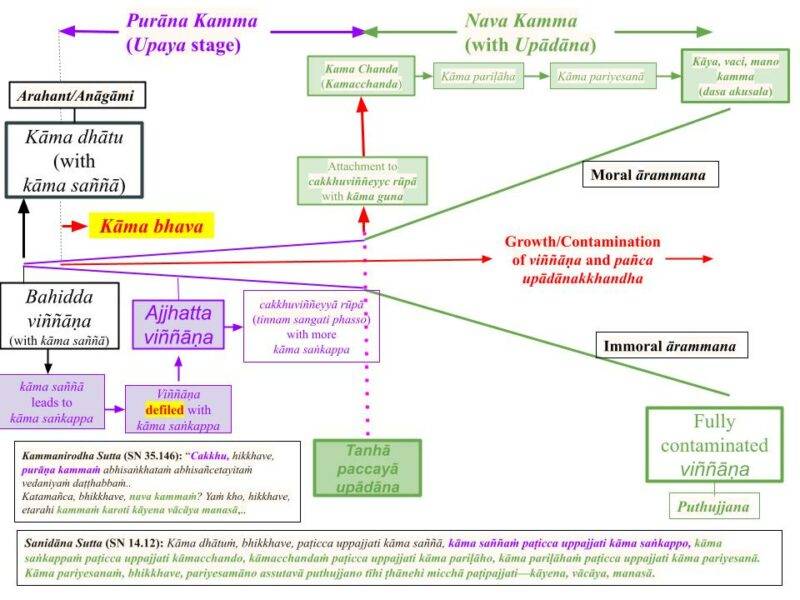
Download/Print: “Purāna and Nava Kamma – 2- revised“
It is from the post: “Purāna and Nava Kamma – Sequence of Kamma Generation” which I highly recommend. Of course, one needs to keep going back to earlier posts to “fill in gaps.”
- All posts in sequence are in “New / Revised Posts.”
3 users thanked author for this post.
-
AuthorPosts


