
Kāma assāda (sensory pleasure) level for a puthujjana builds up in the mind within a split second of receiving a sensory input. However, even the most intense level of assāda (feeling of pleasure) starts off at the very weak manāpa level, which an Arahant also feels; similarly, most dukkha vedanā start at a weak amanāpa stage. As the number of saṁyojana is reduced (corresponding to higher magga phala), sukha/dukkha decrease in steps and end at the manāpa/amanāpa levels at the Arahant stage.
May 1, 2026; revised May 2, 2026
Introduction
1. In the “Aṅguttara Nikāya (1.48)“, the Buddha stated that the mind is the fastest entity in the universe; see #48 in the link.
- The short sutta says: “I do not see a single thing that’s as quick to change as the mind. So much so that it’s not easy to give a simile for how quickly the mind changes.”
- The mind starts off at the ‘kāma dhātu‘ stage for us in the ‘kāma loka.’ The mind can enter ‘kāma dhātu‘ via any one of the six senses. One of six possible rupa (rupa rupa, sadda rupa, through dhamma rupa) must first register in the mind. See the chart in #3 below.
- In this post, let us focus on a visual event based on a rupa rupa, which is usually shortened as rupa. Here, the mind first experiences ‘rupa dhātu‘. (If it receives a sound, that would be via a sadda rupa, etc.)
- Then, within a split second, the mind will go through several steps and reach the cakkhu viññāṇa stage. That will happen for any sight. In Paṭicca Samuppāda, this is the “sankhara paccayā viññāṇa” step, which also generates ‘nāmarupa‘ via “viññāṇa paccayā nāmarupa.”
- If that sight (nāmarupa generated) is appealing (i.e., if it generates kāma guṇa), then it may advance and go through the rest of the steps in Paṭicca Samuppāda, starting with “nāmarupa paccayā salāyatana” to the end: “jāti paccayā…”
Initial Weak Level of ‘Manāpa‘
2. All sensory inputs start at the ‘kāma dhātu‘ stage with the ‘built-in kāma saññā‘ for us in the ‘kāma loka.’ See the chart in #3 below.
- That ‘kāma saññā‘ can induce (i) a ‘sense of liking (manāpa)’, (ii) a ‘sense of liking (amanāpa)’, or (iii) a neutral sense, all three with ignorance in the mind. An example of the third type is seeing the blue sky, which may not induce a like or a dislike, but the mind is still fooled, because the sky is not really blue. No object in the word has ‘color’ as emphasized in #16 below.
- I discussed that in the previous post, specifically in #12 through #15 of “Mahāvedalla Sutta – Sañjānātī, Vijānāti, Pajānāti.” As emphasized there, and as stated in the “Nibbānadhātu Sutta (Iti 44),“ Arahants also experience manāpa and amanāpa. However, for a puthujjana, manāpa can grow into a much stronger level of ‘kāma assāda,’ and amanāpa can grow into a raging anger or intense pain depending on the situation.
- Let us first focus on how manāpa can grow into a much stronger level of ‘kāma assāda‘ for a puthujjana.
Steps in the Increase of Assāda With Increasing Mind-Contamination
3. I explained the basic ideas in the post “Assāda (Sense Pleasure) Experienced Is Mostly Mind-Made.” In #9 of that post, I discussed the key steps involved for manāpa to grow into a much stronger level of ‘kāma assāda‘ for a puthujjana.
- As I explained there, the ‘mind-contamination’ (and the generation of kāma assāda) does not happen in ‘one shot.’ It happens via many steps, even though it can happen within a split second! The following are the three major steps, extracted from that post:
Step 1: Attachment to ‘manāpa’ leads to ‘saṅkappa‘: The initial mind-contamination is triggered by the ‘kāma saññā‘ in the ‘kāma dhātu‘ stage, giving rise to only a ‘manāpa‘ (‘trace of liking‘) as the very early stage of a ‘sukha vedanā.’ That automatically gives rise to ‘kāma saṅkappa‘ in the mind of a puthujjana. This is where ‘kāma rāga‘ arises (it is the ‘saṅkapparāgo purisassa kāmo‘ step). Contrary to what many believe, ‘kāma rāga‘ is very weak. It arises at the beginning of the ‘purāna kamma‘ stage. It will grow into ‘kāmacchanda‘ (a much stronger form) if the mind contaminates further in the following steps.
Once entering the ‘purāna kamma‘ stage, the mind of a puthujjana quickly goes through the ‘bahiddha viññāna‘ and reaches the ‘ajjhatta viññāna.‘ Even in these steps, the mind generates more ‘saṅkappa,’ and further defiles itself.
Step 2: Attachment to ‘kāma guṇa’ leads to ‘sara saṅkappa‘ and ‘gehasita somanassa‘: In the middle of the ‘purāna kamma‘ stage, the mind generates ‘cakkhuviññeyya rupa‘ and if those have sufficient ‘kāma guṇa‘ (based on the mindset at that moment), that will generate ‘sara saṅkappa‘ (sometimes just called ‘gehasita sara saṅkappa‘), and these are stronger than ‘saṅkappa‘ that led to the ‘bahiddha/ajjhatta viññāna.‘ The ‘sukha vedanā‘ intensifies to ‘gehasita somanassa‘ at this stage, i.e., assāda grows further.
Step 4 (in the chart): The ‘taṇhā paccayā upādāna‘ leads to the start of accumulating potent kamma and further increase of ‘assāda‘: Once in the ‘nava kamma‘ stage, mind contamination is much stronger with mano, vaci, and kāya saṅkhāra responsible for mano, vaci, and kāya kamma that can bring vipāka even in future lives. The ‘mind-pleasure’ (somanassa vedanā) generated in this stage is stronger than the ‘gehasita somanassa‘ generated in Steps 2 and 3. That assāda can grow even stronger if the mind ‘really gets into it.’
- The following chart is also from that post.
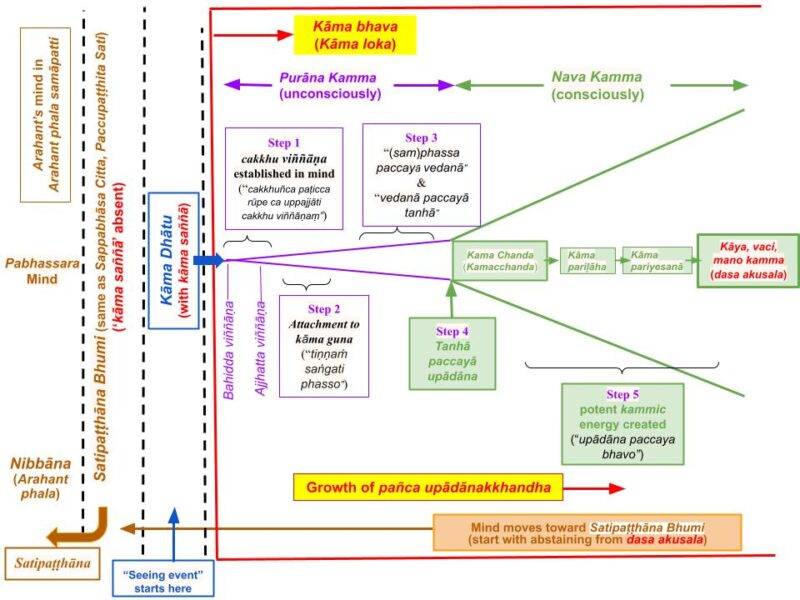
Download/Print: “Overcoming Kāma Saññā“
‘Kāma Sukha‘ Defined in the Pañcakaṅga Sutta
4. In the “Pañcakaṅga Sutta (SN 36.19),” the Buddha defines ‘kāma sukha‘ as follows: “Yaṁ kho, ānanda, ime pañca kāmaguṇe paṭicca uppajjati sukhaṁ somanassaṁ—idaṁ vuccati kāma sukhaṁ.”
- Translated: “The sukha and somanassa that arise from these five kinds of sensual stimulation (pañca kāmaguṇa) are called sensual pleasure (kāma sukha).”
- As we can see from the steps in #3 above, it starts at Step 2, with a mind attaching to pañca kāmaguṇa, which arise in the mind in response to enticing/attractive sensory inputs.
- Here, pañca kāmaguṇa (five types of kāma guṇa) refers to “false, mind-made attractive qualities” that an ignorant mind assigns to sensory inputs (visuals, sounds, odors, tastes, touches, and dhammā). Because of kāma guṇa, we attach (taṇhā) to worldly things, thinking they can bring us happiness. For details, see “Kāma Guṇa – Origin of Attachment (Tanhā).”
Kāma Guṇa Are Associated With Kāma Loka
5. Furthermore, the strength of kāma guṇa reduces as one attains higher magga phala, and is completely eliminated at the Anāgāmi stage when the kāma rāga saṁyojana is eliminated. Thus, Anāgāmis or Arahants do not generate kāma guṇa at all. Thus, their minds do not generate any ‘additional’ sensual pleasure beyond that weak ‘manāpa‘ or ‘slight liking.’
- Consider an Arahant, an Anāgāmi, a Sakadāgāmi, a Sotāpanna, and a puthujjana eating the same meal, which is the tastiest that the puthujjana has ever tasted. Sotāpanna would find it less tasty than the puthujjana, and the Sakadāgāmi would find it even less so. The Arahant or the Anāgāmi would only experience a ‘mild liking’ (manāpa) for it.
- That is because the puthujjana‘s mind generates the strongest kāma guṇa for the meal, whereas the minds of the Sotāpanna and Sakadāgāmi will generate reduced kāma guṇa.
- The minds of the Arahant or the Anāgāmi will not generate any kāma guṇa, because both have eliminated the kāma rāga saṁyojana.
- This is why kāma assāda (sensual pleasures) are completely mind-made!
Pain Is Also Felt via Saññā!
6. In the opposite situation, amanāpa (e.g., caused by hearing threatening or harsh speech) can lead to a raging anger in a puthujjana, while it remains at the amanāpa stage for an Arahant or Anāgāmi.
- The puthujjana would be most distressed, while the Sotāpanna and the Sakadāgāmi would be less distressed. On the other hand, the minds of the Arahant or the Anāgāmi would generate a mild distaste (amanāpa).
- Now, let us consider pain due to an injury, say, due to cutting one’s finger off. It seems like even an Arahant should feel that pain just like a puthujjana.
- However, pain is also a saññā, generated via the nervous system. That is no different from the taste induced by sensors in the tongue or the smell induced by sensors in the ear. The video in Ref. 1 explains that there are people who do not feel pain. If the pain is ‘real,’ then it must be felt by all. (Note that in the case of the person in Ref. 1, he does not feel pain because of a defect in his nervous system or the brain; however, Arahants do not feel pain even though their sense faculties are working normally; see #12 and #13).
- All those are saññā generated via sensors attached to the physical body! Any saññā coming through one of the six senses can only generate manāpa, amanāpa, or a neutral feeling. The enhanced ‘pleasure/pain’ are generated by the mind itself at that time! It is possible to keep the mind at the manāpa/amanāpa stage, without growing to ‘pleasure/pain.’ This is discussed in the Indriyabhāvanā Sutta (MN 152).
Ānāpānasati – Three Major Steps to Arahanthood
7. Before discussing the Indriyabhāvanā Sutta, let me summarize the three major stages to the Arahanthood, as summarized in the Ānāpānasati Sutta (MN 128): (i) Attain the Sotāpanna stage with Ānāpānasati, (ii) cultivate Satipaṭṭhāna to enter the Satipaṭṭhāna Bhūmi (free of ‘lokiya saññā‘) at will, (iii) cultivate Satta Bojjhaṅga to attain higher magga phala while in the Satipaṭṭhāna Bhūmi.
- Thus, only a Sotāpanna can cultivate Satipaṭṭhāna, which is the second stage of Ānāpānasati. Indriya Bhāvanā is a part of Satipaṭṭhāna.
- Thus, only a Sotāpanna can cultivate the Indriya Bhāvanā, which is described in the Indriyabhāvanā Sutta (MN 152)
- Here, we will discuss only the relevant verses in the Indriyabhāvanā Sutta for this post.
Indriyabhāvanā Sutta – Sense Restraint
8. The “Indriyabhāvanā Sutta (MN 152)” explains what is achieved with the six sense faculties after cultivating the Indriya Bhāvanā.
- It starts with the eye faculty. I will summarize the meaning of the verses from marker 4.2 to 4.12.
- When the person (who has successfully completed the Indriya Bhāvanā) sees a sight with their eyes, in them arises what is agreeable (manāpa), what is disagreeable (amanāpa), and what is neutral. This happens when the mind has overcome Step 1 in #3 above and is at the ‘kāma dhātu‘ stage with the ‘kāma saññā.‘
- Once the mind overcomes even those subtle feelings, it enters the Satipaṭṭhāna Bhūmi, which is free of even manāpa or amanāpa. See the chart in #3 above.
9. It is only after being able to enter the Satipaṭṭhāna Bhūmi (and the ability to stay there for long times) that a Sotāpanna is able to engage in Vipassanā and attain higher magga phala.
- Thus, Indriya Bhāvanā is part of the cultivation of Satipaṭṭhāna.
- Once the ability to enter the Satipaṭṭhāna Bhūmi at will is gained, then the Sotāpanna can cultivate the Satta Bojjhaṅga (usually translated as ‘Seven Factors of Enlightenment’) to attain higher magga phala.
- I summarized the three main stages of Ānāpānasati Sutta in “Ānāpānasati Sutta – Complete Overview.”
Verses Relevant to the Experience of Pain/Anger
10. Now, let us discuss the verses relevant to the experience of pain, due to an injury, for example.
- That is discussed in the verses from marker 8.1 to 8.11, and are analogous to those for the eye faculty (from marker 4.2 to 4.12) summarized in #8 above.
- When the person (who has successfully completed the Bhāvanā) feels a touch with their body, in them arises what is agreeable (manāpa), what is disagreeable (amanāpa), and what is neutral. This happens when the mind has overcome Step 1 and is at the ‘kāma dhātu‘ stage with the ‘kāma saññā.‘
- Once the mind overcomes even those subtle feelings, it enters the Satipaṭṭhāna Bhūmi, which is free of even manāpa or amanāpa.
11. However, that experience of not proceeding beyond the manāpa/amanāpa levels is true for Sotāpanna only while they are in the Satipaṭṭhāna session.
- Once they come out of meditation and live their daily lives, they will experience pain from an injury, but it will be somewhat less than that of a puthujjana, as discussed above for the other sense faculties.
- However, an Arahant‘s mind will never increase beyond the manāpa/amanāpa levels even in daily life.
- Thus, when the Buddha’s foot was injured by Devadatta, he only felt an amanāpa. Yet, it was necessary to treat the injury.
Kakacūpama Sutta – The Simile of the Saw
12. In the “Kakacūpama Sutta (MN 21),” the Buddha provides a simile for an extreme situation for an Arahant. That description is from markers 20.1-21.5.
- The meaning of those verses: If two bandits tie you up and start cutting your limbs one by one with a saw, you should be able to maintain your composure and not even generate the slightest anger toward them. There is no need for an Arahant to willfully maintain composure; it is automatic.
- Arahants have eliminated all saṁyojana, including asmi māna. The ‘saññā‘ of ‘this physical body is mine’ does not hold for them. The ‘amanāpa saññā‘ arising with an injury does not expand to pain, as for a puthujjana. That is why they do not experience pain!
- Note that an Anāgāmi (who has not eliminated the asmi māna saṁyojana) would still feel the pain due to an injury, even though it would be less than that for a puthujjana.
The Account of Adhimutta Thero
13. The following account from the Tipiṭaka of Ven. Adhimutta (an Arahant) explains this through a real event.
- A band of bandits captured him. In those days, some people believed in making sacrifices to the Gods.
- They were taking him to be sacrificed, but were astonished to see that the Thero was not afraid of being killed. Usually, their victims would be screaming and begging for their lives.
- The following account starts with the bandits asking him why he is not scared: “Adhimuttattheragāthā.”
- Thero‘s response is from marker 3.1 through 15.4. He explains to them why he is not afraid of dying (he had broken all ten saṁyojana, including asmi māna or the “sense of me”).
- As stated there, in the end, some of the bandits became bhikkhus and eventually attained Arahantship.
Summary
14. Any sensory input can only provide a very weak manāpa or amanāpa level of ‘feelings’ (those are actually saññā).
- Depending on the unbroken saṁyojana, the manāpa and amanāpa stages can greatly intensify to joyful or painful sensations. The ‘magnification’ is highest for a puthujjana with all saṁyojana intact. The ‘magnification’ decreases stepwise as one attains the Sotāpanna stage, followed by higher magga phala. The mind of an Arahant with all ten saṁyojana broken does not elevate from the initial manāpa and amanāpa stages.
- The build-up of manāpa to ‘kāma sukha‘ (sensory pleasure) starts at Step 2 in #3 above.
- Both ‘kāma sukha‘ and ‘kāma dukkha’ (including pain) are reduced as one attains higher magga phala, and are stopped at the Arahant stage.
15. That whole process is described in the Ānāpānasati Sutta (MN 128) in three major stages; see “Ānāpānasati Sutta – Complete Overview.” Stages two and three of that three-stage process are discussed in detail in the Mahā Satipaṭṭhāna Sutta (DN 22); see “Kāye Kāyānupassanā – Details in Satipaṭṭhāna.”
- Most of the relevant posts are in the “Buddha Dhamma” section. Older relevant posts are in “Five Aggregates (Pañcakkhandha)– New Series,” “Satipaṭṭhāna Sutta – New Series” and “Worldview of the Buddha” sections. Even older posts can be found in “New / Revised Posts,” where all posts are in chronological order.
- Enough material has been discussed in those posts to lead up to the Anāgāmi stage.
- I will next start a new section to discuss the sequence of steps required to attain the Sotāpanna stage. I have come to realize that most posts within the past three years or so are ‘out of reach’ for many.
16. The most critical point to be grasped from those posts over the past three years is the following: Any external rupa sensed by the five physical senses does not have color, taste, smell, etc.
- The Buddha called them ‘mirages’ generated via ‘kāma saññā‘ as we have discussed.
- It is fortunate that modern science has confirmed that in recent years.
- Out of the five, the easiest to understand is that ‘color perception’ is a mirage. For example, the sky does not have a blue color or the multi-colored hues at sunset. That is explained scientifically in the video in Ref. 2.
17. Finally, we can now clearly see that the Buddha taught, “saṅkhittena pañcupādānakkhandhā dukkhā” OR “in brief, the origin of suffering is the craving for the five aggregates of rūpa, vedanā, saññā, saṅkhāra, viññāna (pancupādānakkhandha).”
- The chart in #3 above shows how a mind attaches to any sensory input, starting with attaching to the rūpa (which is the mind-made version of the featureless external rūpa).
- As the mind ‘expands’ (indicated by the widening ‘cones’ in the chart), it keeps attaching to all five entities, i.e., pancupādānakkhandha.
- In some cases, that leads to an expanding sense of sukha; in others, it leads to dukkha. However, a feature is not shown in the chart. That is the accumulation of kammic energy to bring about future rebirths. Most rebirths are in the apāyās, because a human can be tempted to engage in immoral deeds in the pursuit of ‘sensory pleasures.’ Yet, the sad truth is that those ‘sensory pleasures’ are mirages!
- As long as one has not comprehended the danger of attaching to sensory pleasures (i.e., not comprehending the deceiving nature of the ‘built-in saññā‘), one will never be able to escape the rebirth process!
References
1. Some people, due to rare conditions like congenital insensitivity to pain, never feel pain despite injuries. The external stimuli are there, but perception is absent. Pain isn’t in the body—it’s the mind’s alarm system, often unreliable.
2. The following is another AI-generated video that explains the fact that color vision is ‘mind-made.’ Color is not present in external objects (an apple is not red) or light (electromagnetic radiation is colorless).
