‘Elephants in the Room’ section highlights obvious contradictions in current translations of key concepts in Buddha Dhamma; there are issues that should be obvious even to beginners. Furthermore, even issues hidden for centuries become glaringly obvious as one makes progress.
October 23, 2026
Obvious Contradictions – ‘Elephants in the Room’
1. The goal of this section (“Elephants in the Room“) is to highlight the obvious contradictions in current translations of key concepts in Buddha Dhamma that have been preserved in the Pāli Tipiṭaka.
- I call these “elephants in the room” because these obvious misinterpretations have gone unnoticed for all these years despite obvious contradictions. It is a puzzling phenomenon because it is not necessary to have knowledge of Pāli to see some of these contradictions. Even a child should be able to see some of these contradictions!
- However, even a Sotāpanna may not see other subtle aspects in the early stages. As one’s comprehension grows, previously hidden issues become glaringly visible almost overnight.
- My experience over the past 3-4 years falls into that latter category. I started seeing ‘more and more hidden elephants’, which were not visible previously.
Ants to Elephants – More Clarity With Progress
2. When I first started this section (“Elephants in the Room“) back in early 2022, I had not fully realized the extent of the damage done to the Buddha’s teachings over the past two thousand years.
- In 2023, I gradually came to realize some deeper aspects of the Buddha’s teachings. I know that many long-time readers are somewhat confused by my shift in focus, which began in mid-2023. Many of my posts since then seem to contradict my earlier posts from the website’s launch in early 2014. In fact, many of those old posts need revision, but I simply haven’t had time; I was fully engaged in ‘digging deeper’ and making sure I wasn’t veering in the wrong direction.
- From mid-2023 to the present, I went through a major learning process. It took me over three years to sort things out to a satisfactory level.
- Let me first briefly describe my journey that started in 2013, so you can understand the shift in my focus over the past few years. My journey has three stages.
The First Stage
3. After retirement, I started seriously looking into the Buddha’s teachings. At first, I saw many contradictions in the teachings (as they were taught at the time), but in July 2013 I came across discourses by Waharaka Thero that resolved many of them. Based on those findings, I launched this website in early 2014.
- Although I traveled to Sri Lanka in 2014 and 2015, I did not get the opportunity to meet Waharaka Thero because he was unwell. However, I gathered many recordings of Thero‘s discourses with help from several of his close associates; I am grateful to them too; see “Parinibbāna of Waharaka Thēro“. As noted there, Waharaka Thero passed away in 2017. That was unfortunate because he would have discovered more.
- Among the critical issues that were resolved in this first stage: (i) ‘Anicca nature’ cannot be seen by looking at the ‘impermanence’ of physical objects in the external world, including one’s own physical body. It actually refers to the ‘unsatisfactoriness ‘ and the danger of giving value to sensory experiences, which are illusions. (ii) The Paṭicca Samuppāda process must be understood to fully understand (i) above. (iii) Ānāpānasati is not ‘breath meditation’.
- I launched the discussion forum (Forums Archive | Pure Dhamma) in 2017.
- Up to 2023, the posts and my comments in the forum largely reflect the material I learned from Waharaka Thero.
The Second Stage
4. In mid-2023, someone sent me a set of discourses in the Sinhala language (“බුදු දහම, මාර්ග ඵල සහ මග වැඩීම“) where I first learned about the ‘purāna kamma‘ stage of the kamma generation process. That marked a new chapter in my learning.
- That opened my eyes to see some ‘hidden elephants’ that escaped my mind in my initial understanding.
- Some of them are: (i) Any sensory event starts at the ‘purāna kamma‘ stage (‘purāna‘ means ‘initial’ and not ‘old’) where subtle saṅkhāra (saṅkappa) arise automatically. See “Purāna and Nava Kamma – Sequence of Kamma Generation“. (ii) Only a tiny fraction of our sensory experiences can be attributed to direct kamma vipāka; instead, our physical body is subjected to any sensory inputs available in the human realm; for example, when there is an Earthquake or a flood, everyone in that vicinity will be affected. (iii). There are no separate ‘vipāka viññāṇa‘ and ‘kamma viññāṇa‘ as I had previously understood (this is related to (ii) above). (iv) A mind does not attach to pañcakkhandha, but always to pañca upādānakkhandha (pañcupādānakkhandha).
- I am grateful to the author, Dr. Chandana Jayasinghe, for the critical findings presented in the discourses above. I do not know him personally.
The Third Stage
5. That new revelation motivated me to start ‘digging deeper’ immediately, and that is when I realized the critical role of the ‘distorted or viparīta saññā‘ in kamma accumulation.
- Book 2 of the Saṁyutta Nikāya provides a systematic, step-by-step account of how kammic energy accumulates, starting with any sensory input.
- The book begins with the idappaccayatā Paṭicca Samuppāda. It then links this to the generation of pañcupādānakkhandha in the next section. See “Sotāpanna Stage – Essential and Unnecessary Concepts“.
- Following those sections, I found another series of critical suttās in Book 2 of the Saṁyutta Nikāya. See “Mind ‘Starts’ at the Kāma Dhātu Stage With Kāma Saññā“. They clearly show that it is the ‘distorted or viparīta saññā‘ that provides a ‘sense of reality’ to illusory sensory experiences.
- Furthermore, that saññā is forced to appear in the very first moment of sensory input (via Paṭicca Samuppāda). See “A Mind ‘Starts’ at an Almost Pure (Pabhassara) State”.
- The net result is an ’embellished’ sensory experience generated by the mind itself; see “Mind ‘Starts’ at the Kāma Dhātu Stage With Kāma Saññā“.
- There is only one Paṭicca Samuppāda (PS) process; the Buddha discussed only the idappaccayatā PS (no need for ‘kusala-mūla PS or Avyākata PS’, as found in the Commentaries). See “Kusalamūla Paṭicca Samuppāda – Evidence Against It” and “Avyākata Paṭicca Samuppāda – Evidence Against It“.
- My other findings on material relevant to higher stages of magga phala (for example, cultivating Satipaṭṭhāna) require more details on the chart below. I will not get into such details in this post.
6. The following chart illustrates those key points. As mentioned above, it is not necessary to understand the details of this chart to attain the Sotāpanna stage. However, a general understanding of the chart can be highly beneficial. For example, the transition from the ‘kāma dhātu‘ stage to the ‘kāma loka‘ is based solely on the ‘distorted saññā’, and it is discussed in the material necessary for a Sotāpanna in Book 2 of the Saṁyutta Nikāya (discussed in #5(iii) above).
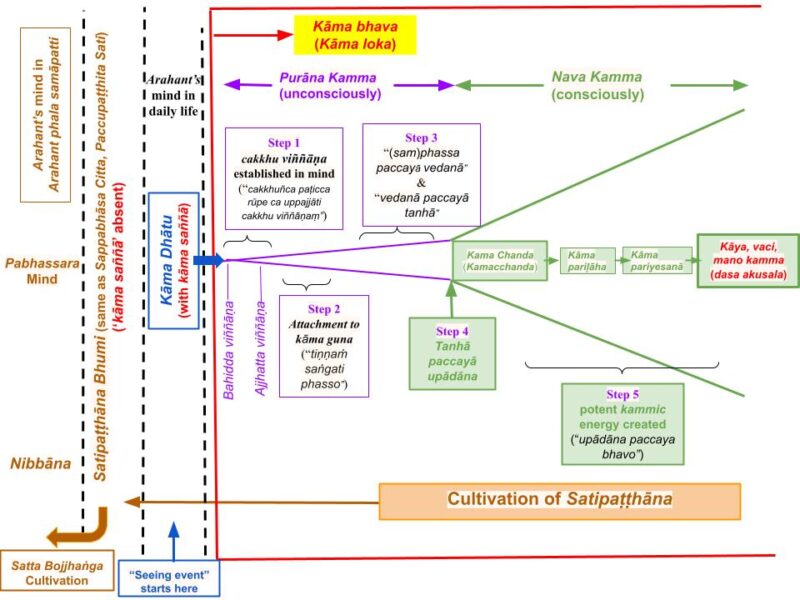
Download/Print: “Overcoming Kāma Saññā -3“
- The chart is from the post “Ānāpānasati – Mindfulness (Sati) Based on Buddha’s Worldview“.
- The arrow at the bottom of the chart could be misleading in that sense, because ‘tracing back’ doesn’t happen within this cycle/chart (which is why it is not easy to express certain ideas well with a single chart). Depicting what happens when the mind moves to the Satipaṭṭhāna Bhūmi requires many charts; see #5 of “Murderer to a Sotāpanna in an Hour – How Is That Possible?“
7. Soon after that, I realized that recent findings in science have already confirmed Buddha’s concept of ‘distorted or viparīta saññā‘ (that our sensory experiences are not real).
- Those scientific findings show that sensory experiences are mind-made (the only difference is that science says the brain makes the illusion); see “Without ‘Mind-Made’ Perception, World Is Colorless, Soundless, Tasteless, Odorless, and Touchless“. Since AI bots are widely available these days, anyone can verify the claims in that post.
- I literally fell off my chair when I realized that modern science had already confirmed the crux of Buddha’s teachings. Even with that confirmation, I can see that many people still have doubts. Now I fully understand why the Buddha (upon attaining Buddhahood) initially considered not teaching his Dhamma to humans. He realized that it would be quite difficult; see “Brahmāyācana Sutta (SN 6.1)”. At Brahma‘s request, the Buddha scanned the minds of living beings and saw that some could comprehend his teachings.
8. The revelation that our sensory experience is a mirage is built into the model scientists have proposed to explain the origin of that illusion (theory of evolution). They say our brain evolved to provide that illusion for our survival. Thus, the illusion is no surprise to them; it is built into their theory of evolution. That is why the general public is unaware that our sensory experience is a mirage.
- Scientists who believe sensory pleasures are illusions think one must enjoy them because life ends with the death of the physical body; they don’t believe in rebirth and think those illusions evolved to help us live just this life. Thus, repercussions (kamma vipāka) of immoral deeds (akusala kamma) done in the pursuit of such ‘pleasures’ are not taken into account in that model.
- Furthermore, their proposed model (the theory of evolution) rests on the unproven assumption that feelings and perceptions can arise in a brain made of inert atoms and molecules. This is the ‘hard problem of consciousness’ they are stuck in, as I explained in the post “Consciousness and Color Perception – Current Scientific Understanding“.
The above summarizes my three-part journey. Now, let me emphasize some aspects I consider critically important to attain the Sotāpanna stage.
Any Rūpa We Experience Does Not Exist in the External World
9. The essence of the Buddha’s teachings is that ‘sensory pleasures’ are not in external objects. People engage in immoral deeds seeking ‘mind-made pleasures’ and then suffer immensely when those lead to rebirths filled with unimaginable suffering.
- Any enticing feature that seems to be in external objects (color, the soothing aspect of music, taste, smell, and pleasant touch) is mind-made; the only difference from science is that science says those illusions are made in the brain.
- The truth of that is easiest to see in the perception of color; nothing in the world has any color. Anyone with a good physics background can think for ten minutes on the key points I discussed in “Colors Are Mind-Made (Due to Kāma Saññā)” and see that they are true. It is also true that we cannot live our lives without that illusion: “Human Life is Unlivable in a ‘Colorless’ World“.
- Paṭicca Samuppāda generates that illusion to keep us alive and provide the ‘sensory experience’ we had craved. However, such ‘mind-made enjoyments’ are short-lived and turn to anxiety/depression when they come to an end. More importantly, immoral deeds done in pursuit of such ‘pleasures’ lead to real suffering with rebirths in the apāyās.
10. The Sotāpanna stage is attained with the realization that sensory pleasures are not real. With the wrong perception that they do, a puthujjana pursues sensory pleasures and generates pañcupādānakkhandha non-ceasingly; that is the origin of suffering, i.e., “saṅkhittena pañcupādānakkhandhā dukkhā”. See #8 of “Essence of Buddhism – In the First Sutta“.
- If such attractive features are really in the external world, then to avoid attaching to them we must either destroy them or live isolated from them. Since the first is impossible, ancient yogis (like Ālāra Kālāma and Uddaka Rāmaputta) went deep into jungles to avoid such enticing sensory inputs. However, that provides only a temporary solution.
- The correct way to lose that attachment is to break the ten sansāric bonds, or saṁyojana, that bind one to the rebirth process.
- That requires one to see that the ‘true origin’ of ‘sensory pleasure’ is one’s mind itself. This is ‘yoniso manasikāra‘ that is needed to attain the Sotāpanna stage; see “Yoniso Manasikāra – Connection to Saññā“.
- Many of those who follow the discourses by Dr. Chandana Jayasinghe (in #4 above) may be able to ‘connect some missing dots’ by realizing that what one experiences is very different from that which is out there in the world (external rūpa). An apple is not red, nor does it have a sweet taste.
11. Think deeply about the following: If sensory experiences are real, then the only way to lose attachment to them is to follow what those yogis did. However, that approach only suppresses the desire for such experiences through sheer willpower.
- Luckily for those yogis, they strictly enforced such discipline and at least temporarily separated from the kāma loka and attained anariya jhāna; since that jhānic experience is much better than the sensual pleasures (e.g., enjoying food, music, etc.), they made visible progress that could be seen.
- However, once the Buddha discovered (and modern science has confirmed) that those ‘sensory pleasures’ are not in the external world, there is no need to physically separate from such sensory experiences. The problem lies in the mind, not in external objects.
- Once that is understood, that understanding itself is enough to automatically abstain from highly immoral deeds (via the breaking of the first three saṁyojana), and thus avoid rebirths in the apāyās. This is all one must do to be free of 99+% of future suffering. See #17 of “Satipaṭṭhāna Sutta – Misconceptions and Wrong Translations“.
- Now, let us discuss what material is not necessary to attain the Sotāpanna stage that became clear to me during the past few years.
Material Not Needed to Attain the Sotāpanna Stage
12. Satipaṭṭhāna can be cultivated only by a Sotāpanna and not by a puthujjana. It is the way to cultivate higher magga phala up to the Arahant stage. Two requirements are essential for cultivating Satipaṭṭhāna:
- One must have attained the Sotāpanna stage.
- Overcoming that kāma saññā (the tendency to attach to those perceptions) is not easy. That requires concerted effort by the Sotāpanna, i.e., cultivating Satipaṭṭhāna. One must be willing to give up ‘sensory pleasures’ for long enough times to be able to enter the ‘Satipaṭṭhāna Bhūmi’ at will; true Vipassanā (insight meditation) is possible only when the mind is totally free of any ‘distorted or viparīta saññā‘ associated with the world of 31 realms (i.e., any type of ‘lokiya saññā‘). It is humorous that many people think that ‘breath meditation’ (just focusing the mind on breath) is a key aspect of Satipaṭṭhāna.
- To fulfill the first of those two conditions (i.e., to become a Sotāpanna), one must cultivate the first stage of Ānāpānasati. That involves grasping the Buddha’s worldview that sensory pleasures lead to future suffering (āna) and rejecting the prevailing worldview that sensory pleasures are to be pursued (āpāna), as discussed in #3-#11 above. Also see “Ānāpāna – Adopting Buddha’s Worldview and Discarding ‘Mundane Views’“.
- Cultivating the four types of Satipaṭṭhāna fulfills four of the 37 factors of Enlightenment (Bōdhipakkhiya Dhamma) needed to attain higher magga phala ending in the Arahant stage. Thus, cultivating all those are needed only after the Sotāpanna stage; see “37 Factors of Enlightenment – Meditation To Attain Arahanthood“. In general, any sutta in the Samyutta Nikaya above SN 45 (i.e., suttās starting at SN 45.1) are specifically for Sotāpannās trying to cultivate the 37 factors of Enlightenment.
13. The following is another fact that became clear to me. There is no point in trying to cultivate jhāna if the goal is to attain the Sotāpanna stage. We can understand why with the following reasoning.
- It is true that Ubhatobhāga Arahants follow a different process to the Arahant stage via Ariya jhāna. Ubhatobhāga Arahants (like Ven. Sāriputta and Ven. Moggallāna) are those who attain paññā vimutti and ceto vimutti together; they attain all rupa loka jhāna and arupa loka samāpatti on the way to Arahanthood. See “Ubhatobhāgavimutta Sutta (AN 9.45)“.
- That process is discussed in the suttās on Kāyagatā Sati, for example, the “Kāyagatāsati Sutta (MN 119)“.
- I haven’t discussed that yet because it isn’t necessary for most people. These days, hardly anyone can do that. Even in the Buddha’s time, only a handful were Ubhatobhāga Arahants.
- However, if you read the Kāyagatāsati Sutta, you can see the process is the same as in the Mahāsatipaṭṭhāna Sutta (DN 22), which describes how to cultivate Satipaṭṭhāna. One’s mind will automatically take the appropriate path, and one will end up either in the Satipaṭṭhāna Bhūmi or the fourth Ariya jhāna (in both situations, lokiya saññā is absent, i.e., one has ‘Sammā Samādhi‘). One does not need to decide which one to cultivate, i.e., Satipaṭṭhāna or Kāyagatā Sati. The procedures are essentially the same. The mind will automatically take the ‘jhāna path’ for a relatively few.
- By the way, it is easy to determine whether one has Ariya jhāna; one must have eliminated kāma rāga saṁyojana (i.e., must be an Anāgāmi) to even attain the first Ariya jhāna, let alone the fourth. Watch an X-rated movie; if kāma rāga does not arise, you are an Anāgāmi.
Status of Posts in the Website
14. The above is a brief overview of my spiritual journey since 2013 and some key concepts that I understood. The progress in my thinking over the critical period from mid-2023 should be apparent in the “New / Revised Posts” section, which lists weekly posts over several years. The third stage mentioned above started roughly around the time of the post “Counterfeit Buddhism – Current Mainstream Buddhism” on June 30, 2023.
- However, the exact sequence in #5-#8 above may not have been apparent in my posts since mid-2023. I was learning in real time and writing posts based on what I understood then. But I have been revising those early 2023/2024 posts to keep up with new knowledge I gained over time.
- I have not had time to revise some of the older posts (pre-2023) to incorporate the ‘new findings’. I am starting on that task with posts in this “Elephants in the Room” section.
Waharaka Thero Passed Away Prematurely
15. I am certain that if Waharaka Thero were alive for a bit longer, he would have figured out those concepts in #4 through #7. In fact, I am certain that he had that knowledge, even though he had not yet connected it all. For example, Venerable Bāhiya attained Arahanthood after hearing a few verses from the Buddha; there was no time to explain any of the above concepts to him. There are those who have gained ‘enough understanding’ in previous lives and need only a little push.
- The difference is the following. Those who lack that ‘knowledge gained in previous lives’ need detailed explanations; even then, some would not be able to make it without spending a concerted effort. How many people today would be willing to admit that their sensory experiences are illusions?
- In contrast, someone like Ven. Waharaka Thero would have immediately grasped those once pointed out. In fact, he had explained that concept in his discourses on the “Pheṇapiṇḍūpama Sutta (SN 22.95)“, which describes ‘mind-made rūpa‘ as a lump of foam, vedanā generated by the experience of such rūpa as bubbles on the water, saññā as a mirage, etc. One of several such discourse is the following (in the Sinhala language): “රූපය පෙන බුබුලක් ලෙස….විඤ්ඤානය මායාවක් ලෙස බලන ආකාරය“.
Make Your Own Decisions
16. I can see that many people are skeptical about my claims about the role of the ‘viparīta saññā‘ (which, for us in the kāma loka, comes in various types of kāma saññā). That is fine. No one needs to take my word. They can examine the material presented and decide for themselves.
- I never ask anyone to accept my explanations. Even the Buddha couldn’t convince many people. Each person must decide for themselves. All I can do is to present the facts as I see them.
- If there are any incorrect interpretations of suttās in my posts on ‘viparīta saññā‘ (essentially any post since mid-2023), please don’t hesitate to comment in the following forum: “Questions About Puredhamma Posts”. I would be happy to answer any questions and provide clarifications as needed.
- As I mentioned in #14 above, some posts from before mid-2023 need revision. I am starting to revise them now by working through old posts in this section (“Elephants in the Room“).
- I also realize that I need to write more posts for beginners. I encourage beginners to ask questions in the forum so I can see what topics they want to learn. The existing beginner posts (e.g., “Moral Living and Fundamentals“, “Living Dhamma“, and “Key Dhamma Concepts“) should be mostly up-to-date since they don’t involve advanced topics that I referred to above.
