Buddha’s worldview has held up over the past 2500 years, whereas the “nature of the world according to science” has changed even over the past few decades.
Revised January 22, 2019; last revision March 12, 2026
1. Whether it is a scientist or a Buddha, each is “discovering” the way nature works, i.e., revealing to the world the fundamental laws of nature. To appreciate a Buddha compared to a scientist, contemplate the following. The scientific knowledge we have today is the CUMULATIVE effort of thousands of scientists, each taking the knowledge base a little further. Newton said, “I was fortunate to stand on the shoulders of giants to see further.”
- Not all scientists make similar contributions. Galileo, Newton, and Einstein made “giant leaps” compared to other scientists’ smaller steps.
- Through cumulative effort over many hundreds of years, science has made significant advances in understanding some fundamental laws relevant to INERT MATTER.
- On the other hand, there has been virtually no progress in understanding how the mind works; see “Consciousness – A Dhamma Perspective.”
2. As I build up this site, anyone can see that Buddha Dhamma is the ultimate Grand Unified Theory. It explains the behavior of both inert matter and living beings that we observe. It also describes living beings in 31 realms (including the human and animal realms that we can see). See “Origin of Life.”
- Buddha Dhamma is not a religion in the sense of providing salvation in a heavenly realm. The Buddha was not a God, a prophet, or a messenger. He was a human being who purified his mind to perfection to see the whole of existence.
- The Buddha was the preeminent scientist who investigated the problem of existence and found a complete solution. We must all find our salvation by following his prescribed path to purify our minds.
3. Newton could not have discovered the laws of gravity if it had not been for the efforts of scientists like Brahe and Copernicus. Similarly, Einstein could not have discovered relativity without the knowledge transmitted by earlier scientists. Quantum mechanics would not have been possible without the efforts of multiple scientists who built on the evidence gathered by hundreds of others.
- The Buddha, in comparison, discovered the complete set of laws about the WHOLE EXISTENCE through his efforts. This includes how inert matter behaves on Earth and throughout all existences in the 31 realms (of which science is unaware). That includes how inert matter behaves in all 31 realms AND the minds of beings in those 31 realms.
- I recently proposed an explanation for the controversy over the “non-locality” issue in quantum mechanics. Everything in the universe is interconnected (or entangled) at a fundamental level; “Quantum Mechanics and Dhamma.”
4. We could say that the minds of the caliber of Newton and Einstein appear roughly every 100 years. The mind of a Buddha is infinitely more advanced, and a Buddha appears once in many billions of years.
- There have been four Buddhās in this Mahā Kappa, but the last Buddha before them was born 30 Mahā Kappās ago. Thus, there was a gap of 30 Mahā kappās (roughly a trillion years) during which no Buddha appeared in this world. See #14 of “Pāramitā – How a Puthujjana Becomes a Buddha.”
- A Buddha uses a method different from the “scientific method” used by scientists. Instead of conducting experiments on inert matter, they conduct mind experiments. Answers to ultimate questions on the existence of living beings with complex minds can be found only by PURIFYING a human mind to the ultimate level. That is what a Buddha does.
5. I will try to provide at least some details of the Buddha’s complex worldview. Buddha’s Dhamma has been muddled and distorted over the past 2500 years.
- “Our world” is much more complicated than what our senses can grasp; see “Worldview of the Buddha” and “The Grand Unified Theory of Dhamma.”
- And our lives do not end with this one; see “Evidence for Rebirth.”
- Those two facts constitute the basis of the true nature of existence. They need to be thought about carefully. One cannot comprehend the Buddha’s message until one at least has some idea of the “big picture.”
- Now, let us examine how it took 2,500 years for science to align with one aspect of the Buddha Dhamma’s worldview.
It Took 2500 Years..
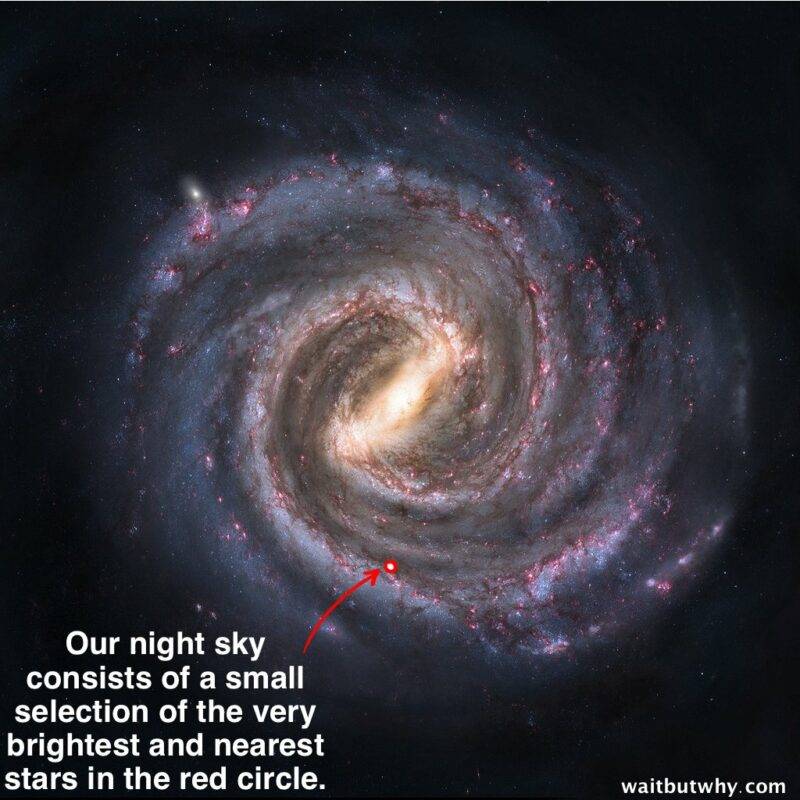
Here is a picture of our Milky Way galaxy. We can see (with the naked eye) only a couple of thousand stars. But there are hundreds of BILLIONS of stars in our galaxy. The following is a high-resolution image of the Milky Way galaxy. Furthermore, there are about an equal number of GALAXIES in our universe. Thus, there is a whole galaxy for each star in our galaxy. It is truly mind-boggling.
1. Even a few hundred years ago, scientists believed our Earth was the center of the universe: “Geocentric model.”
- Therefore, the Buddha’s view of the universe as consisting of innumerable “world systems” was not regarded favorably, even a few hundred years ago.
- Of course, that has changed now. The Buddha’s statement that “there is no discernible beginning to life” is increasingly supported by scientific discoveries. See “Origin of Life.”
2. There is no First Cause (no Creator) in Buddha Dhamma: Life always existed and will always exist. Each living being has gone through innumerable birth-rebirth processes without a conceivable beginning. However, everything in the “world around us” is impermanent, including our universe (a “major world system” in Buddha Dhamma).
- Everything is born, has a transient existence, and eventually decays. This includes our universe. Like everything else, stars (and associated planetary systems) come into existence and eventually fade away.
3. If there is no beginning to life, then where did life exist before the “Big Bang,” i.e., before our universe came into existence? Actually, life is believed to have evolved on Earth much later.
- Even a hundred years ago, people had to take the Buddha’s words solely on faith. However, we are fortunate to have emerging evidence from modern science indicating that life has existed for eternity. Let us look at the emerging evidence.
4. Even as recently as the beginning of the 1900s, Lord Kelvin (one of the top scientists of the day) estimated that the age of the Sun was less than 40 million years. He estimated that, based on gravitational contraction (scientists did not yet know about nuclear fusion). Our knowledge of the universe was also pretty much limited to the Solar System. Thus, this meant that the age of our “known universe” was very short, and consequently, the Buddha’s teachings on a beginningless samsāra (or sansāra) seemed like a myth.
- Vindication of the Buddha’s teachings started in the early 1900s with the advent of quantum mechanics and relativity. Becquerel’s discovery of radioactivity in 1898 and Einstein’s explanation of the photoelectric effect in 1905 led to the development of the quantum theory of atomic structure. That, in turn, led to the correct picture of nuclear fusion as the source of solar energy.
- By 1956, the age of the solar system was estimated to exceed 4 billion years, and the age of the universe was estimated at approximately 14 billion years. Even billions of years are hardly the same as “beginning-less time”!
5. In 1929, Edwin Hubble proved that distant galaxies were moving away from each other and that our galaxy is but one of many. That was a vast understatement, as we now know that there are more than 500 billion galaxies in the observable universe.
- The currently accepted theory of the “big bang” is Alan Guth’s inflationary theory. See “The Inflationary Universe” by Alan Guth (1997).
- However, some scientists do not believe in the “Big Bang.” They have proposed alternate theories; see “Endless Universe” by Paul J. Steinhardt and Neil Turok (2007). In this view, universes are destroyed and reborn. That model resembles Buddha’s explanation that only small parts of the universe (i.e., only a cluster of ‘star-systems’) are destroyed at a time (only to be reformed); see “Aggañña Sutta Discussion – Introduction.”
6. Buddha’s worldview does not have a “Big Bang” beginning, either. Life has always existed and will continue in exist.
- See “Origin of Life.”
- The posts “Buddhism and Evolution – Aggañña Sutta (DN 27)” and “Aggañña Sutta Discussion – Introduction ” discuss some key concepts.
7. By the way, several theories are currently being explored in quantum mechanics related to cosmology. One theory requires a universe to exist for each possible event! So, there may be an infinite number of parallel universes. For example, see David Deutsch’s “The Beginning of Infinity” (2011). In all these theories, multiple universes always exist.
- In any case, the Buddha did not say which of these theories is correct. He stated that life has always existed and always will. But he did say that “star systems” — like our solar system — come into being, survive for long times, and are ultimately destroyed.
- And that process repeats over and over!
8. More information at “Dhamma and Science,” “Quantum Mechanics and Dhamma,” and “Buddha Dhamma” sections.