Tagged: Anatta
- This topic has 14 replies, 5 voices, and was last updated 3 weeks ago by
 Lal.
Lal.

-
AuthorPosts
-
-
September 21, 2026 at 11:11 am #58750
 JaroParticipant
Hello Lal,
I studied physics and chemistry at school and university. I know that colour is electromagnetic radiation within a band of wavelengths, and that the sweetness of honey is tied to sucrose molecules. None of that book knowledge ever gave me a deeper insight into Buddha Dhamma. Knowing the physics changed nothing about how I relate to what I see and taste.
My understanding is that “eso me attā” is about value. It is not about colour, sweetness or beauty as such. In your post on “Etaṁ Mama, Esohamasmi, Eso Me Attā” you read attā as “of value to me,” which fits this. Even if colour were an intrinsic property of an object, the value would still come from the mind. Two people can look at the same person, and one feels joy while the other feels dislike.
The problem, as I see it: when we place colour, sweetness or beauty inside the object, we tend to place the value there too. “This is valuable to me” then feels like a fact about the object, and we set out to acquire it.
Is this the connection you want to point out?
-
September 21, 2026 at 12:47 pm #58751LalKeymaster
Before I address your above comment, I would like to ask you a question. Which category do you fall into in the following categories regarding the rebirth process?
- My belief in the Buddha’s teachings does not depend on that question.
- I don’t believe in the rebirth process; I believe in the evolution of species, as most scientists/philosiphers do. However, I do see value in Buddha’s teachings in certain aspects.
- I do believe in the rebirth process, and I can see it must be true for Buddha’s teachings to be correct.
If you feel uncomfortable making a choice, that is fine. If you do, I can understand your thought process and respond accordingly.
- By the way, I hope others will answer the above question too. It would help me understand whether I am getting my ideas across.
-
September 21, 2026 at 1:47 pm #58752JaroParticipant
3.
-
September 21, 2026 at 3:32 pm #58753LalKeymaster
OK. Thank you!
Jaro wrote: “My understanding is that “eso me attā” is about value. It is not about colour, sweetness or beauty as such. In your post on “Etaṁ Mama, Esohamasmi, Eso Me Attā” you read attā as “of value to me,” which fits this. Even if colour were an intrinsic property of an object, the value would still come from the mind. Two people can look at the same person, and one feels joy while the other feels dislike.
The problem, as I see it: when we place colour, sweetness or beauty inside the object, we tend to place the value there too. “This is valuable to me” then feels like a fact about the object, and we set out to acquire it.”
__________
Let me point out the following.
1. In the post, “Etaṁ Mama, Esohamasmi, Eso Me Attā’ti – Connection to Taṇhā, Māna, Diṭṭhi,” I pointed out that ‘Etaṁ mama, esohamasmi, eso me attā’ti‘ can be translated as ‘This is mine, I am this, this is for my benefit.’
- Those three in bold correspond to taṇhā, māna, and diṭṭhi. In #13 of that post: “Here, “etaṁ mama” means “it is mine” (based on taṇhā); “esohamasmi” means the sense of “me” (māna) based on that taṇhā; and “eso me attā” means the wrong view (diṭṭhi) that it is fruitful/beneficial for “me.”
- Note that one can draw such a conclusion only from sensory inputs that are mind-pleasing and that one would like more of.
- One would not consider anything that one dislikes (rotten food, for example) as ‘This is mine, I am this, this is for my benefit.”
2. On the other hand, the verse ‘rūpaṁ attato samanupassati‘, means to believe that any rūpa that we experience really exists in the external world. See “‘Attato Samanupassati’ and Sotapanna Stage.”
- This statement covers not only those things that one likes, but all sensory experiences.
- A puthujjana thinks even rotten food (in the example of #1 above) really exists (even though they do not like it).
- Therefore, there is a HUGE difference between ‘attā‘ in #1 above and ‘attato‘ in #2 above.
3. Therefore, in a broader sense, it is not just about those sensory experiences that we value. We attach (taṇhā) to those with a liking (kama raga).
- However, we also attach (taṇhā) to disliked things with dislike or anger (patigha).
- As we know, kama raga and patigha samyojana are eliminated together at the Anagami stage.
- In addition, we also attach (taṇhā), with a neutral vedana, to everything else in the world. This is where the verse ‘rūpaṁ attato samanupassati‘ comes into play. For example, when we see green grass, we take it for granted that there is nothing unusual about it. However, ‘green grass’ does not exist in the world!
4. Thus, the verse ‘rūpaṁ attato samanupassati‘ is a broader statement than the verse ‘Etaṁ mama, esohamasmi, eso me attā’ti‘.
- It is critical to note the difference.
-
September 22, 2026 at 5:46 am #58755JaroParticipant
I see the difference now: “eso me attā” applies only to what one likes, while “rūpaṁ attato samanupassati” applies to every sensory experience.
I have two follow-up questions.
1. At school, I learnt that colour is electromagnetic radiation and that grass does not contain any green. That belief never changed how I relate to what I see. In #17 of the post “Attato Samanupassati and Sotāpanna Stage,” you write that Noble Persons below the Arahant stage still attach to neutral sights, but no longer hold the wrong view that those sights are real. What separates my educational knowledge from their seeing?
2. Your reply names three kinds of attachment: to liked things with kāma rāga, to disliked things with paṭigha, and to everything else with a neutral vedanā, like green grass. Anicca handles the first two: what we like cannot be kept, and what we dislike cannot be kept away. The neutral case is where your reading adds something the value reading does not reach. Did you intend the new reading of “attato” to cover that neutral case in particular?
-
September 22, 2026 at 6:46 am #58756LalKeymaster
Great. Regarding your questions:
1. Yes. Many scientists (most neuroscientists) and most philosophers also know that color is not in electromagnetic radiation and that grass contains no green color. They have known that for years. But they have not ‘seen’ the anatta nature.
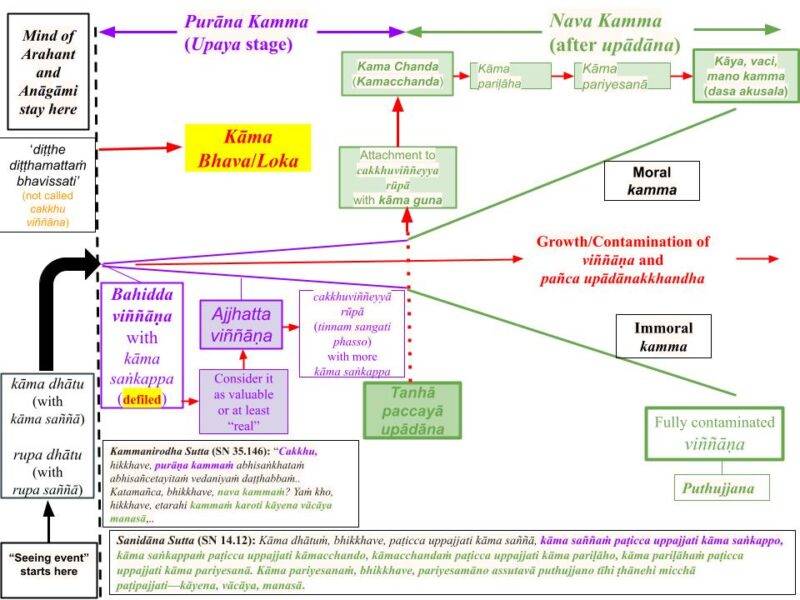
- That is because to ‘clearly see with wisdom’ the ‘anatta nature’, one must also understand the origin of color perception. To see that, one must fully understand the complete ‘kamma generation process’ (including the ‘purana kamma‘ stage) in Idappacayata Paticca Samuppada.
- That is why scientists and philosophers will never understand the ‘anatta nature’. They are trying to figure out how perception and consciousness evolved from inter matter. They have not been able to get there, and they never will. I will discuss that further in the next post.
2. Yes, the explanation of “attato” in the post “‘Attato Samanupassati’ and Sotapanna Stage” covers that neutral vedana.
- This is why an ‘almost pure mind’ at the very beginning, the ‘dhatu stage,’ is automatically defiled with all three types of vedana: sukha, dukkha, and neutral (adukkhamasukha). The following is from another relevant post, “A Mind ‘Starts’ at an Almost Pure (Pabhassara) State.”
“15. A mind ‘starts’ at a ‘pure (pabhassara)’ state called ‘citta.’ However, it arises with a ‘built-in distorted saññā‘ to automatically trigger avijjā in all realms. The ‘citta‘ state quickly degrades to the mano first and then to the viññāṇa state for a puthujjana.

- One must understand that process to see the ‘anatta nature’.
1 user thanked author for this post.
-
September 22, 2026 at 3:34 pm #58767ChristianParticipant
Maybe we are actually entering the Kiṁsukopama Sutta (SN 35. 245) grounds, but I think the first post is kinda right. Whatever it is, real or not, in terms of perception is more like a novelty rather than something to enter realization. You can base that on simple logic, whatever real or not = it has no value, so it’s ultimate because, no matter what, the outcome is the same. If something is real or not, people still can value it and enjoy it (dreams, for example). Even if they know it’s not real, they may even look forward to non-real things (people who practice lucid dreaming). I didn’t see a compelling argument for it either as an object of meditation or wisdom, as people can not penetrate through the unreality of the world in that sense in a non-jhanic mind, even as true.
From personal experience in jhana (arupa), it is as you say about (un)reality of the world, but that knowledge didn’t get me Nibbana even seeing it directly, but learning about the true nature of the world and ultimate factors (irrespective of the reality of something or not) did work as expected in developing Nibbana factors, so I do not understand or find any argument of this being relevant to the Path or Dhamma besides just basic information
-
September 23, 2026 at 12:24 am #58770cubibobiParticipant
Christian: “I didn’t see a compelling argument for it either as an object of meditation or wisdom, as people can not penetrate through the unreality of the world in that sense in a non-jhanic mind, even as true.”<br />
——-I think I relate to your point, but since I’ve never experienced jhana, I’d like to probe a little, if I may.
I gather that you’re saying: it’s not possible to penetrate through the unreality of the world while being in that world. But if that world is transcended then one sees the unreality of it.
Take just the kama loka as an example. While in the kama loka it’s not possible to penetrate the unreality of it. But in jhana samapatti, one transcends the kama loka, and thus knows the unreality of it.
It is like “waking up” from the kama loka and realizing that it was like a “dream”, and this is where I see a connection to your dream analogy. In a dream, even a lucid dream as you pointed out, one perceives it as real and cannot penetrate the unreality of it while in the dream. Once one wakes up, then he knows it was a dream and unreal.
Thank you!
-
September 23, 2026 at 12:39 am #58771ChristianParticipant
“I gather that you’re saying: it’s not possible to penetrate through the unreality of the world while being in that world. But if that world is transcended, then one sees the unreality of it.” – yes
“It is like “waking up” from the kama loka and realizing that it was like a “dream”, and this is where I see a connection to your dream analogy. In a dream, even a lucid dream, as you pointed out, one perceives it as real and cannot penetrate the unreality of it while in the dream. Once one wakes up, then he knows it was a dream and unreal.” – yes
My point is that thinking that something is real = thinking that something is unreal; while, with factors to attain Nibbana, you can see those things in the objects, you can not really see the unreality of it. Even if you somehow can “see unreality,” you still need to fulfill the factors first; otherwise, you will end up like advaita crazies (ie. nothing is real, so I do whatever I want)
1 user thanked author for this post.
-
September 23, 2026 at 1:10 am #58773LalKeymaster
1. This is why I asked Jaro the following question:
Before I address your above comment, I would like to ask you a question. Which category do you fall into in the following categories regarding the rebirth process?
- My belief in the Buddha’s teachings does not depend on that question.
- I don’t believe in the rebirth process; I believe in the evolution of species, as most scientists/philosiphers do. However, I do see value in Buddha’s teachings in certain aspects.
- I do believe in the rebirth process, and I can see it must be true for Buddha’s teachings to be correct.
How would Christian and Cubibobi answer that question?
______
2. Christian wrote: “My point is that thinking that something is real = thinking that something is unreal;”
- That is the strangest statement I ever heard.
- The Noble Truths are about the ‘unreality of the foundation on which the world operates’. An untruth can never be equated to the truth.
- Actions (sankhara) based on an untruth can never avoid suffering; they inevitably lead to suffering. This is what is meant by ‘avijja paccaya sankhara’ in Paticca Samuppada.
-
September 23, 2026 at 2:15 am #58775ChristianParticipant
I don’t think “belief” is the right word in the sense of Buddha’s teaching MN 95 distinguishes “preserving truth” (saying “this is my belief” without asserting that everything else is false) from “discovering truth.”
What I experienced through my spiritual journey is what Buddha taught is true (without any belief)
2. Christian wrote: “My point is that thinking that something is real = thinking that something is unreal;”
- That is the strangest statement I ever heard.
I will explain a bit more here; what I mean here is that something being unreal is not ultimate reality/argument in the context of Sansara because things unreal can still be enjoyed, while the world not being able to fulfill a person’s desires (you can add because of the unreal nature of the world) takes precedence over the unreality that why I put “thinking something is real = thinking something is unreal” because it does not take one into seeing ultimate reality/truth about the world. You can not skip over “fulfillment”; you can skip over “unreality” (as explained above) – that’s why I see those things as the same, as they are in the same “bucket,” while ultimate truths (ie. Anicca, Dukkha and Anatta) are something that you can not really “counter” with anything.
-
September 23, 2026 at 4:27 am #58779ChristianParticipant
I can not edit the above post
While I agree that truth is never equal to untruth (truth here is the ultimate factor), as you said, unreality is a different concept. For example, I agree we do not see things as they are in terms of Anicca, Dukkha, and Anatta, but this is not about objects themselves; we can see and understand false perception of the object or the “unreal” way we see things, but the nature of the object itself (real or not) is irrelevant. For example, in Satipatthana Bhumi, your mind is pristine, and the false perception of objects disappears, so for them to be real or not (as they stopped being attractive) is not something of importance for the mind itself. Maybe if someone could truly see that objects are “unreal,” the way you explain it will go backwards, and a person would lose attraction towards those things, realizing Nibbana – but in my case that wasn’t really true (simply because jhana was more attractive, or the object of attractiveness shifted towards jhana). Let’s assume understanding that “things are not real” grants entry to Nibbana, but for most people it would be a much “harder” entry point to understand, as they have nothing to relate to in the process; they are missing steps of realization, and they just “assume things” based on their personal bias-authority. (ie. I respect Dhamma, so I just think what they’re thinking) which, in the end, turns out to be “Things are real = things are not real”. On top of that, other “philosophies” speak about the illusion of this world (ie. maya), which can be easily confused, but Buddha Dhamma is unique logic and arguments that “hit the right spot” towards realization.
I would not put the explanations about rupa not being real (even if that’s true) above what someone could relate to; if they can have a lower-level entry, the higher ones become irrelevant, as a person seems to know the truth of this world anyway, unless in specific gathi – person needs to have this high-end argument to understand Dhamma, then maybe.
-
September 24, 2026 at 3:25 am #58791Saurabh@2110Participant
Let’s assume understanding that “things are not real” grants entry to Nibbana, but for most people it would be a much “harder” entry point to understand,
I guess you are saying here that ‘anatta’ is hard for most people to understand, hence it is harder entry point to understand. Agreed, that’s why, not realizing anatta, we have dukkha.
as they have nothing to relate to in the process; they are missing steps of realization, and they just “assume things” based on their personal bias-authority.
Basically, by “they have nothing to relate to in the process; they are missing steps of realization”, I think you are saying that they have ‘avijja’ which is ignorance of ‘anicca and dukkha’. By “and they just ‘assume things’ based on their personal bias-authority’, you mean that they don’t understand ‘anatta’. Am I interpreting you correctly?
(ie. I respect Dhamma, so I just think what they’re thinking) which, in the end, turns out to be “Things are real = things are not real”.
By above, Do you mean these 2 types of people: 1. those who think unreal things are real and 2. those who just believe that unreal things are not real in reality, so the reality we see must be unreal, but out of faith only; Do you mean that these 2 people are same? if you mean that, I can’t seem to agree on it.
On top of that, other “philosophies” speak about the illusion of this world (ie. maya), which can be easily confused, but Buddha Dhamma is unique logic and arguments that “hit the right spot” towards realization.
Yes, other philosophies just have ‘avijja’, they can’t understand ‘anicca, dukkha, anatta’. Even if they believe that world is unreal or maya, they are still describing how a blind person would imagine something he has never seen and doesn’t even have any single parameter, and actually having all the wrong parameters to imagine it.
I would not put the explanations about rupa not being real (even if that’s true) above what someone could relate to; if they can have a lower-level entry, the higher ones become irrelevant
I would say here that, higher reasonings are not irrelevant. If one understands lower reasonings or have lower entry, at that point he does not mis-understand higher ones even though he may not understand higher ones.
I hope I didn’t misinterpret you anywhere.
-
September 24, 2026 at 3:42 am #58793Saurabh@2110Participant
I would like to comment on your earlier post as well.
what I mean here is that something being unreal is not ultimate reality/argument in the context of Sansara because things unreal can still be enjoyed,
yes, I agree with above. But this is the case only when the anatta is not fully understood, although partial anicca and dukkha may have understood.
You can not skip over “fulfillment”; you can skip over “unreality” (as explained above) – that’s why I see those things as the same, as they are in the same “bucket,” while ultimate truths (ie. Anicca, Dukkha and Anatta) are something that you can not really “counter” with anything.
Because one does not understand anatta, one cannot skip over “fulfillment”, that’s how I see it. That “fulfillment” provides the remaining conditions to understand anatta, which are ‘anicca’ and ‘dukkha’. With this understanding, I actually agree with you here about – “one (puthujjana) cannot skip over ‘fulfillment'”.
-
September 24, 2026 at 6:52 am #58795LalKeymaster
Excellent observations!
I think the following statement by Christian captures the critical issue that most people are unable to overcome: “what I mean here is that something being unreal is not ultimate reality/argument in the context of Sansara because things unreal can still be enjoyed,”
- This is why smokers cannot give up smoking, alcoholics cannot give up alcohol, or drug addicts cannot give up drugs.
- Most of them know that those habits are bad for their health, and they may even die if they keep up with those habits. But the ‘temporary enjoyment’ overcomes their reasoning.
- Upon attaining Buddhahood, the Buddha realized that it would not be easy to teach his newfound truth about the ‘sensory pleasures’ to people who are blinded by ‘sensory pleasures’. See “Brahmāyācana Sutta (SN 6.1)“.
- Anyway, I have realized it is a waste of time to keep arguing about certain aspects. This is also why I decided to stay away from other discussion forums like Dhamma Wheel.
P.S. The sad thing is that those ‘sensual pleasures’ are mind-made in two ways, which feed on each other: (i) Paticca Samuppada cannot generate matter with inherently colorful, tasteful, etc., qualities. So it ‘creates’ a world that seems attractive by inducing ‘distorted sanna‘ in all living beings via the ‘bhavanga state’ associated with each existence. (ii) That ‘mild sensation of liking’ generated via the ‘distorted sanna‘ is again amplified automatically in the ‘purana kamma‘ stage. Together, these two make the world seem ‘full of sensory attractions’. These are subtle but critical issues. I discussed the first in “Critical Role of Saññā in Mind Contamination” and the second in “Assāda (Sense Pleasure) Experienced Is Mostly Mind-Made.”
- This is why it is not that easy to comprehend the First Noble Truth, the ‘truth about suffering’.
- Furthermore, if one does not believe in rebirth, it is harder to see the logical steps. Most scientists and philosophers start with the assumption that life is limited to the current life and death is the ultimate end; so they can never ‘see the truth’ until they overcome their wrong view.
1 user thanked author for this post.
-
-
AuthorPosts




- You must be logged in to reply to this topic.