- This topic has 19 replies, 3 voices, and was last updated 1 month ago by
 Lal.
Lal.

-
AuthorPosts
-
-
August 11, 2026 at 3:47 pm #58274
 LalKeymaster
1. I believe that the Paṭicca Samuppāda Vibhaṅga in the Tipiṭaka Commentary “Vibhaṅga Pakarana” contains material that is inconsistent with the Sutta Piṭaka.
- Since we know that those commentaries were added after the Parinibbana of the Buddha, they do not contain the Buddha’s words.
- However, we know that almost all the suttas in the Sutta Piṭaka were delivered by the Buddha or were approved by the Buddha.
- Therefore, we must ALWAYS give preference to the Sutta Piṭaka.
2. The following is a draft of a post discussing “Kusalamūla Paṭicca Samuppāda,” a Paṭicca Samuppāda process not even mentioned in the Sutta Piṭaka, which discusses ONLY ONE version of Paṭicca Samuppāda, i.e., Idappaccayātā Paṭicca Samuppāda.
___________
Kusalamūla Paṭicca Samuppāda – Evidence Against It
Kusala and Akusala
1. The “Kusala Sutta (AN 10.180)” defines kusala and akusala.
- First, akusala are the ten types of akusala kamma: Pānātipātā (killing), Adinnādānā (taking what is not given), kāmēsu micchācārā (sexual misconduct), Musāvāda (Lying), Pisunāvācā (slandering), Parusāvācā (harsh speech), Sampappalāpā (frivolous talk), Abhijjā (covetousness; greed for others’ belongings), Vyāpāda (ill-will, hatred), Micchā Diṭṭhi (wrong views).
- Then the sutta says kusala means to abstain (not engage in) any of those ten. The Pali word ‘veramaṇī‘ means to avoid even thinking about, helping others with any of them, etc.
- There are other suttas that discuss the fact that those 10 types can be expanded to forty, and engaging in any of them can lead to rebirth in the apāyās; see “Details of Kamma – Intention, Who Is Affected, Kamma Patha.”
- Note that there is no list of ‘kusala kamma‘ or specific ‘kusala deeds‘ with the body, speech, or the mind.
Kusala Is Not the Same as Puñña Kamma
2. A common mistake is to interpret ‘kusala kamma‘ to be the same as ‘puñña kamma.’
- To understand why they are different, one must first understand ‘puñña kamma‘ and ‘apuñña kamma.’ A puthujjana engages in ‘puñña kamma‘ and ‘apuñña kamma.’
- ‘Puñña kamma‘ or ‘good/meritorious deeds’ accumulate ‘good kammic energies’ that can lead to ‘good results (vipāka)’ and rebirths in the ‘good realms’ at or above the human realm. In contrast, ‘apuñña kamma‘ are ‘bad/immoral deeds’ that accumulate ‘bad kammic energies’ that can lead to ‘bad results (vipāka)’ and rebirths in the ‘bad realms’ or the ‘apāyās.’
Both Puñña and Apuñña Kamma Extend the Rebirth Process
3. The goal of Buddha Dhamma is to overcome rebirths in both good and bad realms. That is because, even though the births in the good realms are relatively free of suffering, the ultimate suffering associated with death is associated with all of them, too.
- Thus, even the ‘good deeds’ or ‘puñña kamma‘ are done with ignorance.
- The Buddha taught that all rebirths among the 31 realms arise due to six root causes: (i) lobha, dosa, moha on the ‘immoral side’ lead to rebirths in the apāyās, and (ii) mundane versions of alobha, adosa, amoha on the ‘moral side’ lead to rebirths in the rest, which are ‘relatively good.’
- Actions, speech, and thoughts based on lobha, dosa, and moha are the worst of akusala kamma or the ten types listed in #1 above. They are also called ‘apuñña kamma‘ and/or ‘pāpa kamma.’
- Actions, speech, and thoughts based on mundane versions of alobha, adosa, and amoha are called ‘puñña kamma.‘ They are not generally called ‘akusala kamma,’ but they are NOT ‘kusala kamma‘ either.
- The mundane versions of alobha and adosa are associated with giving (dana) and cultivating compassion (metta). Moral living without harming others falls under amoha; these people generally do not have the ten types of wrong views either, i.e., they believe in the laws of kamma and the rebirth process.
- The same person (puthujjana) can (and inevitably does, at least in the long run) engage in both ‘puñña kamma‘ and ‘apuñña kamma.‘
Only an Ariya (Noble Person) Can Engage in Kusala
4. As emphasized above, only a Noble Person (at or above the Sotāpanna Anugami) can engage in kusala kamma. Again, this refers to engaging in Vipassanā to eliminate the four types of anusaya or, equivalently, the ten types of sansāric bonds (saṁyojana). Only the elimination of anusaya/saṁyojana can stop kamma accumulation via both puñña and apuñña kamma!
- The “Akusalarāsi Sutta (SN 47.5)” explains how a puthujjana engages in akusala with a mind covered by pañca nīvaraṇa. Here, the arising of pañca nīvaraṇa (same as the arising of avijjā) is triggered by the ‘distorted saññā‘ and thus happens with every sensory input.
- At marker 2.2, the sutta states that one engages in kusala when cultivating Satipaṭṭhāna. As I have pointed out, ‘distorted saññā‘ (and, therefore, pañca nīvaraṇa or avijjā) does not arise while the mind is in the Satipaṭṭhāna Bhūmi. I have also explained that only those at or above the Sotāpanna stage can enter the Satipaṭṭhāna Bhūmi. This step is repeated in the “Kusalarāsi Sutta (SN 47.45).”
- Therefore, only a Noble Person can stop engaging in akusala kamma by cultivating kusala and eliminating anusaya and saṁyojana.
- It should also be clear that even engaging in puñña kamma (without comprehending the Noble Truths) does not lead to Nibbāna. Only the cultivation of Satipaṭṭhāna leads to the breaking of anusaya/saṁyojana, leading to Arahanthood. However, one cannot attain the Sotāpanna stage without being born in a ‘good realm,’ and therefore, one MUST engage in puñña kamma. The Buddha emphasized that fact, too. In case one does not attain the Sotāpanna stage in this life, one must engage in puñña kamma to gain a ‘good rebirth.’
Any Type of Saṅkhāra Cannot Lead to a Magga Phala or Nibbāna
5. I went through the above systematic analysis to clarify the following critical point: A magga phala can be attained only while the mind is free of pañca nīvaraṇa (same as the arising of avijjā), and that happens for the first time when one attains the Sotāpanna stage.
- That first experience of the Satipaṭṭhāna Bhūmi takes place when one is listening to a discourse explaining the Noble Truths/Paṭicca Samuppāda/ Tilakkhana. It can also happen when one is contemplating the Noble Truths/Paṭicca Samuppāda/ Tilakkhana that one has learned.
- I explained that process step-by-step in “Murderer to a Sotāpanna in an Hour – How Is That Possible?“
- Once attaining the Sotāpanna stage, that Sotāpanna must cultivate the four types of Satipaṭṭhāna (kāye kāyānupassanā, vedanasu venanupassana, citte cittanupassana, and dhamme dhammanupassana) to be able to enter the Satipaṭṭhāna Bhūmi at will. Then he/she can cultivate Satta Bojjhaṅga while in the Satipaṭṭhāna Bhūmi to attain higher magga phala.
- That complete process, starting as a puthujjana, is highly condensed as Ānāpānasati in the Ānāpānasati sutta. I discussed that whole process in the “Buddha Dhamma – Systematic” section.
Noble Path Cannot be Cultivated With Saṅkhāra
6. Nowhere in that process is it mentioned that one must cultivate any type of saṅkhāra.
- In the contrary, one must eliminate all types of saṅkhāra to attain mgga phala leading to Nibbāna.
- Many suttas state that all types of saṅkhāra are of ‘anicca nature’; see, for example, “Uppādā Sutta (AN 3.136).” The “Girimānanda Sutta (AN 10.60)” states, ‘sabbasaṅkhāresu aṭṭīyati harāyati jigucchati‘ OR ‘all types of saṅkhāra must be rejected like urine and feces.”
- The Arahantship is reached by eliminating all types of saṅkhāra. It is called ‘saṅkhāra nirodha.’ As we know, all Paṭicca Samuppāda processes start with ‘avijjā paccayā saṅkhārā.’
- Nibbāna is defined as the stopping of the arising of rūpa, vedanā, saññā, saṅkhāra, viññāṇa (these must be understood as the five components of pañcupādānakkhandha: rūpa upādānakkhandha through viññāṇa upādānakkhandha; see “Rupa, Vedanā, Saññā, Saṅkhāra, Viññāṇa – Mostly Misunderstood“).
- Therefore, saṅkhāra (saṅkhāra upādānakkhandha) must be fully eliminated to attain Arahanthood. Also see “Ānanda Sutta (SN 22.21).”
- With that background in mind, let us examine the “Kusalamūla Paṭicca Samuppāda” discussed in the Tipiṭaka Commentary “Vibhaṅga Pakarana.“
Kusalamūla Paṭicca Samuppāda – A Contradiction
7. A Paṭicca Samuppāda process ALWAYS extends the rebirth process. If anyone can find a sutta reference saying there is a Paṭicca Samuppāda process that leads to Nibbāna (or any magga phala), I will remove this post and apologize for my error.
- The “Paṭicca Samuppāda Vibhaṅga” in the Tipiṭaka Commentary “Vibhaṅga Pakarana” has a section “2. Kusalaniddesa” which seems to discuss a “Kusalamūla Paṭicca Samuppāda.” It has several confusing and contradictory sub-sections.
- It defines the process (@249.2) as “kusala mūla paccayā saṅkhāro” and ends with “Evametassa kevalassa dukkhakkhandhassa samudayo hoti.” Thus, it says ‘kusala mūla saṅkhāra‘ also leads to suffering.
- Several subsequent sub-sections have similar statements.
- Then there is 2.10.4. Lokuttara kusala citta section: @marker 279.2, it describes a process via jhana that also has “kusalamūlapaccayā saṅkhāro” but leading to “Evametesaṁ dhammānaṁ samudayo hoti,” apparently referring to magga phala.
- (Then the next section is 2.11. Abyākata niddesa. This is another contradictory section that I discussed in “Avyākata Paṭicca Samuppāda – Evidence Against It.”)
8. The problem is that nowhere in the Sutta Piṭaka is there a “Kusalamūla Paṭicca Samuppāda” or a “Abyākata Paṭicca Samuppāda.” I wrote a preliminary post on the latter as well: “Avyākata Paṭicca Samuppāda – Evidence Against It.”
- Furthermore, the verse, “kusala mūla paccayā saṅkhāro,” never appears in a single sutta!
- There is no such category of saṅkhāra even mentioned in a single sutta.
- As discussed above in #6, ANY TYPE OF saṅkhāra generation ALWAYS leads to kamma accumulation.
- Nibbāna or ‘kamma nirodha‘ is achieved by breaking anusaya or saṁyojana. That happens via engaging in Vipassanā (cultivation of Satta Bojjhaṅga) while the mind is in the Satipaṭṭhāna Bhūmi.
- Any type of saṅkhāra generation would not happen in the Satipaṭṭhāna Bhūmi. While engaging in Vipassanā, the mind engages only in dhamma vitakka/dhamma vicara. Any other types of vitakka/vicara or saṅkhāra WILL NOT arise in the Satipaṭṭhāna Bhūmi because any type of ‘distorted saññā‘ to trigger them will not arise!
References and Final Comments
9. Please feel free to comment or ask questions.
- If there is anything in this post that needs revision, please let me know. I have recently revised the following relevant posts as well. They may have minor errors since I got them done quickly:
Details Of Kamma – Intention, Who Is Affected, Kamma Patha | Pure Dhamma
What Is The Only Akusala Removed By A Sōtapanna? - I plan to post this post as a regular post soon. Your comments will help make it better.
-
August 12, 2026 at 2:00 am #58276Tobias GParticipant
Dear honorable Lal, thank you for this draft and addressing my question! It gives a good overview and much clarity.
Nevertheless, I would like to ask:
So are you saying that Vb 6 in the Abhidhamma Pitaka is incorrect and/or was added later?
Does that mean the Arahants were mistaken?
It is said that the 50 cetasikas, except for sanna and vedana, are “sankhara”. Some of these are universal and occasional cetasikas, such as jivitindriya, manasikāra, or viriya. How, then, could these lead to new kamma?
Furthermore, this text about cetasika says:
“Viriya (effort) can become Sammā Vāyāma.“
“Viriya and chanda are two factors in the four bases of mental power…”
“Saddhā (faith); sati (moral mindfulness) can become Sammā Sati”
How do you view the cetasikas of karunā and muditā?
I’m still grappling with the question of how one actually thinks without external sensory input and without distorted sanna, or rather, how one arrives at genuine kusala citta? If the mind has no external sensory input (no panca-dvara citta vithi), one can only think about dhammas. In this way, one can have contact with sadhamma and, with appropriate “paccaya,” generate kusala citta and ultimately realize magga phala (e.g., during meditation). Is that correct? But this also requires cetasika; yet it isn’t paṭicca samuppāda?
-
August 12, 2026 at 6:56 am #58278LalKeymaster
Tobias asked: “So are you saying that Vb 6 in the Abhidhamma Pitaka is incorrect and/or was added later?”
- Yes. The Commentaries were probably added later.
- Yes. I am saying certain sections of Vb 6 in the Abhidhamma Pitaka are incorrect.
Tobias asked: “Does that mean the Arahants were mistaken?”
- Those sections, or the Vb 6 in its entirety, may have been added later.
Regarding the questions on cetasika: Bypassing the ‘distorted saññā‘ only blocks avijjā from arising and triggering the initiation of a Paṭicca Samuppāda (or a pañcupādānakkhandha process).
- Thus, only the asobhana cetasika (including lobha, dosa, moha) are blocked from arising.
- The sobhana cetasika are not blocked. In fact, this is when the paññā cetasika can be optimal.
Tobias asked: “I’m still grappling with the question of how one actually thinks without external sensory input and without distorted sanna, or rather, how one arrives at genuine kusala citta? If the mind has no external sensory input (no panca-dvara citta vithi), one can only think about dhammas. In this way, one can have contact with sadhamma and, with appropriate “paccaya,” generate kusala citta and ultimately realize magga phala (e.g., during meditation). Is that correct? But this also requires cetasika; yet it isn’t paṭicca samuppāda?”
- Once the mind is in the Satipaṭṭhāna Bhūmi, one engages in genuine Vipassanā.
- Here, one would not think about specific external sensory inputs. One would only examine the steps in Paṭicca Samuppāda or anicca, dukkha, anatta, or the Four Noble Truths. In other words, how the mind becomes defiled, starting with the ‘distorted saññā‘ (various types of kāma saññā in our kāma loka; a ‘rupa loka Brahma‘ would contemplate the role of types of saññā that arise in the rupa loka).
- As I explained in the draft post, there is no specific list of kusala kamma. Cultivating kusala means to cultivate Satipaṭṭhāna. A kusala citta is any citta that arises in the Satipaṭṭhāna Bhūmi, helping the mind to eliminate anusaya/samyojana.
- Of course, what happens in the Satipaṭṭhāna Bhūmi is not Paṭicca Samuppāda. A Paṭicca Samuppāda process ALWAYS generates new kamma, starting at the ‘purana kamma’ stage. The goal of the practice is to stop Paṭicca Samuppāda (or pañcupādānakkhandha) processes from starting; they do not start in an Arahant, and they do not run for anyone while their mind is in the Satipaṭṭhāna Bhūmi!
- Whoever wrote those sections in Vb6 did not understand how a Paṭicca Samuppāda process is initiated at the ‘purana kamma‘ stage, triggered by the ‘distorted saññā ‘.
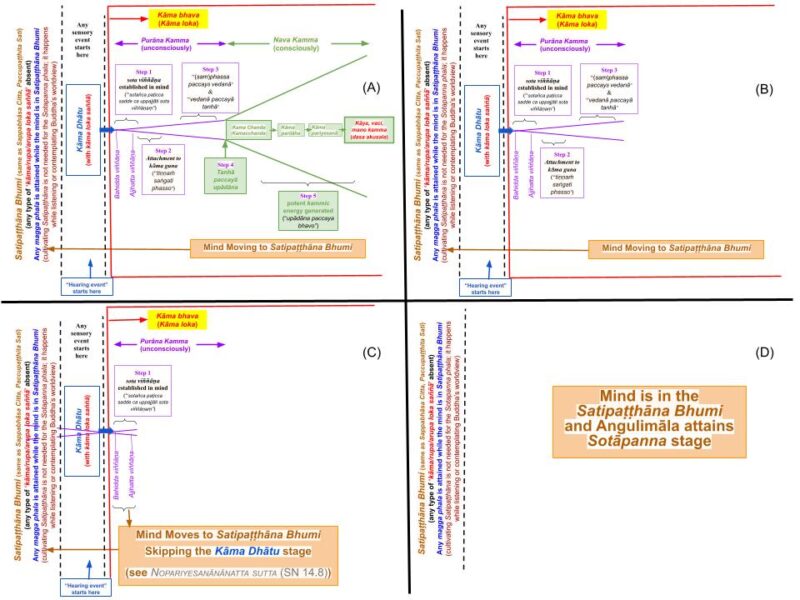
- The following figure from the post “Murderer to a Sotāpanna in an Hour – How Is That Possible?“ could be helpful. No mind contamination in (D):

1 user thanked author for this post.
-
August 12, 2026 at 2:54 pm #58281Tobias GParticipant
Above you say: “…sankhāra generation ALWAYS leads to kamma accumulation.”
Can one conclude from this that sankhara can only be performed with avijja and thus generate kamma (because: avijja paccaya sankhara)? Then the general statement that the 50 cetasika (without sanna and vedana) are sankhara would be false.
It is certainly clear that asobhana cetasika lead to akusala sankhara/kamma, or rather, poor results.
Sobhana cetasika bring good results in the form of punna kamma or magga phala (when paññā cetasika is involved).
Punna kamma is still performed with avijja.
-
August 12, 2026 at 3:59 pm #58287LalKeymaster
You are absolutely correct, Tobias.
- Even ‘puñña kamma‘ (with sobhana cetasika) are done with avijjā.
- I made a mistake there.
- Just below that, I made the correct statement: While in the Satipaṭṭhāna Bhūmi, one would only examine the steps in Paṭicca Samuppāda or anicca, dukkha, anatta, or the Four Noble Truths. In other words, how the mind becomes defiled, starting with the ‘distorted saññā‘ (various types of kāma saññā in our kāma loka; a ‘rupa loka Brahma‘ would contemplate the role of types of saññā that arise in the rupa loka).
- That does not involve any sobhana cetasika either. In fact, here the paññā cetasika ‘graduates to a ñāna‘ for a Sotapanna, which is the first āsvakkhaya ñāna.
- The transition from the highest levels of vijānāti (with paññā) to pajānātī happens at the Sotāpanna Anugami stage; pajānātī is not a superficial understanding but rather with paññā cakkhu (as a Sotāpanna Anugami), which then turns to ‘dhamma cakkhu’ (at an even higher level of abhijānātī) at the Sotāpanna stage. See #8 and #9 in “Mahāvedalla Sutta – Sañjānātī, Vijānāti, Pajānāti.”
- Thank you for pointing that out. This is why comments are useful.
P.S. When one becomes a Sotapanna (and is actively cultivating the Noble Path), all the mental factors on the mundane eightfold path (i.e., sobhana cetasika) are elevated to lokottara versions. For example, paññā is elevated to the ñāna level, and sati (mundane mindfulness) is elevated to Samma Sati. Of course, that would happen ONLY WHEN a Sotapanna‘s mind is in the Satipaṭṭhāna Bhūmi (and he/she is actively cultivating the Noble Path). Two other critical mental factors (cetasika), vitakka and vicara, turn to dhamma vitakka/vicara, i.e., critically examining Dhamma concepts.
1 user thanked author for this post.
-
August 13, 2026 at 2:44 pm #58296Tobias GParticipant
Can you please answer these questions?
Above, you say: “…sankhāra generation ALWAYS leads to kamma accumulation.”
Can one conclude from this that sankhara can only be performed with avijja and thus generate kamma (because: avijja paccaya sankhara)?
That would mean sankhāra are always connected with avijja. Thus, someone thinking while doing vipassana in satipatthana bhumi does not generate sankhāra, right? Therefore, the general equation sankhāra = “50 cetasika” only applies when avijja is involved. Is that right?
1 user thanked author for this post.
-
August 13, 2026 at 3:59 pm #58298LalKeymaster
We can clarify this by understanding what is meant by ‘kamma‘ and ‘cetana‘ in the suttas.
1. In the Buddha Dhamma, ‘kamma‘ means actions, speech, and thoughts that are based on raga, dosa, or moha. Only those can lead to vipaka.
- Thus, they include punna kamma, apunna kamma, and akusala kamma.
- Therefore, walking to the kitchen to get a glass of water is not an act of kamma.
- An Arahant offering part of his meal to a hungry person is also not a kamma, since that action was not based on raga, dosa, or moha (even though it would be a punna kamma for a puthujjana).
2. That is also why ‘cetana‘ in the suttas really means ‘ sancetana‘, or ‘intentions rooted in raga, dosa, or moha.’
- See #2 of “Details of Kamma – Intention, Who Is Affected, Kamma Patha.”
- Sañcetanā are ‘defiled intentions,’ and actions, speech, and thoughts based on them are abhisankhara. Thus, only those actions, speech, and thoughts that belong to punna kamma, apunna kamma, and akusala kamma involve abhisankhara. Also see #1 above.
3. Therefore, it is necessary to keep in mind those two issues discussed above when reading suttas.
______________
4. Therefore, only sankhara (devoid of raga, dosa, or moha) and NOT abhisankhara can arise in an Arahant.
- The same is true for anyone (Sotapanna or above) while their minds are in the Satipaṭṭhāna Bhūmi. No abhisankhara generation there, either.
5. Please ask further questions if anything is unclear.
-
August 14, 2026 at 1:36 am #58301Tobias GParticipant
Dear Lal, you say:
1. In the Buddha Dhamma, ‘kamma‘ means actions, speech, and thoughts that are based on raga, dosa, or moha. Only those can lead to vipaka.
- Thus, they include punna kamma, apunna kamma, and akusala kamma….
——————–
I thought punna kamma are done with alobha, adosa, amoha, and with avijja. Thus we have six roots leading to rebirth. Of course only akusala kamma leads to bad vipaka or downward path.
-
August 14, 2026 at 4:44 am #58304LalKeymaster
Yes. All rebirths among the 31 realms arise due to six root causes: (i) lobha, dosa, moha on the ‘immoral side’ lead to rebirths in the apāyās, and (ii) mundane versions of alobha, adosa, amoha on the ‘moral side’ lead to rebirths in the rest, which are ‘relatively good.’
- Magga phala can be attained only with lokuttara versions of alobha, adosa, amoha, i.e., based on the comprehension of anicca, dukkha, and anatta nature.
-
August 14, 2026 at 5:14 am #58306Tobias GParticipant
So ‘kamma‘ means actions, speech, and thoughts that are based on raga, dosa, moha or alobha, adosa, amoha, and with avijja.
-
August 14, 2026 at 7:19 am #58308LalKeymaster
We can say raga, dosa, moha or the mundane versions of alobha, adosa, amoha arise in a mind based on avijja.
- Avijja is eliminated by comprehending that all ‘sensory pleasures’ are mind-made and, thus, are of anicca nature. That anicca nature also leads to dukkha (suffering), and thus attaching to such ‘mind-made sensory pleasures’ are of anatta nature. That leads to the lokottara version of alobha, adosa, amoha.
- One becomes a Sotapanna by seeing the truth of that.
- But a Sotapanna still attaches to those sensory pleasures with tanha and mana. They have eliminated only ditthi. That is why they must cultivate Satipatthana to eliminate tanha and mana. Both of those are are eliminated at the Arahant stage. An Anagami eliminates only part of tanha involving the kama loka; they still have tanha for (mind-made) jhanic/samapatti ‘pleasures’ in rupa and arupa loka. See “Etaṁ Mama, Esohamasmi, Eso Me Attā’ti – Connection to Taṇhā, Māna, Diṭṭhi.”
- Avijja (and tanha, mana, ditthi) is totally eliminated only at the Arahant stage.
1 user thanked author for this post.
-
August 14, 2026 at 12:06 pm #58311LalKeymaster
I have revised an old post on that subject: “Six Root Causes – Loka Samudaya (Arising of Suffering) and Loka Nirodhaya (Nibbāna).”
- I hope that would help. Feel free to ask questions. These issues must be resolved.
-
August 15, 2026 at 8:10 am #58336LalKeymaster
I just posted the final version of the draft at the beginning of this thread: “Kusalamūla Paṭicca Samuppāda – Evidence Against It“
- Please feel free to comment or ask questions.
-
August 15, 2026 at 7:50 pm #58342cubibobiParticipant
I read post:
Kusalamūla Paṭicca Samuppāda – Evidence Against It
Instead of saying kusalamūla paṭicca samuppāda, if we may call it something like “puñña mula” paṭicca samuppāda then it makes great sense to me:
In akusalamūla paṭicca samuppāda, one link feeds the next with lobha, dosa, moha, and in “puñña mula” paṭicca samuppāda it is (mundane) alobha, adosa, amoha. Each process continues samsara, but one goes in the dugati direction and the other the sugati direction.
I recall a post on “kusalamūla paṭicca samuppāda”, now deleted, from many years ago, that had the following links:
kusalamūla paccayā saṅkhāro
saṅkhāra paccayā viññāṇaṃ
viññāṇa paccayā nāmarupaṃ
nāmarupa paccayā salāyatanaṃ
salāyatana paccayā phasso
phassa paccayā vedanā
vedanā paccayā pasādo
pasāda paccayā adhimokkho
adhimokkha paccayā bhavo
bhava paccayā jāti
jāti paccayā jarā maraṇaṃ
Evametesaṃ dhammānaṃ samudayo hoti.#6 in the post said that we MUST engage in puñña kamma. A few other posts on the site also explain that puñña kamma does not lead to nibbana, but help set the background to attain it.
If we do two things to the above links:
(1) Replace “kusalamūla paccayā saṅkhāro” with “puñña mula paccayā saṅkhāro”
(2) In the last line, take dhammānaṃ to mean not magga phala but dhammā that help set the background to attain it… then these steps make perfect sense to me, and in my opinion do not contradict other aspects of Dhamma, even if they do not appear in the suttā.
Best,
Lang -
August 15, 2026 at 8:16 pm #58343LalKeymaster
The critical problem with your suggestion is the following:
You wrote: (1) Replace “kusalamūla paccayā saṅkhāro” with “puñña mula paccayā saṅkhāro”
- You missed the main point in today’s post, “Kusalamūla Paṭicca Samuppāda – Evidence Against It.”
- The point is that one cannot attain Nibbana by engaging in puñña kamma. Please specifically read #3 there.
- Also, read the following post, which was a recommended link there: “Six Root Causes – Loka Samudaya (Arising of Suffering) and Loka Nirodhaya (Nibbāna).” As explained in detail there, any puñña kamma also extends the cycle of rebirth. They can lead to rebirth in the ‘good realms’ at or above the human realm, but NOT to Nibbāna.
- Furthermore, there is not a single sutta with a verse including “kusalamūla paccayā saṅkhāro.” Of course, “puñña mula paccayā saṅkhāro” is valid. But they lead to more rebirths, not to Nibbāna.
P.S. The following sutta explains how various types of puñña kamma lead to rebirth in corresponding ‘good realms’: “Puññakiriyavatthu Sutta (AN 8.36).”
-
August 15, 2026 at 9:46 pm #58345cubibobiParticipant
“The point is that one cannot attain Nibbana by engaging in puñña kamma. Please specifically read #3 there.”
Correct, and I happen to not miss this point; you explained it quite well. And I also understand that both akusala/apuñña kamma and puñña kamma extend the rebirth process.
“Furthermore, there is not a single sutta with a verse including “puñña mula paccayā saṅkhāro” OR “kusalamūla paccayā saṅkhāro.” “
“puñña mula” is something I made up. What I meant to say is this: I can conceive of a “paṭicca samuppāda”-like process that goes in the “good” (sugati) direction, where each link from sankhara on is based on mundane alobha, adosa, amoha. Such a process, to me, explains a sugati birth, and maybe in one such a birth, with enough merit, one may meet conditions for sotapanna magga phala: sappurisa samsevo, sadhamma savanam, etc.
This is from the standpoint of a puthujjana, since kusala kamma does not happen until the sotapanna anugami stage.“kusala” + “paṭicca samuppāda” is self contradicting, but if we “plug in” “puñña” then it’s not.
After “plugging in” my made-up phrase “puñña mula”, I remember the other 12-link (non canonical) formula that includes “pasādo” and “adhimokkho”, instead of tanha and upadana, which to me explains very well the mundane, “good” direction of the rebirth process. It also helps me understand what you wrote in #6: “…One must engage in puñña kamma to gain a ‘good rebirth’ in case one does not attain the Sotāpanna stage in this life.”
Finally, this is just a sharing of my learning experience, since I happen to absorb an idea well in some type of formulaic expression like this, and at times I “make up” Pali expressions in the learning process.
Best,
-
August 16, 2026 at 3:18 am #58348LalKeymaster
I simply do not understand the point you are trying to make.
- Of course, “puñña mula paccayā saṅkhāro” is valid; see my comment above. That is the standard Paticca Samuppada process, even though it is not usually written like that. It leads to rebirths in the ‘good realms.’
- In other words, “puñña mula” is also “avijjā.” Since puñña kamma also fuels the rebirth cycle, “puñña mula paccayā saṅkhāro” is the same as “avijjā paccayā saṅkhāro”
__________________
The point of the new post, “Kusalamūla Paṭicca Samuppāda – Evidence Against It”, is to say there cannot be a Paticca Samuppada process with “kusalamūla paccayā saṅkhāra.” Do you have any evidence against that?
__________________
Note: Even though I initially wrote, “Furthermore, there is not a single sutta with a verse including “puñña mula paccayā saṅkhāro” OR “kusalamūla paccayā saṅkhāro”
- I revised it to the following immediately at that time: Furthermore, there is not a single sutta with a verse including “kusalamūla paccayā saṅkhāro.” Of course, “puñña mula paccayā saṅkhāro” is valid. But they lead to more rebirths, not to Nibbāna.”
-
August 27, 2026 at 1:01 pm #58453Tobias GParticipant
Hello Lal,
Can you please tell me in which section the post “Kusalamūla Paṭicca Samuppāda – Evidence Against It” is in?
I think it is still linked to the main page. -
August 27, 2026 at 1:53 pm #58455LalKeymaster
-
August 29, 2026 at 3:59 pm #58479LalKeymaster
Several hours ago, I posted “Idappaccayatā Paṭicca Samuppāda – Bhava and Jāti Within a Lifetime.”
- Just before posting this comment, I made a few minor revisions. So, those who already went through the post may want to re-read it, especially if there were unresolved issues.
- Hopefully, this rewritten post will help clarify the basic/fundamental concepts.
- Note that Idappaccayatā Paṭicca Samuppāda intrinsically explains the ‘purāna kamma‘ and ‘nava kamma‘ stages of mind contamination, and how that ‘purāna kamma‘ stage gets started with ‘viparita (distorted) saññā.’
- Feel free to ask questions. That is the only way to resolve any issues that I may have overlooked.
-
-
AuthorPosts




- You must be logged in to reply to this topic.