
July 14, 2026
1. The original post had the title “Avyākata Paṭicca Samuppāda for Vipāka Viññāṇa,” originally written on October 17, 2017.
- However, I recently realized that such a Paṭicca Samuppāda process is incompatible with the Buddha’s teachings.
- Furthermore, sensory inputs do not come to us only via kamma vipāka, which are responsible for only a minute fraction of our sensory experiences.
- I will discuss both those issues below. Since I don’t have time to write the full post, I will outline the main points below.
2. Avyākata Paṭicca Samuppāda is in the Tipiṭaka, and only the Pāli version is available at: “Paṭicca Samuppāda Vibhaṅga” (Section 2.11 on Abyākata Niddesa).
- However, there is no mention of it in the Sutta Piṭaka, which describes only one version, the Idappaccayātā Paṭicca Samuppāda; see “Idappaccayātā Paṭicca Samuppāda – Bhava and Jāti Within a Lifetime.”
- Furthermore, ‘avyākata‘ or ‘abyākata‘ means ‘undeclared.’ See “Abyākata Sutta (AN 7.54).” As explained in that sutta, the Buddha refused to answer ten questions that ‘did not make sense’ or ‘questions that cannot be answered.’
3. Regarding ‘kamma vipāka as the cause for sensory experience’:
- The human body can encounter sensory input from its environment. For example, if an earthquake occurs where one lives, one will face the same inconveniences as anyone else living there. It is not that each sensory event in triggered by a specific kamma (unless it is an ānantarika kamma). See “Girimānanda Sutta (AN 10.60).” As stated there, “kammavipākajā ābādhā” is only one of many possible causes.
4. An incorrect version of the following chart was in the original post, “Avyākata Paṭicca Samuppāda for Vipāka Viññāṇa.”
- I have revised that chart as follows.
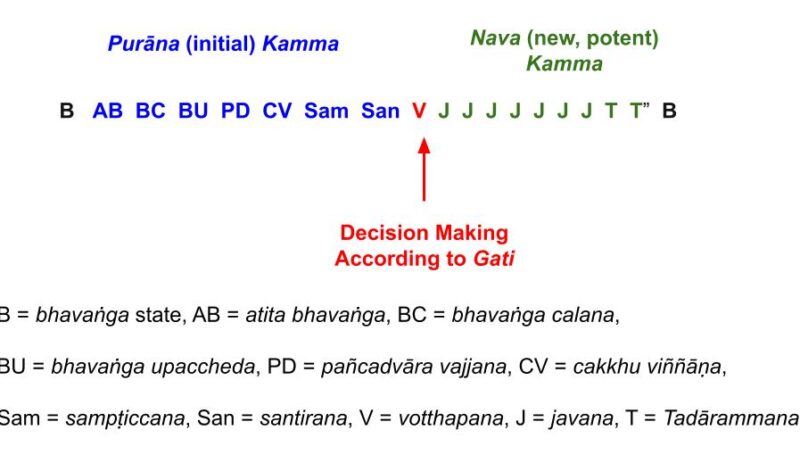
Click the following link to download: “Purāna Kamma and Citta Vithi.”
Further explanation:
| Citta Vithi | Purāna/Nava Kamma |
| Pañcadvāravajjana | Kāma dhātu |
| Cakkhu viññāna | bahiddha followed by ajjhatta viññāna (with kāma saṅkappa) |
| Saṁpaṭiccana | ‘cakkhu viññeyya rupa’ to ‘kāma guṇa‘ to ‘samphassa-jā-vedanā‘ |
| Santirana | ‘samphassa-jā-vedanā paccaya taṇhā‘ |
| Vottapana | ‘taṇhā paccayā upādāna’ |
| Javana citta (7) | ‘upādāna paccayā bhavō’: Nava kamma |
| (One is ‘born’ in a ‘temporary jāti‘ and accumulates kammic energy) | |
| Tadārammana (2) | That ‘temporary jāti‘ generates a ‘temporary bhavaṅga‘ (BT) and fuels the next citta vithi |
| A new citta vithi starts with BT as the ‘bhavaṅga.‘ Thus, the javana cittās in the new citta vithi will be stronger. That process with billions of citta vithi can proceed if the ārammana is strong enough. It will eventually die out when BT becomes weak and merges into the ‘natural bhavaṅga.’ That ‘temporary jāti‘ will come to an end. But the accumulated kammic energy can bring future vipāka. | |
5. I will complete this post in the future. I just wanted to explain why the original post is being removed from the website.
