 Lal
LalTobias asked: “So are you saying that Vb 6 in the Abhidhamma Pitaka is incorrect and/or was added later?”
- Yes. The Commentaries were probably added later.
- Yes. I am saying certain sections of Vb 6 in the Abhidhamma Pitaka are incorrect.
Tobias asked: “Does that mean the Arahants were mistaken?”
- Those sections, or the Vb 6 in its entirety, may have been added later.
Regarding the questions on cetasika: Bypassing the ‘distorted saññā‘ only blocks avijjā from arising and triggering the initiation of a Paṭicca Samuppāda (or a pañcupādānakkhandha process).
- Thus, only the asobhana cetasika (including lobha, dosa, moha) are blocked from arising.
- The sobhana cetasika are not blocked. In fact, this is when the paññā cetasika can be optimal.
Tobias asked: “I’m still grappling with the question of how one actually thinks without external sensory input and without distorted sanna, or rather, how one arrives at genuine kusala citta? If the mind has no external sensory input (no panca-dvara citta vithi), one can only think about dhammas. In this way, one can have contact with sadhamma and, with appropriate “paccaya,” generate kusala citta and ultimately realize magga phala (e.g., during meditation). Is that correct? But this also requires cetasika; yet it isn’t paṭicca samuppāda?”
- Once the mind is in the Satipaṭṭhāna Bhūmi, one engages in genuine Vipassanā.
- Here, one would not think about specific external sensory inputs. One would only examine the steps in Paṭicca Samuppāda or anicca, dukkha, anatta, or the Four Noble Truths. In other words, how the mind becomes defiled, starting with the ‘distorted saññā‘ (various types of kāma saññā in our kāma loka; a ‘rupa loka Brahma‘ would contemplate the role of types of saññā that arise in the rupa loka).
- As I explained in the draft post, there is no specific list of kusala kamma. Cultivating kusala means to cultivate Satipaṭṭhāna. A kusala citta is any citta that arises in the Satipaṭṭhāna Bhūmi, helping the mind to eliminate anusaya/samyojana.
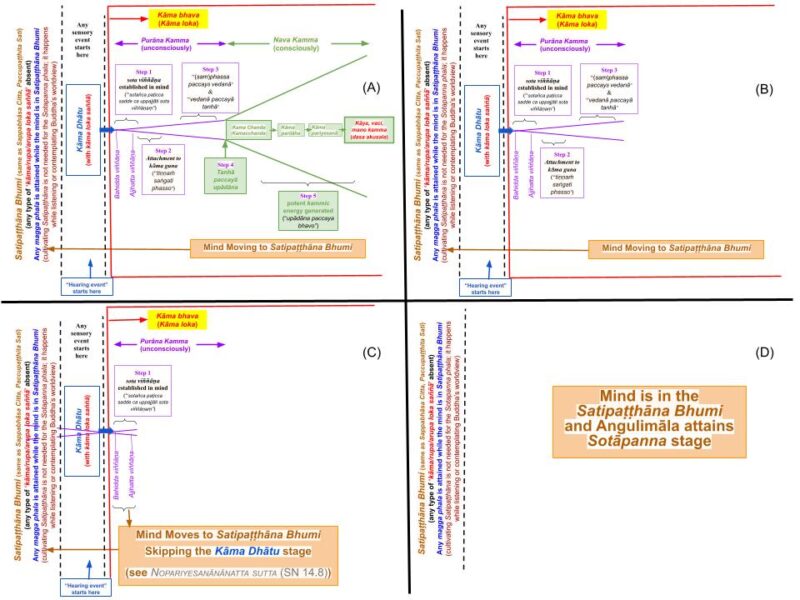
- Of course, what happens in the Satipaṭṭhāna Bhūmi is not Paṭicca Samuppāda. A Paṭicca Samuppāda process ALWAYS generates new kamma, starting at the ‘purana kamma’ stage. The goal of the practice is to stop Paṭicca Samuppāda (or pañcupādānakkhandha) processes from starting; they do not start in an Arahant, and they do not run for anyone while their mind is in the Satipaṭṭhāna Bhūmi!
- Whoever wrote those sections in Vb6 did not understand how a Paṭicca Samuppāda process is initiated at the ‘purana kamma‘ stage, triggered by the ‘distorted saññā ‘.
- The following figure from the post “Murderer to a Sotāpanna in an Hour – How Is That Possible?“ could be helpful. No mind contamination in (D):