March 5, 2025 at 11:03 am
#53778
 Lal
LalKeymaster
No. The Thero does not advise to focus on a light.
- The English translation at the beginning can be misleading: “Be illuminated with the disintegration of desire.”
- The correct translation is: “Be released from the loka (aloka; commonly pronounced as āloka) with the disintegration of desire.”
- As you pointed out, “Aloka would mean transcending the loka, or Nibbana.” That is depicted in the following figure.
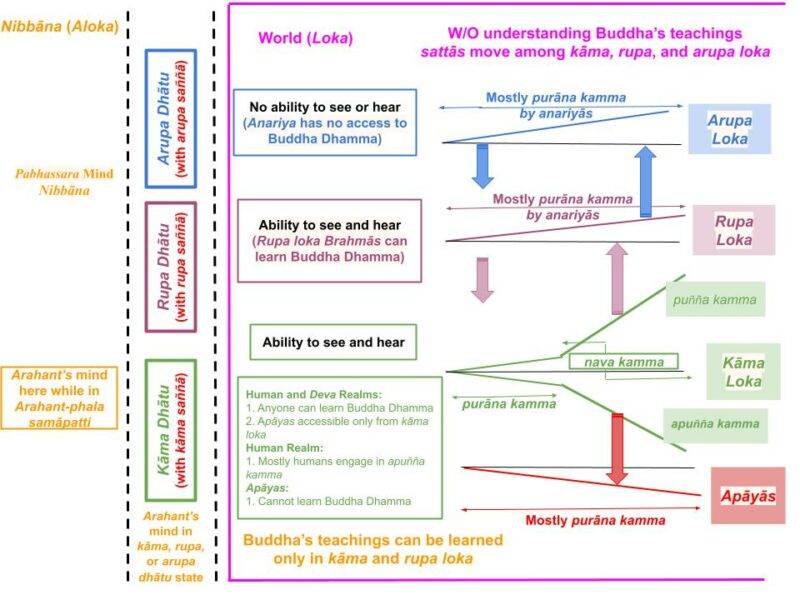
It is from “Pāth to Nibbāna – Learning Dhamma to Become a Sotapanna.”
_____
1. Of course, an anriya jhana can be cultivated by focusing on an object belonging to the world.
- Those are anariya kasina meditations. They focus on light (tejo), a clay ball (pathavi), breath (vayo), or a water bowl (apo).
____
2. There is a subtle connection to light, as pointed out by the Thero @1:20 minutes.
- Our minds are in the dark, covered by avijja, ignorance about the Noble Truths. “Seeing light” means dispelling that darkness of ignorance.
- As Thero pointed out, darkness is completely dispelled at Arahanthood. “The mind becomes illuminated.” That is not about a light.
- Once one becomes a Sotapanna (and comprehends the anicca nature), one can contemplate that “end result of Nibbana of an illuminated mind.”
- Another similar technique is to contemplate with the verse, “etaṃ santaṃ etaṃ paṇītaṃ yadidaṃ sabbasaṅkhārasamatho sabbūpadhipaṭinissaggo taṇhākkhayo virāgo nirodho nibbānan’ti” in the “Samādhi Sutta (AN 10.6)“. It is a good idea to read the whole sutta.
- But those are not about cultivating jhana. It is about progressing on the Path toward higher magga phala.
- @ 3 minutes, the Thero specifically says, “āloka means Nibbana.” That is translated in the video as “The light is one way of discerning Nibbana.” This is why some translations are not very reliable.
___
3. However, while in samadhi, one may feel a “lightness in the body” and even the presence of “white light.”
- Eventually all those go away. Light also belongs to the world (loka.)
